By: Alicia Amuso
In William H. Beard’s Seminole Child with Bittern, 1878, the interaction between artist and subject creates an interesting question about the Indigenous American identity. This painting is unusual in several ways, only visible upon close examination of the piece and its historical context. This includes the feeling the painting inflicts upon the viewer, the stylistic choices the artist made while creating the painting, and the role Indigenous Americans played in American society of the nineteenth century. Therefore, the very method of representing this child’s identity is unique, varying from traditional American representations of Indigenous Americans. Seminole Child with Bittern exists within the context of the American cultural imagination, influenced by colonization, imperialist expansionary policy, preexisting beliefs on Indigenous Americans as well as their interactions with White and non-Indigenous Americans. Beard’s painting also points to the struggles and resilience the Seminole people showed despite colonialism and violent struggles like the Seminole Wars in the nineteenth century. In this study, I will analyze the ambiguity of the details surrounding the piece’s creation and how the relationship between artist and subject works to define the Indigenous American identity, more specifically, the Seminole identity.

Beard, William H. “Seminole Child with Bittern”. 1878. Wellin Museum.
The Art:
The main focus of the painting is a young child, noted in the piece’s title as being of Seminole descent. This child is positioned within the piece to be looking directly at the viewer, straight ahead of them. The child’s eyes are dark but sparkle as if the child were alive before the viewer. Their cheeks are rosy and full of life. The look on the Seminole child’s face is somewhat ambiguous, slightly melancholic. The child’s eyes look slightly fearful, yet they look at the viewer fiercely and directly. The child’s body is turned in a three quarters position, mirroring a classical portrait. A white cloth is wrapped loosely around the child, who is otherwise naked. Held in the cloth is a bird that appears to be in distress, being strangled by the child. This bird is in an unnatural position, held captive by the child. In the background of the painting, there are two other birds. These birds are identified in the painting’s title as bitterns, which typically inhabit marshes or lakes. These bitterns are both placed behind the child, looking into the distance in opposite directions. While these birds are one of the focal points of this painting, they do not make eye contact with the viewer as the child does. These two free bitterns seem anxious in the child’s presence, perhaps fearful of being captured and meeting the same fate as the bittern in the child’s clothes. The fearful sentiment displayed through the birds may be a reflection of the unease in the child’s eyes. The background of this piece is key in unpacking the representation and identity of this child. A heavy background of deep greens and browns frames the child and bitterns. The location where the child was painted appears to be a densely vegetated forest. It is most likely a depiction of Florida, the native homelands of both the Seminole people and bitterns. Leaves of varying sizes fill the space, blending to form a monochromatic background. Larger leaves frame the subjects of the painting, acting almost like a protective layer from the outside world.
Categorizing the Painting:
One of the most complex parts in defining how the interaction between artist and painter shapes the representation within this work is the ambiguity of its classification. While Seminole Child with Bittern is centered around a single person, it is not truly a portrait. Typically, portraits would be commissioned, and the control and agency of their creation would lie mainly within the opinions of the subject. This would be a direct and interactive relationship between the artist and subject to create an intentional representation of the person being painted. In Beard’s work, it is unlikely that the Indigenous child commissioned the painting to be made. Therefore, the relationship between artist and subject was most likely one-sided, with more power given to the painter. Beard most likely saw this Indigenous child and chose to depict them in a portrait style painting, or came up with a generalized image of a Seminole child, creating a somewhat stereotypical representation of Indigenous life. In “The Aesthetics of Postrevolutionary Haiti: Currency, Kingship, and Circum- Atlantic Numismatics,” Esther Chadwick discusses how accuracy in representations of identity can be harmed by generalization. Chadwick analyzes the representation of Black Haitians, such as King Henry Christophe. The king had commissioned his bust to be engraved on the new currency of Haiti. This act of engraving occurred in Europe, where the engraver chose a random Black individual in the street to act as a model. The bust became the representation of the Haitian King, but it enforced European stereotypes of Black bodies being generalizable and interchangeable. In Seminole Child with Bittern, the piece’s title creates generalization. Beard does not give the viewer any information on the specific identity of this child, labeling them solely with their racial identity. In neglecting to use any identifying information specific to this child, the interchangeability of individuals within a race is enforced within the minds of the painting’s viewers.

Wyon Sr, Thomas. ‘One Gourde’ for King Henry Christophe of Haiti . 1820. London: British Museum. Photo:Trustees of the British Museum.
This painting is also not exactly a landscape, as living subjects are dispersed throughout the work. The background of the painting depicts a forest, but it may act as a symbol of the child’s indigenous identity rather than as a landscape. The plants appear to be aquatic leaves, representing marshes or wetlands. This is the natural habitat of bittern birds. Since these bitterns have been painted around the child amongst these aquatic leaves, the viewer can assume that Beard painted them in their natural habitat. The Seminole people originally lived in the wetlands of Florida before being forcibly relocated. In purposefully depicting a Seminole child in their original homeland, Beard returns some level of power to the subject of the painting, showing their resilience against colonialism. This ambiguous depiction may be Beard highlighting the resilience of the Seminole people as a whole through one child meant to represent the entire group. Ambiguity amongst the definitions within Seminole Child with Bittern may hint at Beard showing the complexity of the Seminole identity and how it adapted and was formed due to colonization.
The Artist:

Beard, William H. “The Bulls and Bears in the Market”. 1879. Collection, The New York Historical Society.
For Beard, Seminole Child with Bittern was stylistically unique from his other works, which were typically satirical. After the Civil War in the nineteenth century, the United States underwent rapid urbanization as well as an influx of immigration. This unstable and quickly changing American society created a perfect environment for satirical artists such as Beard to use their art to critique and create parodies of the state of the nation. Beard studied art from his older brother, James Henry Beard, who specialized in painting animals. As a result, Beard’s works typically feature animals who are personified. They are typically represented as being drunk, involved in politics, or participating in financial markets. For example, one of Beard’s most well-known works is Bulls and Bears in the Market, 1879. This work shows bears and bulls at war on Wall Street, creating a scene of utter chaos and confusion. This was meant to be a commentary on the financial markets of America, specifically the investment market. It was a criticism of the cutthroat competition that fueled the American economy, particularly in the late nineteenth century. Beard’s works and artistic style may be grouped with Thomas Nast, an extremely prominent figure in political and satirical cartoons, many appearing in journals such as Harper’s Weekly. While Beard was more focused on naturalism as an artist, both Nast and Beard contributed to creating a precedent for using the natural world for political commentary. As a well-respected artist in nineteenth-century America, Beard held somewhat of a platform for political attention. When he created new illustrations, they would be respected as important within the political realm of America, and his opinions conveyed through these illustrations would be valued. Even though Beard mainly created political cartoons critiquing the new American society, any artwork he created would gain some attention and be respected. By creating Seminole Child with Bittern, Beard must have drawn some attention to the question of where Indigenous Americans fit within American society.
The work is an odd combination of unease, fearfulness, fierceness, and resilience. Beard may have hoped that this work would draw attention to the presence of Indigenous Americans within the United States, reminding society that these are real people who are an important part of the nation. Beard used his status as a White male in American society and an established artist to create this representation of the Seminole people. In “Belisario’s ‘Kingston Cries’ and the Refinement of Jewish Identity in the 1830s”, Kay Dian Kriz studies how Jewish artists, such as Belisario, created depictions of Black Jamaicans and people of color and how it helped establish their identities. Belisario depicted Black Jamaicans in the Cries style of lithography. Black individuals would be portrayed in streets, selling goods or working as chimney sweeps, for example. In portraying them doing tasks that would also be normally done by Jamaicans of other races, Belisario may have helped Black Jamaicans establish an identity separate from roles in forced labor. There is a level of complexity with the relationship between artist and subjects here, as Belisario’s motives for creating these lithographs may have been economical, rather than to shine a positive light on the identity of Black Jamaicans. Beard also gives a voice to Indigenous Americans through his art, inserting representation into an inaccessible field. However, like Belisario, the exact motive for creating this art piece was unclear. It is possible that Beard created Seminole Child with Bittern for financial gain, but also possible that he was making a statement on the treatment of Indigenous people.
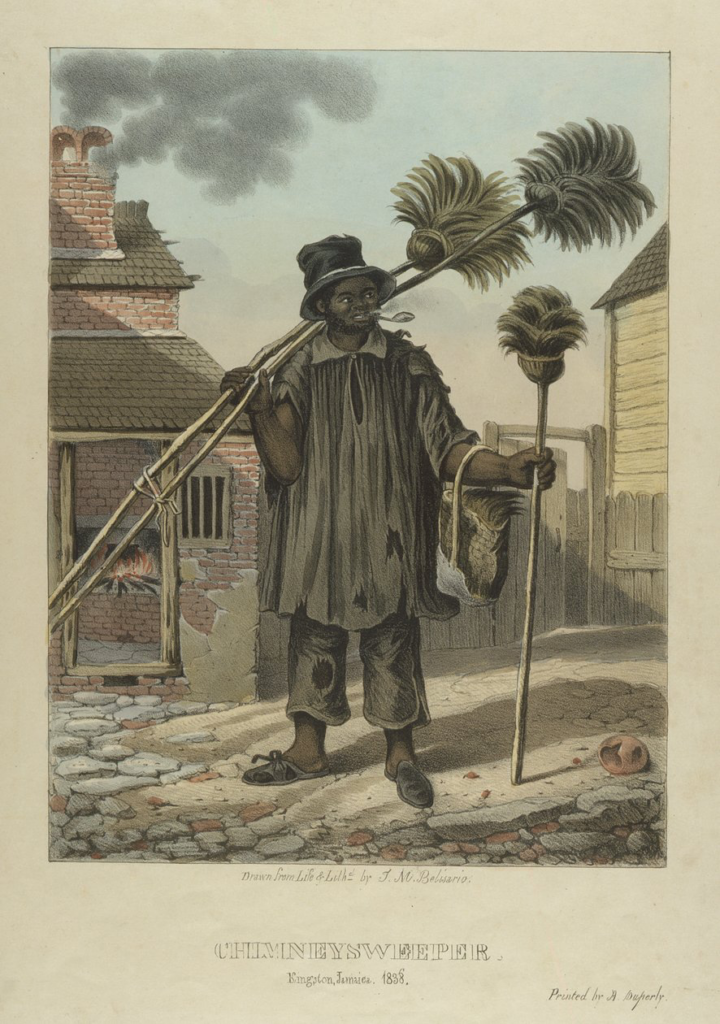
Belisario, Isaac Mendes. “Chimneysweeper”, from Sketches of Character, In Illustration of the Habits, Occupation, and Costume of the Negro Population in the Island of Jamaica. 1838. Yale Center for British Art, Mellon Collection.
Historical Context:
One of the factors that may have inspired Beard to paint a child of Seminole identity was the complicated relationship between White and Indigenous Americans within the nation. A lack of understanding of the Indigenous identity, along with the American government’s harsh expansionary policies, led to hostilities and even wars. It was common for Indigenous Americans to be forcibly removed from their native homelands and relocated elsewhere in the United States. While the American government tried its best to stamp out and push aside indigenous life and identities, Beard highlights the Seminole identity through his painting Seminole Child with Bittern. Even holding space for the indigenous identity is extremely important, as Americans widely supported their removal. In Seminole Hostilities. Message from the President of the United States, Transmitting a Supplemental Report Respecting the Causes of the Seminole Hostilities, and the Measures Taken to Suppress Them, the American government’s ideas surrounding the Seminole people are apparent. In a letter from May 29, 1849, the Secretary of War at the time, George W. Crawford, discusses interactions between the Seminole people and White Americans in Florida. Crawford explains that new legislation has given Florida legal control over the entire territory, which would increase the proximity of White Americans to the Seminole people. He describes the Seminole people as “the wildest and fiercest remnant of a tribe which has been distinguished for their ceaseless opposition to the arts of civilisation.” Crawford also introduces the idea of having a Seminole person who has already migrated West to Oklahoma to encourage those who have not yet migrated to do so. If they agreed to migrate, they were promised many advantages. At the very least, Crawford hopes to create a means of discussion between the Seminole people and the American government. While hostilities had not erupted yet, it was clear that the United States government saw no room for both White settlers and Indigenous people to coexist. This forcible migration is effectively the same as removing their identity from American society. It was expected that Indigenous Americans would pick up their things and move Westward in order to create opportunities for settlers. White Americans could take up more physical and cultural space by making the indigenous identity smaller. In a letter from July 26, 1849, Crawford writes about a White American citizen killed by a small group of Seminole people. It was uncertain whether the Seminole people who committed the act were a part of the dwindling Seminole tribe or indigenous people unaffiliated with the Seminole people. These sentiments reflect the growing tension and hostility between Florida’s inhabitants, later becoming a violent outbreak commonly referenced to as the Seminole Wars. The Seminole Wars became an important aspect of historical context and cultural relevance for Americans.
The role that Indigenous Americans played in the cultural imagination of Americans is key in understanding the significance of Seminole Child with Bittern. Philip J. Deloria studies the complicated relationship between White and Native Americans in his book Playing Indian. In his first chapter, Deloria looks at how the concept of duality has been applied to Indigenous Americans since the birth of the nation. They represented “savage freedom,” the American ideal of liberation that inspired their break from Britain. However, the term “savage” is also applied commonly to Indigenous Americans in a negative lens, as they were seen as counterintuitive to the American ideal of “wanting to savor…civilized order”. This duality of the native identity was placed upon them by White Americans, defining them in a way that serves the promotion of their hierarchical power in society. Seminole Child with Bittern portrays this dual identity for the child depicted. On one hand, the child is entirely free, meant to be painted in their native land. They do not wear European clothing, have a Europeanized hairstyle or cut, and there are no foreign objects that disrupt the natural environment. Both the bitterns and the aquatic leaves would be present in the native homeland of the Seminole child. This may be Beard trying to represent the sense of freedom associated with Indigenous Americans. At the same time, Beard captured the child in a way that was within Western standards for portraiture. The child’s three fourths positioning is that of a traditional portrait, and they look somewhat frightened as if they were caught mid-activity. This could be a visual representation of Indigenous Americans being forced to fit the standards of White Americans or be removed. Viewers’ interpretations also rely heavily on these base-level prejudices or opinions they gain from societal standards. While Beard does grant some power to the native child depicted, they are also now subject to the viewer’s opinions, which have the ultimate impact.
Imperialism and Empire:

De Scott Evans. Homage to a Parrot, ca. 1890. Private collection (artwork in the public domain; photograph courtesy of Sotheby’s, Inc. © 2020)
The relationship between subject and artist also contributes to the political significance of the Seminole child. In Maggie Cao’s Playing Parrot: American Trompe L’oeil and Empire, she studies how the themes of empire and imperialism become apparent through the trompe l’oeil style of art. This term means to “fool the eye”, and it consists of art that tricks the viewer’s eye into believing a two-dimensional object is almost three-dimensional. It was considered unimpressive and frowned upon in the American art industry. Cao specifically studies Homage to a Parrot by De Scott Evans, which was made in 1890. This piece features a taxidermied parrot in a glass case with a wooden background. The protective glass has been broken in front of the parrot, and its head appears to poke through to face the viewer head-on. In the nineteenth century, parrots were a common commodity or status symbol to attain in Europe and the United States, an exotic possession that could be brought to the household. Since this parrot was taxidermied, it carries another level of political meaning. This parrot was stuffed and placed behind glass to serve the purpose of its White owner, just as the child in Seminole Child with Bittern is positioned in a three fourths position to fit the Westernized standard of portraiture. The represented identities of both the parrot and the child depend on how their artists perceived them and positioned their bodies. In Homage to a Parrot, geographic dislocation plays a significant role in the identity of the parrot. Since the parrot has been displaced from its original homeland and forcibly moved to France, it has adopted a hybrid identity, a fusion of its native land and France. Since the child is painted within their native land, we do not see this aspect of geographic dislocation.. However, imperialization and empire are present in Seminole Child with Bittern. These themes may take shape through the strangled bird being held by the child. Beard may have used the captured bittern in a way similar to De Scott Evans’ parrot but reversing the roles played by the colonizer. The Seminole child captures the bittern, which might be Beard’s way of representing the agency of the Seminole people within their forced migration.
Within Beard’s work, there is a complex tradeoff between representation and true identity. Artist and subject interact to form this piece, yet the artist’s interpretation of the subject ultimately carries greater weight as to the representation seen by the viewer. While creating this painting, Beard used a style of art different from his typical one to take a stance on the system of American colonization. Ultimately, the Seminole identity will be interpreted within this painting by the viewer, who will form their opinions based on what is visually represented as well as their previously formed opinions on Indigenous Americans. As society changes and greater knowledge is developed and respected regarding Indigenous Americans, paintings such as Beard’s may take on different interpretations than in the nineteenth century, for example. In modern-day art historical discussions, this process of interpreting identity is still present in the existence of empire, imperialism, and colonialism. Any viewer will have preconceived notions surrounding a subject and must try to put them aside to interpret what the author is trying to show about the subject’s identity. The best way to view a subject’s identity and experiences may be through observing how they represent themselves, whether through art, documentation of events, or personal records.
Bibliography:
Burns, Sarah. “Party Animals: Thomas Nast, William Holbrook Beard, and the Bears of Wall Street.” American Art Journal 30, no. 1/2 (1999): 8. https://doi.org/10.2307/1594630.
Cao, Maggie M. “Playing Parrot: American Trompe l’oeil and Empire.” The Art Bulletin 103, no. 3 (July 3, 2021): 97–124. https://doi.org/10.1080/00043079.2021.1882798.
Deloria, Philip J. Playing Indian. Yale University Press, 1999.
Chadwick, Esther. “The Aesthetics of Postrevolutionary Haiti: Currency, Kingship, and Circum- Atlantic Numismatics.” Art History 46, no. 5 (2023): 1014–45.
Kriz, Kay Dian. “Belisario’s ‘Kingston Cries’ and the Refinement of Jewish Identity in the Late 1830s.” Art and Emancipation in Jamaica: Isaac Mendes Belisario and His Worlds, 2007. https://doi.org/10.37862/aaeportal.00018.014.
United States. War Department., and United States. War Department. Seminole Hostilities. Message from the President of the United States, Transmitting a Supplemental Report Respecting the Causes of the Seminole Hostilities, and the Measures Taken to Suppress Them. Washington: Blair & Rives, printers, 1836.