Landscape painting has long served as a tool for presenting political, social, and economic identities. For this reason, it provides a valuable lens through which to examine the evolving dynamics of these arenas at the time of a landscape’s creation. Landscape art in the mid-19th century Caribbean was undergoing transformation, mirroring the sweeping changes in the region. Previously, landscapes often celebrated European colonial dominance over nature and enslaved peoples. However, with emancipation movements liberating the enslaved populations, artists began producing works that could emphasize, challenge, or complicate the legacy of imperialism (Arabindan-Kesson, 2022; Barringer, 2018; Carmichael, 1833; Thompson, 2011).
The watercolor “Kingston, St. Vincent,” painted by John Herbert Caddy in 1845, exemplifies these shifting artistic paradigms. Created by a Canadian-born lieutenant and engineer in the British military (Dictionary of Canadian Biography, n.d.), the painting portrays a tranquil seaside town. Its composition, devoid of human activity yet rich with architectural and natural detail, reflects a serene, picturesque view of the British West Indian colony. The absence of human figures—enslaved or free—underscores a deliberate attempt to decontextualize the island’s fraught history. By analyzing Caddy’s artistic choices in this painting, we can see how his work deviated from earlier 19th-century landscape conventions while simultaneously complicating narratives of the West Indian environment and colonial experience.
The Painting
Caddy’s “Kingston, St. Vincent” (Figure A) employs a layered perspective to guide the viewer’s gaze from the dramatic green hills and cloudy sky in the background, through the tightly clustered town in the mid-ground, to the rippling sea in the foreground. The lush hills and expansive sky dominate the composition, diminishing the man-made buildings and harbor in scale and significance. The muted color palette of greens, blues, beiges, and browns enhances the idyllic tone, suggesting a harmony between nature and civilization.
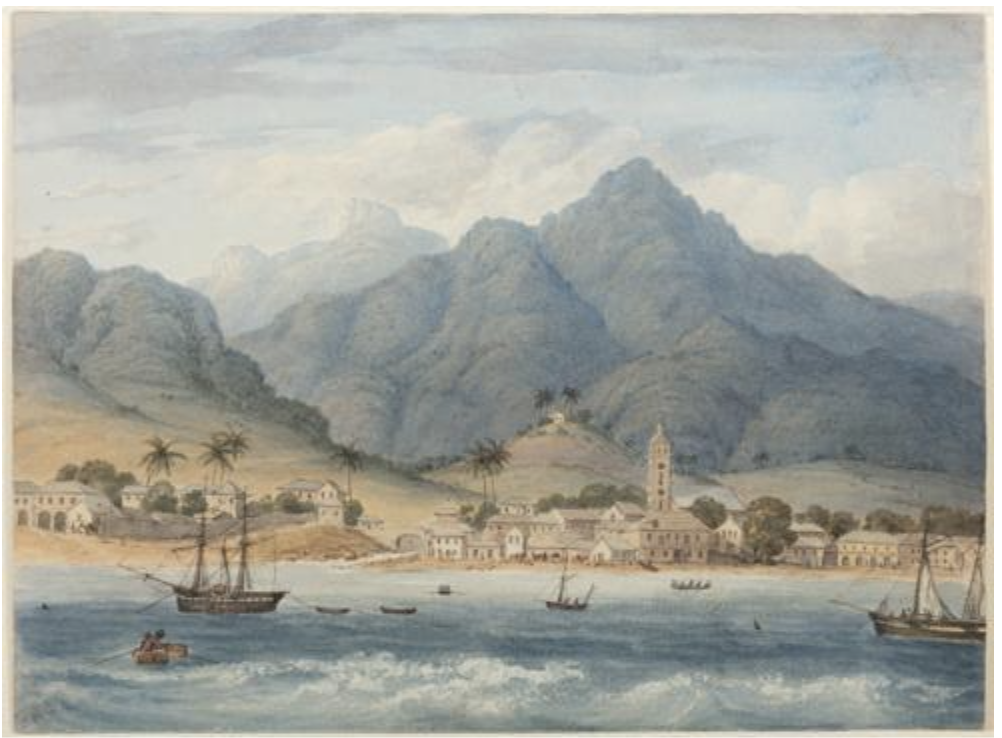
In the immediate foreground, the ocean waves churn gently, their blue hues echoing the sky. Sailboats and rowboats dot the harbor, indicating economic activity, yet they are portrayed at a scale that emphasizes their insignificance against the grandeur of nature. The town itself, composed of cream-colored buildings interspersed with palm trees, appears orderly and tranquil. However, this orderliness obscures any trace of the social, political, or economic tensions that accompanied emancipation. Human figures are scarce; the two barely discernible men in a small rowboat blend almost seamlessly into their surroundings, reducing them to elements of the landscape rather than active participants.
The History of Saint Vincent
Saint Vincent was first inhabited by the Ciboney people, followed by the Arawak people of Venezuela, who were then displaced by the Carib people, who originated from South America (Tolson, Niddrie, & Fraser, 2024). The Caribs intermarried with a group of previously enslaved Africans who had escaped from plantations on other nearby islands. Throughout the 17th century, the Caribs fought off a number of efforts by Europeans to invade and settle Saint Vincent, although they ultimately allowed French settlement in the early 18th century. In 1763, Britain gained control of Saint Vincent with the Treaty of Paris, but the Caribs refused to acknowledge the authority of the British, leading to two wars from 1772—73 and 1795—96. When the Caribs eventually lost, they were exiled from the island, allowing the British to take full control of Saint Vincent. They implemented a plantation economy, which utilized enslaved Africans to produce crops of sugar, cotton, coffee, and cocoa. In 1834, emancipation freed those enslaved and gave them more bargaining power with plantation owners, although competition for work and pay increased later in the century when Portuguese and South Asian workers arrived and sugar prices fell (Tolson, Niddrie, & Fraser, 2024).
Caddy’s History
Raised in Canada, John Herbert Caddy went to England at the age of 14 to receive a military education at the Royal Military Academy, ultimately becoming an engineer, like his father and others before him, and being trained to execute topographical sketches and paintings (Dictionary of Canadian Biography, n.d.). After rising to the rank of first lieutenant, he married a colonel’s daughter in 1828 and was subsequently posted to a series of West Indian colonies. On location, he kept a diary, with written descriptions of his experiences and excursions, as well as some sketches of the areas he visited, some of them coming to be expanded upon as paintings and published after returning to England. His third posting was in St. Vincent in 1834, where he was reportedly joined by his family. In 1843, he retired from the military and settled with his family in London, Canada, working as a civil engineer and, later, turning his hobby of painting Canadian landscapes into his profession, instructing others privately and as a college professor (Dictionary of Canadian Biography, n.d.).
According to the Dictionary of Canadian Biography (n.d.), “Caddy was a painstaking artist who worked slowly and carefully from pencil sketches made on the scene, through sepia drafts, to the finished picture” and “he sometimes completed several versions of the finished landscape.” Still, as a painter who was trained in his art by the military, Caddy’s eye and skill were necessarily focused on different aspects of a landscape and with a different intention in mind than a painter trained in an art school. As Tom Villemarie noted for the The Sudbury Star (2017), “One part of his education involved learning how to sketch and paint in order to record topographical features for reference, for example for future shelling or building of a road or a fort.” This militaristic and colonial perspective is vital to keep in mind, then, when viewing Caddy’s work, particularly given that his published paintings of St. Vincent and other West Indian locations were drawn from sketches performed on the job in his role as soldier and engineer.
Saint Vincent Prior to Emancipation
Carmichael’s 1833 book, Domestic Manners and Social Condition of the White, Coloured, and Negro Population of the West Indies, provides a first-hand account of Saint Vincent just before Caddy’s arrival. As a plantation owner, Carmichael reflects colonial paternalism, describing being visited by “several of our own people” (p. 5), a phrase that normalizes ownership of enslaved individuals. She dismisses their language as “uncouth jargon” akin to “African tongues” (p. 5), revealing colonial prejudices that devalue African culture and obscure systemic barriers to education. Misinterpreting the enslaved’s “happiness” at seeing their “master” as loyalty (p. 5), she aligns with narratives of contented servitude while ignoring resilience and strategic navigation of power. Although she observes white sailors’ cruelty, such as calling a boy a “black devil” (p. 6-7), her detachment minimizes its significance and omits her complicity. Carmichael admires the productivity of Black people bringing surplus produce to market (p. 4-5), but her praise is tied to colonial profitability rather than agency. On the island, she notes poor clothing among the enslaved (p. 9-10), focusing on appearances rather than systemic deprivation, and criticizes women washing laundry semi-nude (p. 10), reflecting Eurocentric propriety. She describes distrust between Black and “Coloured” people (p. 17), an observation that underscores colonial divisions but avoids critical engagement with exploitation. Complaining of theft and neglect among the enslaved (p. 20), she dismisses these acts as resistance, framing them instead as failures of service. While she describes the “hard life” of a plantation owner’s wife, including moral oversight of the enslaved (p. 21), her focus on supervising labor (p. 22-23) dehumanizes enslaved individuals and ignores the systemic exploitation inherent to slavery. Still, by emphasizing the exhausting nature of the work in Saint Vincent for the supervising plantation owner’s wife, she is also inherently saying that the enslaved there are tasked with doing a tremendous amount of work.
Perhaps the greatest critique, though, that Carmichael has for the social structure of Saint Vincent comes from her depiction of the children of plantation owners, whom she calls “Creoles.” Carmichael notes how poorly behaved these Creoles are generally and especially how badly they treat the enslaved, as they are “permitted and encouraged to use the negroes, both young and old, tyrannically” (p. 28). This depiction underscores how systemic cruelty is ingrained from childhood, with plantation culture normalizing oppressive behaviors as a status symbol. Still, she excuses this behavior by attributing it to their “totally neglected education” (p. 28), failing to acknowledge how such negligence perpetuates the plantation’s exploitative structures. Her dismissal of the impact on the enslaved—claiming their strong feelings “quickly evaporate” in passionate expressions of emotion (p. 30)—reflects a dehumanizing view that reduces complex human responses to fleeting outbursts, minimizing the psychological toll of systemic abuse. This rationalization not only absolves the Creoles of responsibility but also reinforces colonial justifications for maintaining the social hierarchy. Read another way, though, Carmichael clearly articulates the problems within this system, as, starting from a young age, it makes unfeeling and badly behaving monsters out of those who oppress others.
Carmichael also describes the vegetation and landscape of Saint Vincent at length. She notes that the landscape showed “mountain heaped upon mountain, in that wild confusion that told of those awful convulsions of nature to which these tropical regions have been subject” (p. 3-4), invoking imagery that situates the island within a narrative of sublime chaos. This depiction reflects a colonial gaze that views the natural environment as both an obstacle and a spectacle, emphasizing its untamed quality while underscoring its utility for plantation economics. Her complaints about “the disadvantages of a tropical climate” (p. 65), including heat and sand, reveal a sense of alienation and discomfort that contrasts with the labor expected of the enslaved, who endured these conditions without reprieve. She notes the decreasing value of West Indian produce and the difficulty of paying staff (p. 63), framing enslaved labor as essential to maintaining profitability, thereby justifying its continuation. Her claim that hoeing—done exclusively by enslaved people—is “literally nothing” due to the lightness of the tools (p. 98-99) trivializes the immense physical toll of such labor, minimizing the suffering inherent in plantation work while reinforcing colonial narratives of enslaved people as naturally suited for hard labor. While this rhetoric reflects broader efforts to obscure the brutality of slavery while presenting the plantation economy as indispensable, it also belies the fact that this enterprise was rapidly failing.
Landscape in the Atlantic World
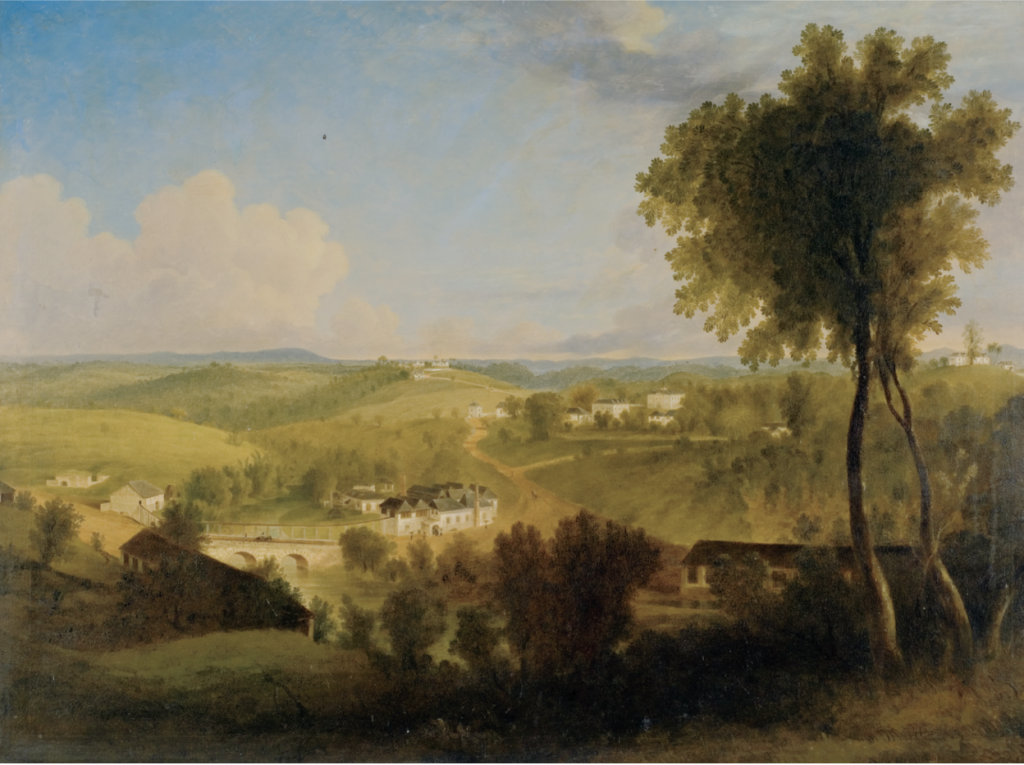
Images of colonies were historically used to “unite and homogenize” the various parts and peoples of the Empire of which they were a part (Auerbach, 2004, p. 47). By using the constructed image of locations that were far-flung and disparate, the artist could provide “a measure of coherence and control” not available to the individual traveler or the government worker waiting on (Auerbach, 2004, p. 48). Within the colonial framework, an artist could “conceal the hardships and beautify the frequently unpleasant surroundings that characterized life in the imperial zone, refracting local people and conditions through a single, formulaic lens” (Auerbach, 2004, p. 48). These efforts are evident in Joseph Bartholomew Kidd’s oil painting “Good Hope, circa 1835—1836” (Figure A). Treating distant lands, including to the island of Saint Vincent, to this formulaic, unifying lens allowed those within the Empire to relate to, embrace, and even feel possessive of these far-off places.
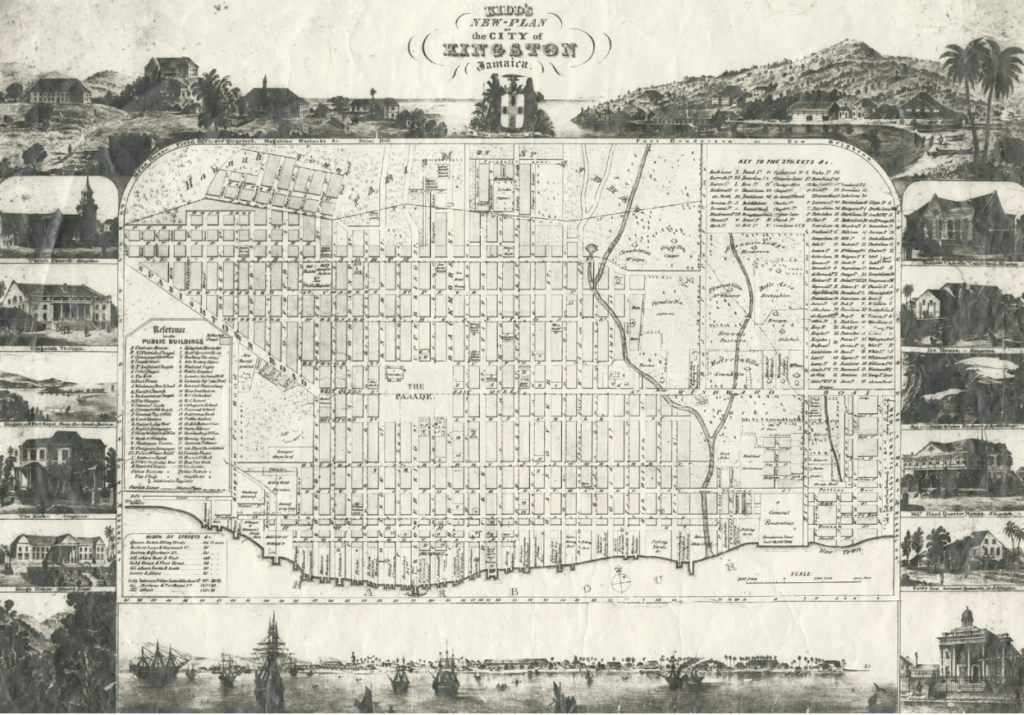
Landscape depictions of the West Indies often strove to show the order made by colonialism out of chaos, how the wild ways of the land and the bodies it subjugated were brought under control and made prosperous, commercial, worthy of investment, and able to fill the viewer/consumer with contentment. In considering a map of Kingston, Jamaica made by artist Joseph Bartholomew Kidd in the mid-19th century (Figure B), Jaffe (2018) discusses the ways in which West Indian towns were created in an urban grid plan in an attempt “to imprint colonial order onto a potentially unruly social and physical landscape the aftermath of emancipation” (p. 73). Colonial planners and those who executed their wishes—that is, military engineers, like Caddy—expressed their authority through the buildings and streets they constructed even down to their “dimensions, materials, styles, or colors” (Jaffe, 2018, p. 73). Jaffe explains, “Urban planning was often directed toward controlling the black and low-income populations, and impressive architecture served to bolster ideas of European civilization” (p. 73). Discussing the landscape images presented alongside the map of Kingston, Jaffe also encourages us to notice both what is included in such as depictions, as well as what is not, for example, ”some two dozen calmly floating sea vessels demonstrating the port’s posterity,” as well as its lack of people: “the map’s version of Kingston seems to ignore the presence of the urban majority, composed of newly freed Afro-Jamaicans” (p. 75). Turning this perspective to Caddy’s painting of Saint Vincent, we see some of the same themes: grand and orderly buildings all of similar hues and European design, an active harbor of boats, and an overwhelming lack of people.
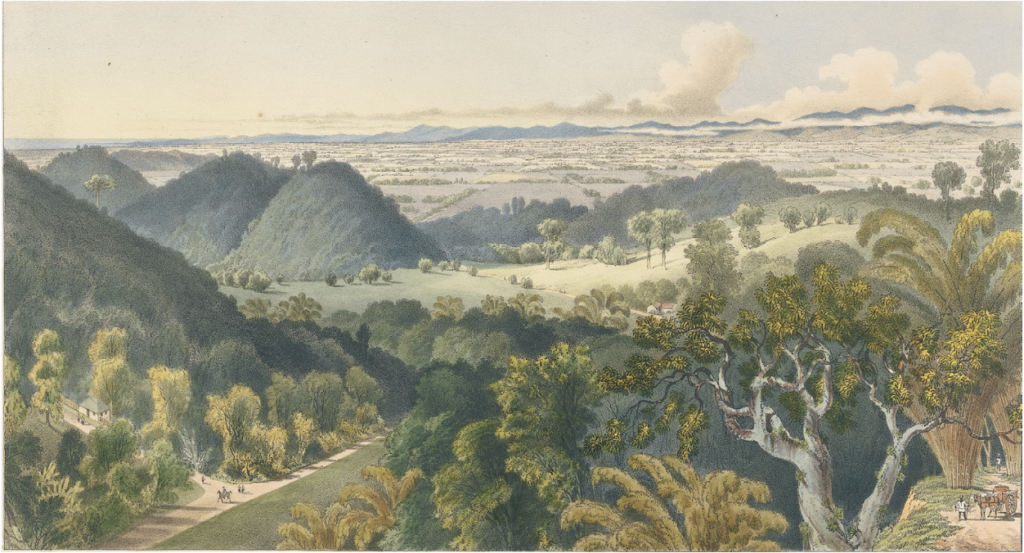
Emancipation didn’t just change the relationships and economy in the colonies, but also changed the messages that artists and their sponsors wanted to share with potential investors and tourists about the location. Barringer (2018) notes how, at the time of emancipation, visual representations of the land of nearby Jamaica were changing. Prior to 1838, when enslaved people gained their freedom, artists generally focused on the sugar crop and its wealthy proprietors, utilizing “the vocabulary of the picturesque to present the island’s agrarian landscapes as elegant and tranquil and its great houses as the epitome of opulence and refinement” (Barringer, 2018, p. 282). With emancipation, though, the relationships between the plantation owners and their workforce changed dramatically. There was unrest, uncertainty, and difficulty for plantation owners to find the workers they needed. Despite—or perhaps because of—reports in the press of “the febrile and unsettled condition of the colony…[Scottish artist Joseph Bartholomew] Kidd, reassuringly, presents an eyewitness account of a Jamaica that appears static and peaceful” (Barringer, 2018, p. 288). After emancipation, promoters sought to use images of West Indian colonies to emphasize the health, vitality, and fecundity of the land, functioning as glowing advertisements more so than accurate artistic reflections. These efforts were created to combat the belief that the islands had been “ruined” by emancipation (Thompson, 2011, p. 45). One such example is that of Joseph Bartholomew Kidd’s “Distant Views of the Plains of Westmoreland” (Figure C). Caddy’s idyllic, fertile, lush presentation of Saint Vincent indicates a wish to return the town to this perceived contented, peaceful, and organized state prior to emancipation.
The bodies of those depicted in images of the West Indies also changed with emancipation. Prior to emancipation, Barringer (2018) continues, “The human body played a limited role in Jamaican art…black figures were generally represented as servants or deployed only in the middle distance of agricultural scenes, peacefully at work” (p. 282). Yet, with the declaration of emancipation came a belief that Africans were predisposed to idleness, even that emancipation was a failure for not having taught enslaved people to enjoy voluntary work, and this stereotype carried over into art as depictions of Afro-Jamaicans as lazy and only seeking to fulfill their immediate desires. Still, images of black workers were often conflictual—at times, they were shown as lounging and eating the crops they are meant to sell, while others showed them as “industrious and disciplined laborers—qualities that would appeal to new business investors” (Thompson, 2011, p. 46-47). Given that Caddy’s original sketch occurred the same year that Saint Vincent passed emancipation, the nearly complete lack of humans in his landscape seeks to subtract the humans that reside here completely, as well as any political and rifts, riots, and conflicts occuring in Saint Vincent leading up to or following this major change.
Caddy’s Perspective
Given that Caddy was stationed on Saint Vincent in 1834, he would have witnessed the early days of the emancipation of the island’s enslaved people—perhaps even the very day it took effect. Undoubtedly, 1834 was one of great flux in Saint Vincent, as power and the island’s economy shifted to incorporate the new rights of its formerly enslaved inhabitants. It is intriguing then that Caddy’s landscape shows so few people and so little action at all, none of the usual hustle and bustle of a port, nor any signs of the strife or upheaval one would expect from such events. Considering Caddy’s depiction of this West Indian colony at this moment in time from his perspective as an engineer for the British military, we can see the ways in which Caddy was trained to remove people from landscapes in order to focus on the utility and/or problems with the land and how it could be manipulated. Additionally, given that this image was first captured in his sketchbook while he worked and then redrawn and painted later, much after the fact and from a distance, gives us some indication that he was motivated to portray the island in a way that both romanticized nature and looked back sentimentally at the physical aesthetics of imperialism. The people were removed out of habit, by instruction, and for simplicity—the people who could have been in the picture—enslaved or free, master or businessman—complicated the beauty of the land and could be subtracted to preserve what was naturally beautiful and that which he admired from his work as an engineer—the calm, organizing presence of cream-colored structures.
Conclusion
John Herbert Caddy’s “Kingston, St. Vincent” encapsulates the complex interplay between art, colonialism, and historical transformation in the mid-19th century Caribbean. By employing a serene composition and omitting human figures, the painting constructs a vision of harmony that masks the island’s turbulent social realities. As a product of its time, Caddy’s work reflects both the aspirations of colonial narratives and the anxieties surrounding emancipation and its aftermath.
Ultimately, this painting invites viewers to critically consider how art can simultaneously reflect and distort historical truths, offering a curated vision of the past that serves specific ideological ends. By situating “Kingston, St. Vincent” within its historical and artistic contexts, we gain insight into the ways landscape art has been used to shape collective memory, obscure injustices, and reinforce systems of power. At the same time, the painting’s beauty and technical skill remind us of the enduring power of art to evoke reflection, even as it conceals as much as it reveals.
References
Arabindan‐Kesson, A. (2022). Transmission and Transfer: Plantation Imagery and Medical Management in the British Empire. Art History, 45(3), 472–497. https://doi.org/10.1111/1467-8365.12660
Auerbach, J. (2004). The picturesque and the homogenisation of empire. The British Art Journal, 5(1): 47–54. http://www.jstor.org/stable/41614516.
Barringer, T. (2018). Land, Labor, Landscape: Views of the Plantation in Victorian Jamaica. In Victorian Jamaica (pp. 281-). Duke University Press. https://doi.org/10.2307/j.ctv11hpgxv.36
Breen, H. H. (1844). St. Lucia: Historical, statistical, and descriptive. Henry Hegart.
Caddy, John Herbert. Kingston, St. Vincent. 1845. Watercolor on Paper. Accessed October 23, 2024. https://emuseum-2022.hamilton.edu/objects/37/kingston-st-vincent?ctx=6936dfcc60d0f66ac0c78f200ed0b75d01f76046&idx=3
Carmichael, M. (1833). Domestic manners and social condition of the white, coloured, and negro population of the West Indies (Vols. 1–2). Whittaker, Treacher, and Co. Dictionary of Canadian Biography. “Caddy, John Herbert.” Accessed October 23, 2024. https://www.biographi.ca/en/bio/caddy_john_herbert_11E.html.
Hamilton College eMuseum. “Lt. John Herbert Caddy.” Accessed October 23, 2024. https://emuseum-2022.hamilton.edu/people/190/lt-john-herbert-caddy.
Jaffe, R. (2018). Kidd’s new plan of the city of Kingston, Jamaica, 1854. In Victorian Jamaica (pp. 73-75). Duke University Press. https://doi.org/10.2307/j.ctv11hpgxv.36
Thompson, K. (2011). The Evidence of Things Not Photographed: Slavery and Historical Memory in the British West Indies. Representations, (113), 39-0_4. https://doi.org/10.1525/rep.2011.113.1.39
Tolson, R., Niddrie, D.L., & Fraser, A. (2024, October 29). Saint Vincent and the Grenadines. Encyclopedia Britannica. https://www.britannica.com/place/Saint-Vincent-and-the-Grenadines
Villemarie, T. (2017, January 15). Caddy was a pro painting early Ontario. The Sudbury Star. https://www.thesudburystar.com/2017/01/15/caddy-was-a-pro-painting-early-ontario
Wen, X., & White, P. (2020). The Role of Landscape Art in Cultural and National Identity: Chinese and European Comparisons. Sustainability, 12(13), 5472. https://doi.org/10.3390/su12135472