Redefining Antigua’s Skyline
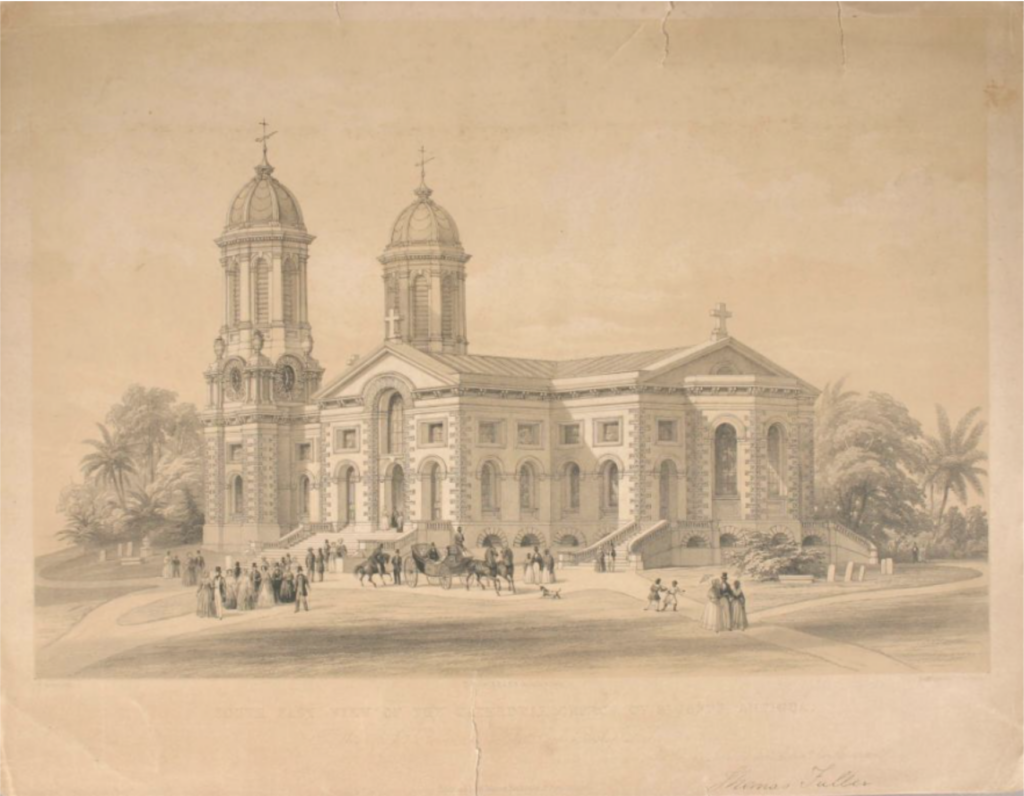
An essay about Thomas Picken’s South East View of Cathedral of St. John’s Antigua of the Wellin Museums Beinecke Collection.
By Mathilde Fowlkes
Between the years of 1834 and 1843, a number of historic events occurred in the British empire that would have lasting effect on the future of the British colony of Antigua.
Antigua is an island in the Caribbean that was ruled by England from 1632 to 1981, cultivating and exporting sugar through a plantation economy. Like many of the Lesser Antilles, Antigua historically used slave labor to cultivate its resources until England abolished slavery in 1834. In 1837, Queen Victoria rose to power and in 1842, many of the British islands became their own diocese, which is a district run by a bishop under the Christian Church, including Antigua. Lastly, in 1843, an earthquake devastated the Lesser Antilles, leaving towns and buildings destroyed. Today, many works from and about this region can be found in the Wellin’s Beinecke collection which features prints, drawings, watercolors and oil paintings that date from the 18th and 19th centuries. One of these prints is of St. John’s Cathedral in Antigua, created as the center of the new Diocese of Antigua and as the replacement for the previous church, which crumbled in the 1843 earthquake. The church still stands today, a magnificent structure built of free stone, following a cruciform floor plan and designed in the Roman style. Today, I will be investigating what the architecture of St. John’s Cathedral and the print of the same subject communicate about the religious, political and social state of Colonial Antigua. In this essay, I argue that this print communicates an idealized future of emancipated Antigua according to the Anglican Church, placing its soon-to-be-built cathedral as the central force paving the way to a civilized, tolerant and distinctly European modern era.
This print is called South East View of Cathedral of St. John’s Antigua by Thomas Picken. It is a lithograph on board created around 1845 in the town of St. John, Antigua. It depicts a view of St. John’s Cathedral and its congregants as they depart through its courtyard. The Cathedral is depicted at an angle, displaying the many arches of the stone building’s facade. On the right we see the protruding exterior of the aps with its vertical stretching arches, while in the center there is a clear view of the transept and its grand staircase. The building is lightly ornamented with the edges of the walls lined with darker, layered stones and the two crosses sitting at the pinnacle of the low-sitting roof. To the left, we see two identical towers, each capped with a cupola, rising above the rest of the church, one of which is partially covered, reaching towards a sky speckled with fading clouds. Leaving the church, we see multiple groups of people, all in dignified European dress. There are both black and white people depicted and while one or two can be seen intermingling with the other race, they mostly seem to be grouped with people of the same race. A carriage, driven by a black man, pulls away from the church, its white passengers in tow. Also in the yard are what seem to be tombstones on both the right and left. Framing the cathedral, we see a lush forest of diverse trees. Below the image, its title and publisher, W. Mercer Bookseller, are printed. Also written below is a faded message that reads “To the Right Reverend the Lord Bishop of this Diocese. This Print is respectfully inscribed by his Lordship’s most obedient humble servant,” and it’s signed clearly, in ink by Thomas Fuller. His name is also listed in print as “Thomas Fuller A.R.I.B.A., Architect Bath,” meaning he is the architect who designed this cathedral. This print is most likely a final mock-up design of what the future cathedral would look given that the print dates to 1845, which is the year when the cornerstone of the actual cathedral was laid by Sir Charles Fitzroy gov in chief.
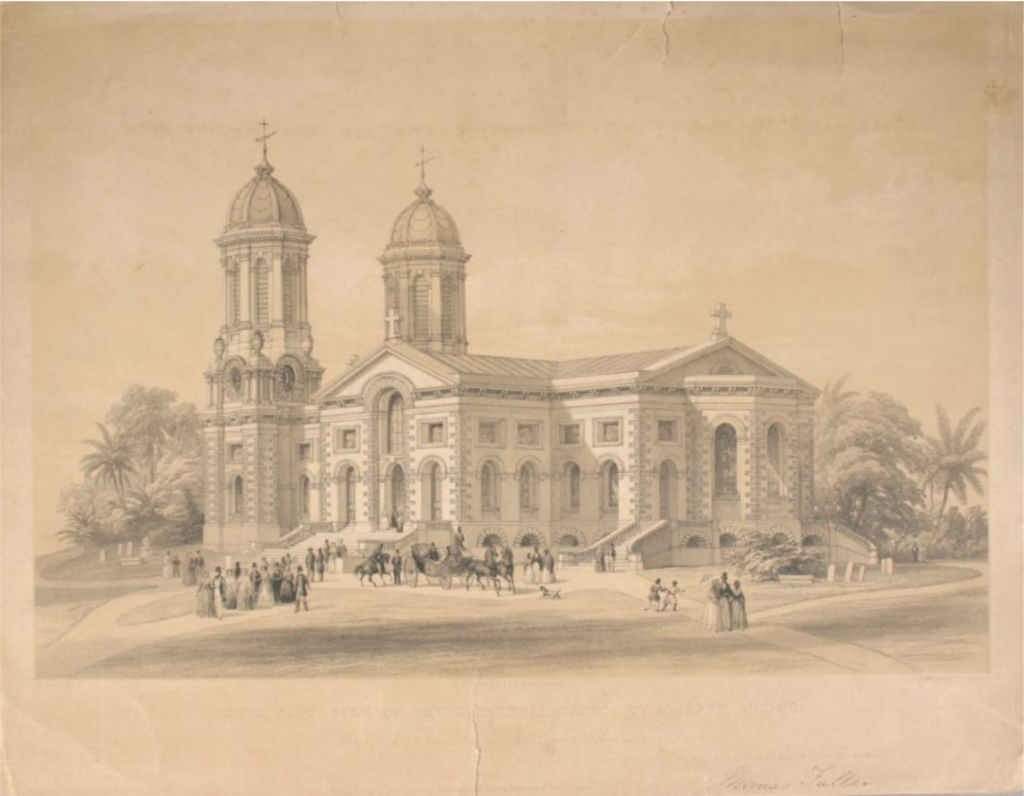
Contrary to the expectations and debates on proper ecclesiastical architecture by the architectural associations in Britain, St. John’s Cathedral strays from popular design. In the print, the cathedral is designed with elements of the “Roman style”, as described in an article from The Church of England Magazine, such as the curved archways, small windows, triangular roof and two identical towers flanking the western facade. The towers, however, are slightly more Baroque in feel due to their thinness and cupolas. To a normal viewer, this might appear like any other cathedral or church, but it starts to feel quite out of place compared to the Pointed/Gothic architectural revival that was having its moment in 1840s Britain. Upon Queen Victoria’s rise to power in 1837, Late Georgian Classicism, a style marked by symmetry and proportion based on Greek and Roman classical architecture, remained resilient but was challenged by revivals of medieval styles formulae. The architectural societies of Oxford and Cambridge were taking a serious approach to the study of medieval architecture, whose elements mixed with the up and coming gothic revival to create what would become Victorian architecture. Between these two styles, it is clear that St. Johns leans more toward Late Georgian Classicism with its symmetry and classical detailing, but all together, the style of this structure appears to exist independently of these movements.
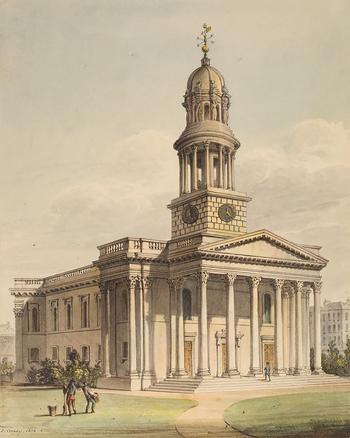
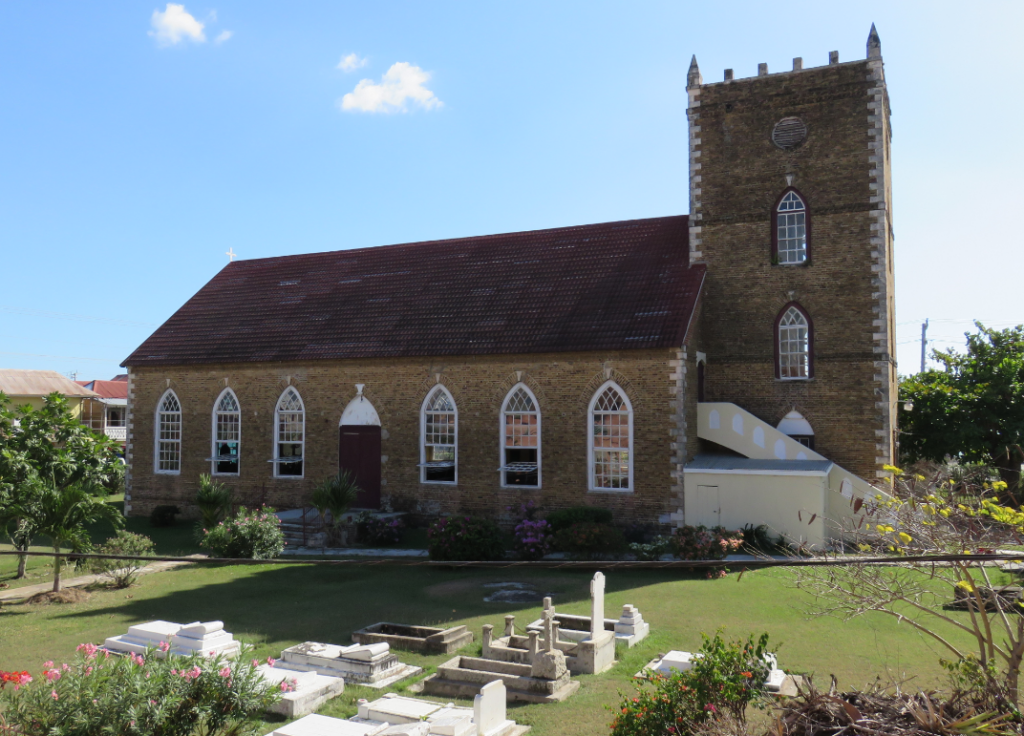
These differences, both stylistic and functional, can also be seen when comparing St. John’s architecture to the other Anglican churches constructed in the British Lesser Antilles in the late 1830s. Many of the other churches built around this time demonstrate a general consensus in Britain: that Middle Pointed style ought to stay the basis of proper ecclesiastical architecture with appropriate modifications. But while the church tried its best to follow what was standard, they realized that adaptations were necessary to meet the demands of both the climate and culture. In the Caribbean, this meant adapting to the seismic activity and tropical weather conditions. Tropical Pointed churches were constructed more compact with thick heavy walls and sometimes buttresses, which were thought to add stability during earthquakes. This is best exemplified in Jamaica St. John the Evangelist, constructed in 1837, whose simplistic, sturdy shape, reminiscent of a medieval English parish, greatly contrasted the ornate and vertical St. John’s Cathedral. Spires were rarely seen in these churches as architects thought they might blow over in the high winds. Together, the differences that define St. John’s Cathedral gives it a unique, enlightened appearance and classical splendor that distinguishes Antigua as a flourishing colony and an independent diocese.
It should be noted that St. John’s still meets the requirement of basic form and splendor that the British Empire expected of a cathedral, reflecting the European standards of Christian monumentality. From the angle the cathedral is depicted in the print, we can clearly see that it has all the basic elements of a church, such as the Greek cross floor plan and Christian iconography. The British would accomplish this by importing building materials, craftsmen and ideas to the colonies. This is exemplified in the print itself, as the architect who signed it, Thomas Fuller, was an associate of the Royal Institute of British Architects (A.R.I.B.A). Thus, the Anglican Church ensured that the church fell in line with the standards and ideals of the religion and empire that housed it. Beyond that, the structure is depicted with an air of elegance and monumentality as it dominates the scene with its grand stairways and ornate detailing. Britain’s main concern in their early attempts of erecting church buildings after the founding of the colonial dioceses was that they possessed correct ecclesiastical models with proper liturgical arrangements and a distinctly Christian style of architecture. Cathedrals were held to even higher expectations, as they were considered an architectural ornament with the task of symbolizing the glory of the English Church and being the administrative and spiritual center of the diocese. This new landmark, as reflected in its architecture, was created to reshape the transforming local skylines around British religion and imperial power as impoverished plantations fell. In relation to Britain, this cathedral conforms to the concepts of religious splendor and monumentality of the island’s colonizers, giving the print a distinctly European feel.
The print of St. John’s Cathedral by Thomas Picken is a beautiful scene of sophistication and tropical luster, but when comparing it to a similar print of the same subject from just a year later, we can see how Picken’s print might be an exaggeration of what would eventually be built. Looking at the picture of the Cathedral in the 1846 April edition of the Church of England Magazine, we can see some key differences. Architecturally, many of the church’s features stay the same except that the staircases at the back are removed and the grand staircase has been elongated and more so resembles a ramp. Also, the crosses at the top of the building have been removed, so there is no longer that distinct signifier that it is a Christian building. Changing these factors seems to take away from the overall angelic and monumental effect prominent in Picken’s print, which begs the question of which one is a representation of what the cathedral actually became? This feeling continues to diminish when looking at the elements surrounding the building as well. Instead of a paved path surrounded by well-kept lawns, we see a cracked landscape covered in crooked graves and sarcophagi. Looking at pictures of the cathedral today, we can see that it is in fact surrounded by an old cemetery filled with these types of graves. This means that Picken chose to stretch the truth, leaving only a couple of misplaced headstones, in order to give the atmosphere a more elegant, clean look and to potentially draw the viewer’s attention more to the cathedral itself. Instead, Picken draws orderly lawns and tamed shrubbery, reminiscent of proper British landscaping. He seems to do this as well in the scenery behind the cathedral as the forest is more lush and there are no other buildings such as the hut depicted in the newspaper’s print. By framing the cathedral with a more tropical yet curated and organized setting, it elevates the scene into a depiction of idealized tropical elegance while still conforming to the standards of British landscaping aesthetics.

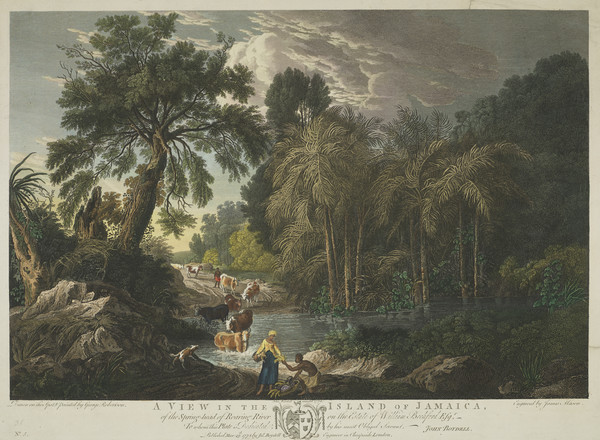
Throughout Antigua’s history as a British Colony, the Anglican church and other religions have played a big part in shaping the trajectory of slaves’ lives, something the artist of this print tries to highlight. From the congregation leaving the church, we see both black and white figures, similarly dressed in sophisticated European clothing. They leisurely talk and walk side by side, their similar levels of elegance suggesting they are equally ranked members of society. The reason that the artist might have included sophisticated depictions of both demographics is to demonstrate the efforts the church implemented to educate and elevate the slave population before and after emancipation. In Sylvester Hovey’s Letters from the West Indies he accounts the religious and educational roles of missionaries on Antigua and other British islands. They were originally met with heavy opposition, but after some time, they gained over public sentiments, and since 1828, slaves had free access to places of worship. They would occupy the isles, galleries and even, in the later years, attend schools under the superintendence of their respective clergy. The clergy was the main supporter of these schools and built them with the purpose “to civilize, instruct and improve the negro race” (78). At St. John’s church specifically, 1200 emancipated people would be kept after the morning sabbath sermon where the Reverend Mr. H would keep track of who was present and repeat that day’s sermon in simpler language so that they could follow him more clearly. Thomas Picken attempts to exemplify the fruits of the church’s efforts by portraying civilized and Christianized emancipated slaves leaving the church as if they are a product of the church itself. This would not be the first time Afro-Caribbean people have been used as ornaments in landscape settings. In Arabindan-Kesson’s article, she examines the use of the picturesque genre in the visualization of Caribbean plantations under British rule and how the aesthetic representations of plantations were used in the medical world. In her discussion, she examines George Robertson’s Spring Head of Roaring River Estate, in which two black figures pose aesthetically with overflowing baskets of goods. She argues that these laborers are ornamental, placed in this way to accentuate the natural appeal of the land and its plentiful resources. At the time of this print, despite being emancipated, the ex-slaves are still being used to demonstrate the arts’ underlying ideologies. By portraying them in this way, they become ornaments of the church, glorifying the Anglican Church and British rule for paving the way to the future of the colony after emancipation.
Despite the church’s missions and claims to betterment, when placed in historical context, this print is far from the truth of Antiguan society at that time. The picture of the departing congregation is one of social harmony and bliss, with finely dressed black and white ladies and gentlemen walking side by side in conversation and a pair of black children playfully chasing each other. It should be noted that of the British Caribbean islands, Antigua was one of the most progressive when it came to emancipation. The colonial assembly skipped over the Apprenticeship System, put in place by Britain to help with the transition out of slavery, proclaiming complete emancipation in August of 1834. However, this does not mean that Afro-Antiguans immediately became the equals to the island’s white inhabitants. According to Hovey’s report, which was published a few years later, the overruling of the Apprenticeship System was carried by a small majority and that just because slavery had been eradicated, this does not mean prejudice was too. Of the emancipated people attending St. John’s church, the Reverend noted that their clothing was the “marks of a people just emerging from ignorance into a state of civilization” (80). With this, it becomes clear that emancipated slaves at this time would not have been wearing the fine European dress that they are depicted wearing here. Also, while they might have had access to the church, they most likely would not have been interacting with the white congregants as comfortably as they are depicted here. The one element of the print that seems true to form is the elegant horse-drawn carriage driven by a black man in a European-style uniform, transporting his white employers back to their estate. The artist’s choice to depict this harmonious church community only a couple of years after emancipation, when the living conditions of freed slaves only minorly improved, shows that this print is not meant to be an accurate depiction of Antiguan society but an idealized vision of what it could become with time and commitment to the church and its teachings.
With all of this in mind, and with the help of Tim Barringer’s essay titled Land, Labor, Landscape: Views of the Plantation in Victorian Jamaica, we can start to see that this print is likely depicting the church’s view of a perfect Antiguan society after emancipation. In the article, Barringer argues that the representation and visuality of the Jamaican landscape has evolved over time, being determined by the dominant ideologies because power and vision are linked. These dominant ideologies dictate the perceived future of an emancipated Jamaica in both positive and negative ways. He goes on to discuss the ideologies present in James Phillip’s Sligoville with Mission Premises, which Barringer explained is the socially radical vision of the Baptist church in which Afro-Jamaican converts are considered equal to everyone else. Instead of plantations, the idealized image resembles an English village, except it lacks class hierarchy, with each pristine cottage wholly equal to the other, all under the dominion of the church upon the hilltop. Barringer argues that it proclaims the church’s faith in the power of religion to civilize ex-slaves under a new “culture of deference to British norms” (297). This ideology and the visual organization used to represent it are similar to what is being represented in Picken’s print, a variety of different people deemed equal under the supervision of the church. Using this argument, Picken made this print by taking the dominant ideologies within the colonial Anglican church and creating a visual representation of what the future of emancipated Antigua would look like: civilized, tolerant, and very Christian. This can be seen in the way the cathedral dominates the scene, with everything else feeling simply ornamental, furthering its prestige and beauty. Even the people, too, who, upon closer examination of the work, were added in after the image of the cathedral was completed as the lines of the building show through their figures. To further support this interpretation, recall that this print is most likely a final mock-up of the future cathedral meant for the Bishop himself. Knowing that this design would eventually be built in real life and be the center of the new diocese, it makes sense that the artist would idealize the scene to represent the potential impact this new building and its bishop would have on the population of the island. In a way, this print is meant to communicate the idea that this cathedral will propel Antigua into the future, becoming a civilized and respectable society on the same level as their European counterparts.

Despite this print of St. John’s Cathedral in Antigua being tucked away in Hamilton’s Beinecke collection, it tells a rich story of Antigua’s society and the role of religion at that time. From what I have gathered, this print is an idealized representation of the future church and the role it will have in elevating and modernizing the fairly new emancipated Antigua. The church’s goal of an elegant and educated European-esque higher class is captured in the Roman and classical style architecture of the structure. Its architectural style distinguishes Antigua as a unique, enlightened colony with its own diocese. However, the basic structure of the church and setting of the print turn Antigua’s landscape into a European vision, bringing the island closer to the British ideal of civilized Christian society. Though it may not represent the current reality of the island, it does display the importance of religion, specifically the Anglican church, in social issues such as emancipation. While I have done lots of research to try and unravel the mysteries of this piece, there is still a lot about this print left unsolved. For example, what was the broader impact of this print? Or did St. John’s Cathedral live up to the expectations depicted in this representation? For now, those will have to remain unanswered questions.
Bibliography
Arabindan-Kesson, Anna. Transmission and Transfer: Plantation Imagery and Medical Management in the British Empire. Art History 45, no. 3 (2022): 472-497.
BARRINGER, TIM. Land, Labor, Landscape: Views of the Plantation in Victorian Jamaica. In Victorian Jamaica, edited by TIM BARRINGER and WAYNE MODEST, 281–321. Duke University Press, 2018. https://doi.org/10.2307/j.ctv11hpgxv.36.
Bremner, G. A. Imperial Gothic: Religious Architecture and High Anglican Culture in the British Empire, c.1840–1870. London: Paul Mellon Centre, 2013. Accessed November 25, 2024. https://aaeportal.com/?id=-23936.
Crain, Edward E. Historic Architecture in the Caribbean Islands. Gainesville: University Press of Florida, 1994.https://search-ebscohost-com.ez.hamilton.edu/login.aspx?direct=true&db=e000xna&AN=20715&site=ehost-live&scope=site.
Hovey, Sylvester. Letters from the West Indies : relating especially to the Danish island St. Croix, and to the British Islands Antigua, Barbadoes and Jamaica By Sylvester Hovey .. New York City, New York: New York Gould and Newman, 1838. Readex: Caribbean History and Culture, 1535-1920: Imprints from the Library Company of Philadelphia. https://infoweb-newsbank-com.ez.hamilton.edu/apps/readex/doc?p=CRBHCC&docref=image/v2%3A13D59FCC0F7F54B8%40EAIX-154E9AE63768D468%40-155BBD3A5922E408%4051.
Robertson, James. Jamaica’s Victorian Architectures, 1834–1907. In Victorian Jamaica, edited by TIM BARRINGER and WAYNE MODEST, 439–73. Duke University Press, 2018. https://doi.org/10.2307/j.ctv11hpgxv.41.
St. John’s Cathedral, Antigua. The Church of England Magazine Vol. 20-21 London Edwards and Hughes, April 4, 1846. No.577