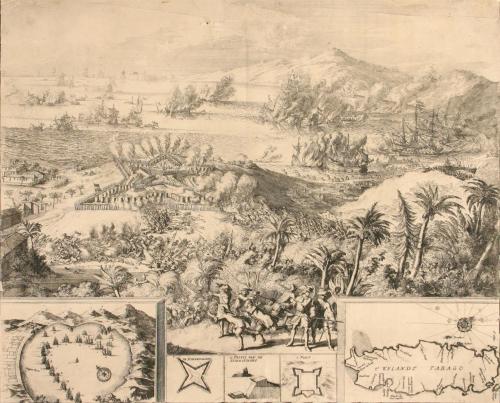
Untitled [battle between French and Dutch troops on the Isle Tobago, 1677 F.M. h. 2601] is an engraving created by Dutch artist Romeyn de Hooghe in 1677. This print depicts a battle fought between French and Dutch troops on the island of Tobago. The main focal point of the piece is a battle scene, showing a fight between the French and the Dutch, on the island but primarily in the waters surrounding it. There are also several inserts depicted; furthest left there is a map of ship positioning in the bay before the fighting began, in the middle there are three small images of what may be the forts that defended the island, and on the far right there is a map depicting the island of Tobago itself. The battle being fought began when a French contingent, dispatched to put an end to piracy in the area during this time period, attempted to take Tobago from the Dutch. Tobago did not have a permanent European settlement until after this image was created, when Great Britain took control and began developing sugar plantations. Tobago was in the southern portion of the “West Indies,” with a location close to the northern tip of South America. This battle scene is a print of an engraving, done by a prominent European artist of the time. The virality of this battle scene displays how chaos and violence can be used as propaganda.
Historical context is important for discussing this piece. The battle depicted in this image was the first of two battles between the French and the Dutch over the island of Tobago. Fought on March 3, 1677, this battle ultimately ended in French defeat. However, the French returned in December of the same year and came away victorious; capturing the island, deporting its inhabitants, burning down plantations and other structures, and abandoning the island. These battles were a part of a larger conflict known as the Franco-Dutch War, which saw fighting between France and the Netherlands (and their various allies) from 1672 to 1678. This war led to the shifting of power, territories, and resources amongst many countries, not just France and the Netherlands, during this time. The Dutch often overestimated their abilities, which frequently led to their unexpected defeat. The other question is why was the island of Tobago important? Looking at records of laws passed in regards to Tobago a few years later in the 19th century, the prominence of trade and slave labor is demonstrated. This island was a prime spot for plantations that could be worked on by both indigenous and African slaves. This labor led to the development of goods that could be traded, which led to more resources and wealth for the government of whichever country owned the island. Overall, this was a turbulent time in European history, and the art generated during this time may have impacted how the people of the time viewed their country’s state of affairs.
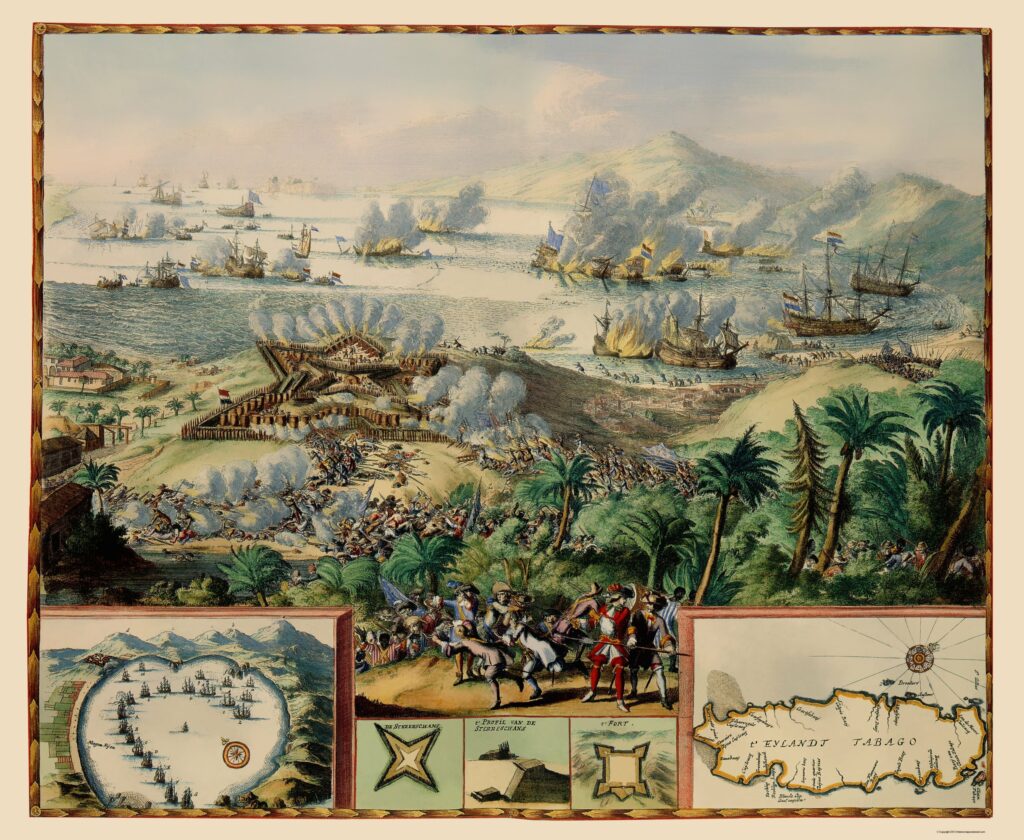
Using Stephanie Porras’ ideas of “virality” and “the copy,” one can begin to outline where this image may have fallen in terms of the public eye. Porras uses the modern term of “virality” to discuss the relevance of artwork in the culture of the time. A viral piece of media now, is something that is rapidly shared and spreads far from the original, often globally. In a modern context, virality often uses the internet, as it is a way to quickly spread art and information. The 17th century did not have the internet, so they heavily relied on shipping to spread their art and ideas across the globe. Trans-Atlantic Ocean shipping is risky and not as easy as pressing a button and sending the art across the globe. The fact that a print of an engraving done by a Dutch artist made it to the Lesser Antilles is not that unexpected because of a few reasons. The print does depict the island of Tobago, which is located in the Lesser Antilles, the Dutch also had extensive trade routes that ran through that region of the world in the Dutch West India Company. The idea of the “copy” plays a slightly different role than the way that Porras initially describes it. Porras describes the “copy” as a form of the original that may be slightly different in some way. So, instead of an exact replica, the “copy” gains meaning and interpretations as it is touched by more artists and ideas. In this case, the print is made from an engraving, so the copy is simply a copy of the original. The original being the engraving. There is not much room for added interpretation, as all of the copies in circulation were likely manufactured using the same engraving. This does bring up some speculation about how vast this interpretation of the “copy” can go. If a work of art located in the Caribbean is identical to another piece located in Europe, do these pieces have inherently different meanings? One could argue yes, that what is seen as a triumphant battle scene displaying a victory for the country in one location, may simply be viewed as a record of a battle that took place in another. So, how much does the location of the audience matter in terms of interpretation of the work of art?
Due to the nature of this piece as a battle scene, it easily lends itself to the idea of virality. Generally speaking, the public loves drama. So, if an image displays the chaos and drama of a battle, as this piece does, it is with relative ease that the piece becomes popular. This has a few drawbacks, however. Due to the easily popular nature of battle scenes, this means that what is spread amongst the general populace may not always contain all of the facts. Looking at this piece by Romeyn de Hooghe is a great example of these drawbacks. The image depicts what is clearly a large battle, there is smoke and chaos and fighting; yet, at the top of the fort stands the Dutch flag, untouched by the battle and flying proudly. In fact, there are a few places in this scene where the Dutch flag flies in an almost triumphant manner, while the few depictions of the French flag show it almost haphazardly. Imagine the pride that Dutch citizens would feel in seeing their flag displayed in such a way, almost proving the power and might of the Dutch military. It is in this way that the art could be used in a propagandic way. It is important to note here that de Hooghe was infamous for generating propagandic art in support of William III of Orange, however that does not necessarily indicate that this specific image was created for that purpose. While the Dutch did win this specific battle, there was lots of turmoil during the years before and after this image. Art is often used as propaganda as it reaches a larger audience than words often can (Vagts 88). One does not need to speak Dutch in order to understand what is happening in this image. The audience is presented with an image, which invites them to make their own interpretations. The artist can steer the audience in a certain direction by including key details such as the central location of the Dutch flag, instead of simply presenting them with a nondescript battle scene. This circles back to the idea of how the audience’s experience impacts the interpretation of a copy. The iconography of the Dutch flag when presented to a person in the Netherlands may give them a sense of pride in their country, while a French person’s view of the flag may be less savory.
Briefly mentioned above is the idea of the Dutch West India Company. The Dutch West India Company is a company involved in both the trans-Atlantic slave trade, and in the trade of goods from the Americas to Europe and vice versa. This control that the Dutch had over trade going into and out of the Americas may have played a role in the spread of propagandic art. The prominence of the Dutch West India Company led to the Netherlands controlling several major trading posts throughout the New World, it was also a large contributing factor in the Dutch colonization of the Americas. Since the Dutch controlled various chunks of land throughout the New World, and they controlled trade into those colonies, it allowed the government to somewhat control the media consumed by their people. This limited media exposure in itself is a form of propaganda, as all the media going through these colonies has been vetted by the Dutch. This control meant that the Dutch government could create this powerhouse image of itself in the minds of its constituents. Many settlers in these Dutch-American territories were foreigners in the Netherlands, as they were born in other parts of Europe and the New World. This meant that the Dutch had control over a large group of people who were not nationally Dutch, whether it was other European settlers or enslaved indigenous peoples. This group of people would have relied heavily on Dutch merchants for information and media coming from Europe. This reliance on the Dutch, meant that this group of people who lived in Dutch territories likely believed the stories that were provided to them of the might of the Netherlands. Putting this propaganda in a context that they would understand, as an image of a battle on an island that they know, provided them a clearer picture of the overarching themes of the piece.
Carolyn Dean discusses defining the term “art,” and how visual media may take different forms in a variety of different cultures and ways. Can propaganda be considered art? Thinking about this piece simply as a form of visual media, it tells a story and likely elicits some form of emotional reaction from the viewer. There is a sort of catchiness to the image. While in this specific instance there is a story being told, at the end of the day it is just another battle scene. Battle scenes are frequently depicted in art, as they are dramatic and flashy. Battle scenes are popular, or one could say “viral.” Does the virality of the image detract from its status as a piece of art? Can something become so mainstream that it loses its sense of meaning? Like yes, this piece can be used as propaganda about the strength of the Dutch military and its holdings overseas, but it is also just a battle scene that has been picked at by generations of historians. Perhaps Romeyn de Hooghe just wanted to engrave a depiction of a battle win, and he had no other intentions for the piece. But also, is that not what art is? Isn’t art about how each member of the audience interprets the piece differently, creating their own copy and interpretation of the scene laid before them. Is it not possible that what makes art, art is the impact that a piece of visual media has on the audience, as described and imagined by the author? Arnold Hauser makes the excellent point that only in rare circumstances is a piece of art in no way influenced by the society in which it is created. By that description, isn’t all art propaganda and all propaganda art?
David Bromwich introduces an interesting idea of “imagined community” in his “Comment: on Art and Nationalism.” An imagined community is a group of people whose passion and cohesion lends itself to a sense of community, when in reality they share few similarities in terms of an actual community. The conversation of art and propaganda plays an interesting role here. What better way to generate a sense of community than with a sense of nationalism and pride in the identity as a citizen of that country. This artwork by de Hooghe may have helped to generate that kind of national pride, especially in those that were foreigners living in Dutch territories. The propaganda is being used to create a false sense of community, when there is no real reason for community, other than the same location. These people have no real ties to one another, hence they have no reason to feel any sort of bond to each other, their territory, or what is happening in the world around them. Building this sort of imagined community may have at least given settlers a reason to get along until real ties and bonds could be established. The establishment of these bonds may have contributed to the overall health of the trade economies that were present at the time. If the people were living and working together, and they were getting along, there would be less time spent fighting each other, and more time spent working to create things that could be exported. Furthermore, if there was a sense of community there would be less chance of infighting. This would allow the Dutch government to be slightly more hands off in their interactions with their colonies. If they did not have to spend time preventing civil wars, more time could be spent defending their assets from other countries who want to swoop in and take them. This just demonstrates another way that the propaganda in battle scenes could be used to further the agenda of the issuing country.
Art has the potential to be a powerful tool for propaganda purposes, especially the depictions of battle scenes. The use of battle scenes is prevalent for many reasons. Battle scenes are eye catching and can instill a strong sense of community and nationalism in their audiences. Victory battle scenes in particular create the image of a powerful military and government. More generally, art is a great tool in propaganda as it is totally visual, meaning that everyone who sees it, regardless of background, can somewhat understand the meaning behind it. As these images gain popularity and spread around the world, or “go viral” their meanings may adjust and shift to the audiences that view them. As all audiences have slightly different experiences and backgrounds, the way they interpret an image will vary from those around them. However, art tells a story, and often the story transcends backgrounds and differences. A good artist creates an image that can be understood by everyone, not just those who study art history. While Romeyn de Hooghe may not have set out to create a piece of propaganda that declares to the world about the strength of the Dutch military, by depicting the battle he chose to depict, and the final image he generated, that would be the subtext to the image no matter what. The best propaganda is propaganda that is not labeled as propaganda. It is hidden in everyday imagery or the historical reimagining of scenes the artist was not present for. Propaganda is a word with a negative connotation, however the dictionary definition of the word is “information used to promote a particular political cause or point of view.” All art is promoting a specific point of view. Based on this, all art is propaganda.
Works Cited
Brereton, B. M.. “History of Trinidad and Tobago.” Encyclopedia Britannica, September 29, 2023. https://www.britannica.com/place/history-of-Trinidad-and-Tobago.
Bromwich, David. “Comment: On Art and Nationalism.” The Yale Journal of Criticism 15, no. 1 (2002): 211-216. https://dx.doi.org/10.1353/yale.2002.0003.
Carolyn Dean, “The Trouble with (The Term) Art.” The Art Journal 65, no. 2 (2006): 24–32.
Hauser, Arnold. “Propaganda, ideology and art.” In Aspects of History and Class Consciousness. Routledge, 1971.
Hooghe, Romeyn de. “View of the sea battle between the Dutch and the French at Tobago in 1677.” Atlas of Mutual Heritage.
Klooster, Wim. The Dutch Moment: War, Trade, and Settlement in the Seventeenth-Century Atlantic World. Cornell University Press, 2019.
Neirop, Henk ven. “The Pamphlet War.” In The Life of Romeyn de Hooghe, 1645-1708: Prints, Pamphlets, and Politics in the Dutch Golden Age. Amsterdam University Press, 2018.
Porras, Stephanie. “Going Viral? Maerten de Vos’s ‘St Michael the Archangel.’” Nederlands Kunsthistorisch Jaarboek 66 (2016): 54–79.
Vagts, Alfred. “Battle-Scenes and Picture-Politics.” Military Affairs 5, no. 2 (1941): 87–103. https://doi.org/10.2307/2937602.
“West Indies (Windward Islands), Tobago: acts [v. 4].” Tobago: A. Melvill/E. Henderson, 1847.