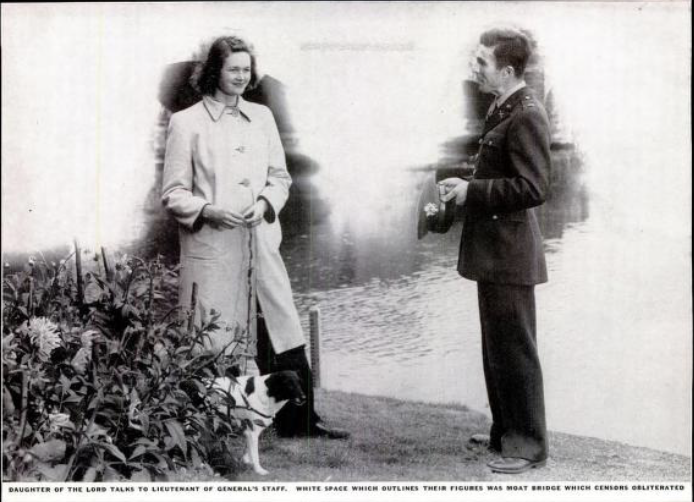
Wartime photography brought up many significant discussions about the credibility of visual media. It was often conflated with propaganda, accused of sending political messages and misinformation, and designed with the purpose to change people’s opinions about the war. This image is from the September 28th, 1942 edition of LIFE magazine. It portrays a young woman with her dog conversing with a man in uniform. They stand at the edge of a body of water, although the majority of the background has been blotted out. The caption reads, “Daughter of the lord talks to lieutenant to the general. White space which outlines the figures was [a] moat bridge which censors obliterated.” By viewing a censored photograph through the lens of an American magazine during WWII, the image comments directly on how the censorship of media can be a form of oppressive surveillance, although in other cases, it can be seen as liberation. It also sheds light on how the manipulation of a physical photograph can change how the final product is perceived. 1
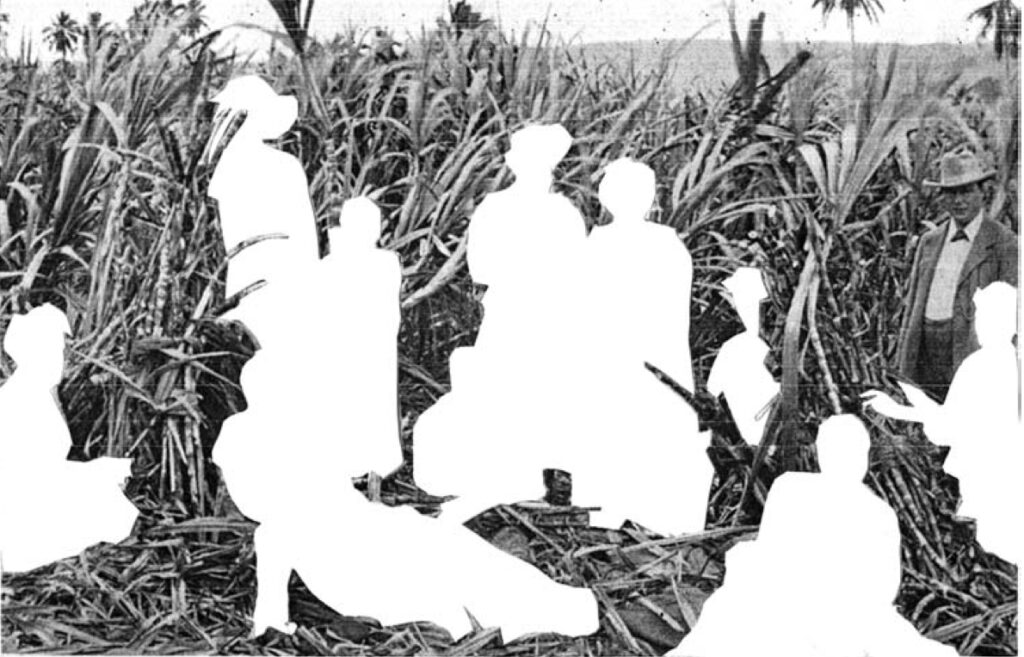
The censorship of photography and other forms of media is viewed in this case as offensive and unnecessary. The article description states that “family portraits, leaded windows, [and] the castle moat” were all deleted by British censors so that no one would be able to tell the exact location that American officials were residing in. While the American writer somewhat agreed with these precautions against German citizens, they were outraged that the British were hiding information from their allies as well since the obvious redaction compromises the objectivity and indisputable truth of the image. The harsh diction used in the caption and article description reveals such ire, with the writer emphasizing that the censors “obliterated” details. The first line imbues an accusatory tone as it states: “The pictures on these pages show to what lengths censorship can be carried.” Additionally, the writer makes sure to highlight the fact that these pictures “are exactly as they came from the office of the censor,” pointing out that while the British might not be trustworthy with their allies, the Americans are still honest. The white-washed background seems to give the image a more clandestine aura, even though the actual events are quite innocent, adding to the feeling of stifling regulation due to censorship at the time. However, such censorship in photography can also be viewed from a more liberatory light. Photographer Andrea Chung analyzes photos taken by the American company, Duperly and Son, of post-emancipation Jamaica when white people were attempting to ‘tame’ the native population to increase tourism. The resulting postcard images portrayed workers in staged, carefree poses, although many still maintained blank or confused expressions. In Chung’s edits, the figures of slave workers are purposefully cut out to allow them the privacy and freedom of not being looked at. Chung recognizes the unwilling and unnatural appearance of the workers as they pose for the photographer and chooses to remove them entirely, liberating them from the oppressive gaze of others. She leaves the figure of the white supervisor intact to bring “into further focus the surveilling role of the photographer in the spaces of black labor during the period” (Thompson 64). For LIFE magazine, the photographer was denied complete access to the subjects of their photographs and felt that this form of oppressive surveillance was perpetrated against them. In Chung’s opinion, the black workers had the right “to escape the confines, the spatiotemporality, of the photograph” because the photographer was too invasive and exploitative with the eye of their unwavering lens (Thompson 64). 2
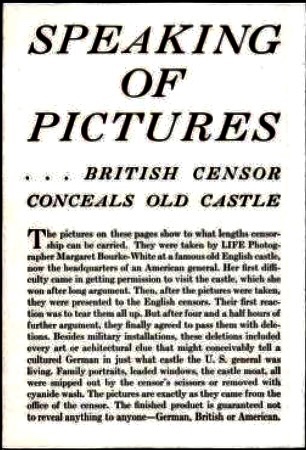
Text reads: “The pictures on these pages show to what lengths censorship can be carried. They were taken by LIFE Photographer Margaret Bourke-White at a famous old English castle, now the headquarters of an American general. Her first difficulty came in getting permission to visit the castle, which she won after a long argument. Then, after the pictures were taken, they were presented to the English censors. Their first reaction was to tear them all up. But after four and a half hours of further argument, they finally agreed to pass them with deletions. Besides military installations, these deletions included every art or architectural clue that might conceivably tell a cultured German in just what castle the U.S. general was living. Family portraits, leaded windows, the castle moat, all were snipped out by the censors scissors or removed with cyanide wash. The pictures are exactly as they came from the office of the censor. The finished product is guaranteed not to reveal anything to anyone-German, British or American.”
The historical context for the LIFE magazine photograph is impactful to its reception by the public because it was taken in 1942 during World War II. The war had many effects on visual media because of accusations about propaganda and hidden political messages within the images. Paranoia and suspicion from the war transform a seemingly mundane photograph of a British woman chatting with an American lieutenant into something that the British are potentially trying to keep secret from their allies. The use of cyanide wash to irreparably damage the original photograph adds to the suspicion and outrage even more, demonstrating that the physical alteration of a photograph immensely changes how the final product is perceived by viewers. This notion holds true even before photography was officially invented because the exact chemical process used to create a physical image changed how others accepted the product as its own invention. For example, one of the most famously known pioneers of photography, Louis-Jacques-Mande Daguerre, created the daguerreotype in 1838, which he called “‘the spontaneous reproduction of the images of nature received in the camera obscura, not with their colors, but with very fine gradation of tones’” (Batchen 34-35). However, this invention faced suspicion in its originality since a colleague of Daguerre’s, Nicèphore Nièpce, had previously invented a similar product under a different name and chemical process. Nièpce, “having in 1816 made some early attempts with paper soaked in silver chloride…concentrated his later efforts on making heliographs, as he called them, using pewter plates coated with a light-sensitive bitumen solution” (Batchen 33). Many other scientists came forward at this time as well, each with a slightly different process being used to create an overall similar product, which aroused doubt in the public’s eye about the product as a whole. Therefore, transparency in how an image is created and what forms of manipulation are used prior to its final product significantly impact the audience’s acceptance and trust in the photograph that is presented to them. Similarly, the tense atmosphere of WWII and the presence of physical deletions altered the perspective of the world when viewing visual media, especially when such photographs seemed to be deliberately hiding valuable information. 3
According to the common saying that ‘a picture is worth a thousand words,’ visual media seems to be an important and invaluable source of information. However, when analyzing visual and contextual evidence, this claim quickly falls apart. The physical manipulation of an image, although at times useful for one’s liberation from the camera’s eye, can completely skew how the public perceives the originality and veracity of visual media. Additionally, the presence of any form of censorship, especially within a tense political and social atmosphere, immediately instills suspicion and offense among viewers. The featured image from LIFE magazine is a perfect example of these concepts as the appearance of censorship in the photo at the height of WWII converts an innocent conversation between allied citizens into a secretive meeting. Furthermore, the physical alteration of the photograph reinforces the extent to which censorship can be taken, changing the public perception of the image into one of outrage and indignation. This affects the objectivity of the photo because it has been modified to reflect the opinions of British censors and what they deem important for outside countries to know.
- LIFE Magazine. September 28th, 1942. ↩︎
- Thompson, Krista. “The Evidence of Things Not Photographed: Slavery and Historical Memory in the British West Indies.” Representations (Berkeley, Calif.), vol. 113, no. 1, 2011, pp. 39–71. ↩︎
- Batchen, Geoffrey. “Conception.” Burning with Desire: The Conception of Photography, 1999, pp. 24–53. ↩︎

Leave a Reply