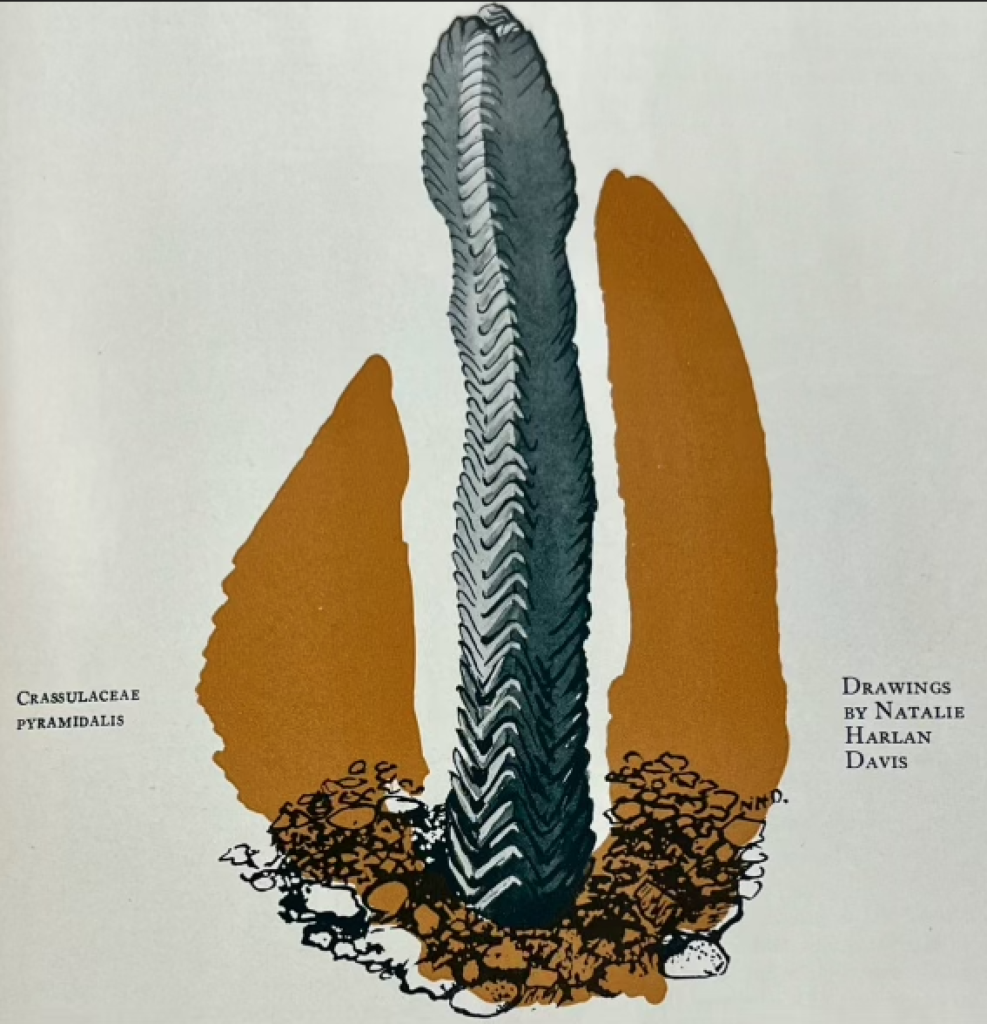
This South African plant is drawn so it is both stylized and realistic. Being in an article for the Natural History magazine, this image served the dual purpose of being an advertisement and being informative. The image is composed of only four colors which gives the image an aesthetic similar to to advertisements. While the artist has made some artistic choices, such as the orange shadow surrounding the drawing, the succulent remains representative of its species. The use of shadows and light gives the plant texture and added detail that is not found elsewhere in the piece. In this way, the image shows evidence of scientific illustrations and advertisements, much like the Natural History magazine.
Being in a magazine, this image was meant to be displayed alongside the text, so the words that accompany this image cannot be discounted when examining the illustration. This particular image is the first in the article “Your Indoor Desert” Garden from the magazine Natural History. The article contains images drawn in a similar style of various plants and succulents from South Africa described to have “curious forms” and are easy to cultivate. The bright colors used to illustrate the succulent further invoke excitement and exoticism. This magazine is reminiscent of atlases, and the ability to travel the world from the comfort of one’s own home. Bringing one of these exotic and “curious” plants into your home would be a way to experience part of South Africa without the travel involved.
Natural History frequently used exotic aesthetics in advertisements and articles to promote their image of adventure. In a different example, two elephants Carl II and Rosie were used to promote the same sense of adventure for a resort in Florida. Carl and Rosie were gifted to a Florida resort where they had many different roles including entertainment, labor, as well as advertising. To make Florida a more enticing tourist location and investment opportunity, landowners built structures with exotic architecture and imported tropical plants according to an essay by Anna Andrzejewski. Andrzejewski continues to explain the value of the elephants as the owner of the elephants and the resort wrote to a friend, “I am going to get a million dollars’ worth of advertising out of this elephant”. These elephants were used to promote an image of an exotic, adventurous, yet safe Florida. During the mid 1900s, when “Your Indoor Desert Garden” was printed, similar advertisements for exotic landscapes were playing out in Florida. Florida was becoming a tropical tourist location conveniently close to the United States and had exotic plants and animals that tourists would associate with adventure without having to travel outside of the country. There are many similarities between the image of the succulent and the tourism advertisements for Florida during the 1950s. Both used bright colors and line art styles that could be easily reproduced. The more expensive homes in Florida boasted exotic tropical landscaping with air conditioners inside. This creates a comfortable, familiar space within the home while still having that exotic aspect of adventure that drew people to Florida in the first place. Much like owning this plant, these Floridian houses provided the opportunity to have an exotic experience without leaving one’s comfort zone. The drawing and article “Your Indoor Desert Garden” advertises the plant as being exotic, unique, and most importantly easy to care for.
The use of drawing to document specimens has been widely used throughout history. One of the challenges these artists faced when documenting these species was creating an image that was as close to true to nature as possible. Without a camera, drawings and paintings were one of the most reliable ways to capture and transport information about species Europeans encountered. This image of the succulent has many characteristics from these scientific illustrations, even with how stylized it is. The background of the image is very simple with very little environment surrounding the specimen and it is labeled with its scientific name Crassulaceae Pyramidalis as opposed to a more common name for the plant. Natural History illustrations often focus almost entirely on the subject to make an objective image that could take the place of the specimen in a museum. Baltasar Jaime Martínez Compañón y Bujanda created paper museums made of illustrations of different plants, animals, and objects from Peru according to Trever and Pillsbury in their chapter ‘Martínez Compañón and His Illustrated ‘Museum’” in the book Collecting Across Cultures. These illustrations were used as part of a museum to show Europeans what Peru was like. In this way, these illustrations were used to share what a place was like without having to travel there much like the desert plants highlighted in “Your Indoor Desert Garden”.
These characteristics the succulent image shares with scientific illustrations highlight the natural history emphasis of this magazine. The magazine, Natural History has articles about science and history, yet most of the advertisements were for hotels, cruises, and other traveling services across the world. The images of the succulent capture the intersections between these ideas, advertising an exotic object of curiosity in one’s home. Much like the magazine Natural History itself which brings the museum and the faraway places in time and space to your doorstep. This image of a succulent which combines scientific and advertisement aesthetics sells the same lifestyle as the Natural History magazine, one of a knowledgeable, worldly person without the travel involved. Much like the opportunities provided by traveling to Florida, where one can escape and experience a new, different landscape without leaving the United States. The succulent represents a worldliness aesthetic that is not necessarily accessible to subscribers of Natural History.
Works Cited
Andrzejewski, Anna. Work, Play, and Elephants in South Florida’s Leisure Landscape. 27 April 2023. Edge Effects, Edge Effects, https://edgeeffects.net/miami-beach-elephants/.
Davis, Natalie. Your Indoor Desert Garden. Crassulaceae Pyramidalis. Natural History, vol. 40, no. 3, 1937. Drawing.
Trever, Lisa, and Joanne Pillsbury. “Martínez Compañón and His Illustrated ‘Museum.’”
Collecting Across Cultures: Material Exchanges in the Early Modern Atlantic World, edited by Daniela Bleichmar and Peter C. Mancall, University of Pennsylvania Press, 2011, pp. 236–53.

Leave a Reply