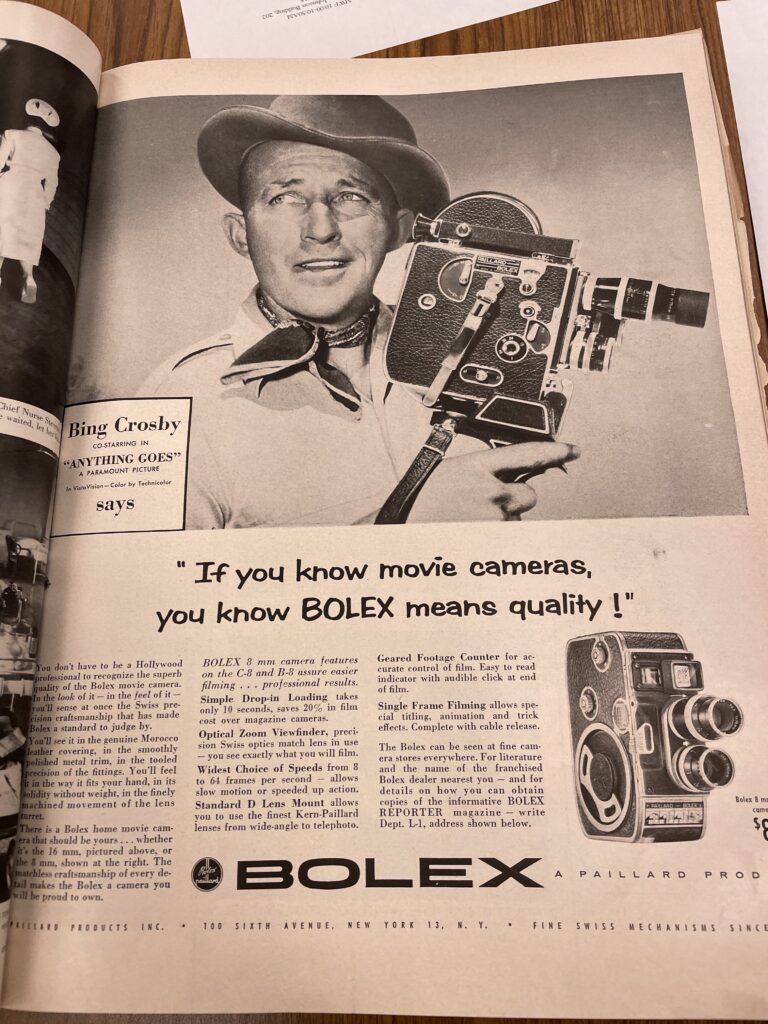
The mid-20th century marks a turning point in American culture and the collective psyche, ushering in an age of technology, consumerism, and a heightened sense of American idealism. Following World War II, in which life was characterized by material conservation and the ever-present fear of active wartime, the postwar period became an utter counter to the sparsity of the past decade and with the exponential rise of the American middle class, the collective society latched onto a newfound life of affluence and leisure––manifested through new technology, expansive land developments, the rising jet age, and the reinstatement of mass media through television and Hollywood. Despite a supposed push for individualism, too, this period was founded in a deeply-rooted set of propagated norms that governed the majority of society through a de facto set of rules; creating the idealistic image of the suburban, middle-class, heteronormative nuclear family that we all continue to associate with the 1950s and 60s today. The subject of my analysis here is, at its surface, an advertisement for the new Bolex movie camera found in a May 1956 issue of LIFE Magazine that uses the image of Bing Crosby to market the device, but looking deeper, we come to see this advertisement as an example of a long (and still standing) trend of how visual media and especially commercial-use imagery informs and reflects mass culture and dominant society.
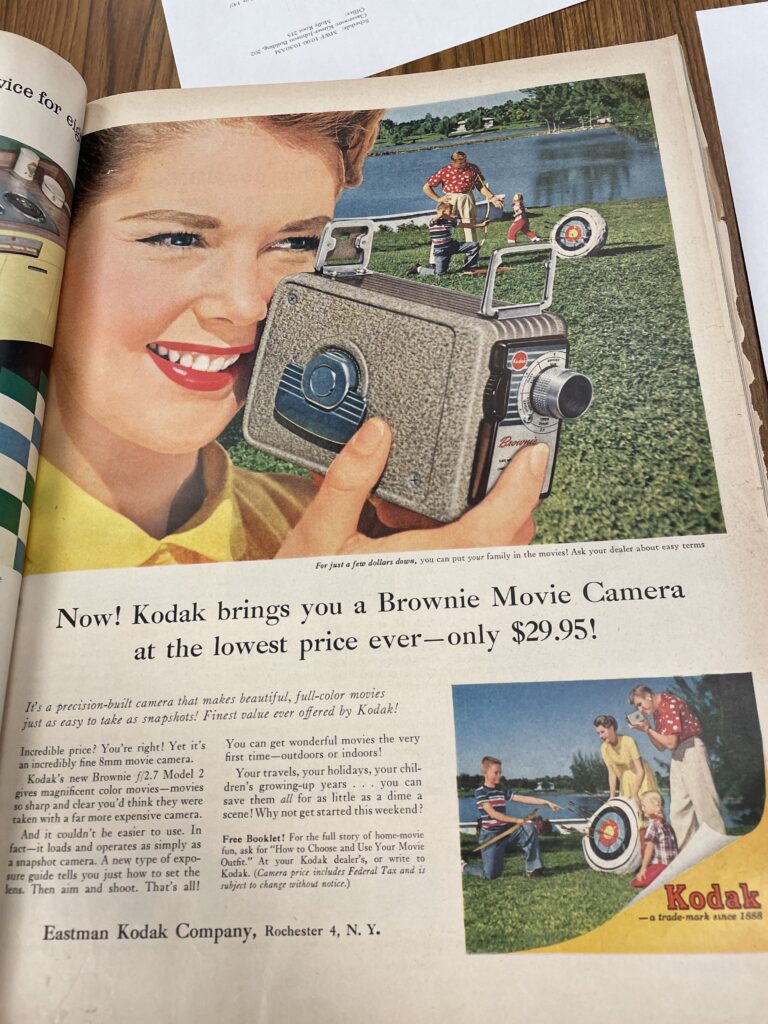
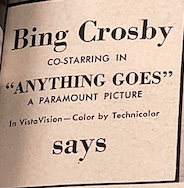
LIFE during this postwar period was a publication geared toward the expansive white middle-class, using an overarching visual aesthetic of bright colors and attention-grabbing imagery coupled with consumerist advertisements and topical articles in order to cater to and perpetuate the notion of the nuclear household and the domestic life. While the Bolex advertisement does not have the same bright color palette as similar ads (fig 2), it instead achieves reader––and therefore consumer––attraction through the star power of Bing Crosby, his most recent film Anything Goes (released April 1956), and Paramount Pictures (fig 3). In doing so, this image becomes a mutually beneficial, two-for-one advertisement for the camera and the film experience, drawing a connection between the material product and the star-studded world of Hollywood, and ultimately in many ways feeding fantasy; as if to say ‘you, too, can be one of the greats… beginning by buying this Bolex camera.’
In her book Jet Age Aesthetic: Glamour of Media in Motion, Vanessa R. Schwartz dedicates a chapter to examining the role of Disneyland as a cultural phenomenon but, more importantly perhaps, as a physically interactive space that intermingles audience and media. She focuses particularly on the rise of technology––a piece in the wider ‘Jet Age’ era––intermingling leisure and entertainment with gadgets and expanded knowledge, borrowing the phrase “infotainment” as representative of this intersection of advanced technology and the middle-class masses (Schwartz 11). While her focus remains on Disneyland and the more interactive nature of the park, though, there is an underlying yet explicit presence of Hollywood in making Disneyland possible and more widely creating a collective environment in which celebrity, entertainment, and media govern mainstream culture and influence everyday life.
Returning to the Bolex ad at the center of this analysis, then, this same ideology that Schwartz introduces to Disneyland can be carried over in many ways––both Disneyland and the ad arising out of and in response to the world of ‘infotainment,’ intertwining popular media, new technologies, and hands-on experiences. Moreover, Shwartz examines how Disney, Disneyland, and the Disneyland Television Show generated subtle yet influential propaganda for white, Christian, middle-class, heterosexual life (11). While the Bolex ad is not as explicitly promoting these aspects, too, its contextualization within LIFE places the image as one aspect of a greater collage of the mass-American lifestyle, as idolized and perpetuated by Hollywood.
Looking now at Lynn Spigel’s introduction to her book TV Snapshots: An Archive of Everyday Life, we move closer to the content of the Bolex ad itself as one of many camera ads (fig 2), pointing to the increasing accessibility of photography and, as a result, the quickly spreading practice of amateur snapshot photography over the previously exclusive, dominant artistic and photojournalistic photography (10-11). The basis of her particular book is on a trend of domestic snapshots that used the television set as a backdrop for informal family photos, creating a new, relaxed version of photography or “snapping” photos, while also showing off the family’s middle-class status through their ownership of a TV and––unseen but of course implied––a camera; the combination of such she labels as “companion technologies” (Spigel 6). The Bolex advertisement carries great similarities with Spigel’s writings, down to the notion of the ‘companion technologies,’ but namely under the umbrella of multiple forms of media intersecting and coming to a head in a space dominated by the middle-class and the domestic sphere, such as LIFE Magazine. While Spigel’s snapshots are taken on a camera within the home, backed by the television set, the Bolex ad fronts the camera as the device on sale, Bing Crosby’s presence stands in for the world of television and film entertainment, and LIFE serves as a representation of the living spaces in which Spigel’s snapshots were taken.
While Spigel does claim the valuable idea that the accessibility of cameras is not merely accessibility by one gender, race, sexuality, or class, but allows for more diverse stories to be told, there still remains a stark difference in the applications of the product itself compared to its advertisement (8). Reiterating once more, then, while the Bolex ad and the presence of Bing Crosby are not as forwardly family-oriented and domestic––arguably the presence of a celebrity removes the image from the home in a way––the advertisement perpetuates the mass culture and the family circle all the more through the contextualization if LIFE Magazine as a whole and the utilization of Bing Crosby and his star power as a means to draw together the domestic and the Hollywood, creating one intermingled fantasy of leisure, technology, and idols––the eye of the postwar mass-cultural storm.
The Bolex image is situated firmly within the postwar movement in terms of its precise content, context, and approach to consumers––that much is true. However, zooming out into our present day, we know that celebrity and advertisement remain intrinsically intertwined and, as such, the culture of mass media, Hollywood idolization, and consumerism are not far removed at all between the 1950s and today. Ultimately, while the products, publication methods, and stars themselves vary, we are still in many ways entrenched––perhaps even trapped––in this cycle of technology, goods, and fantasy that keeps Americans constantly buying, consuming, and creating.

Leave a Reply