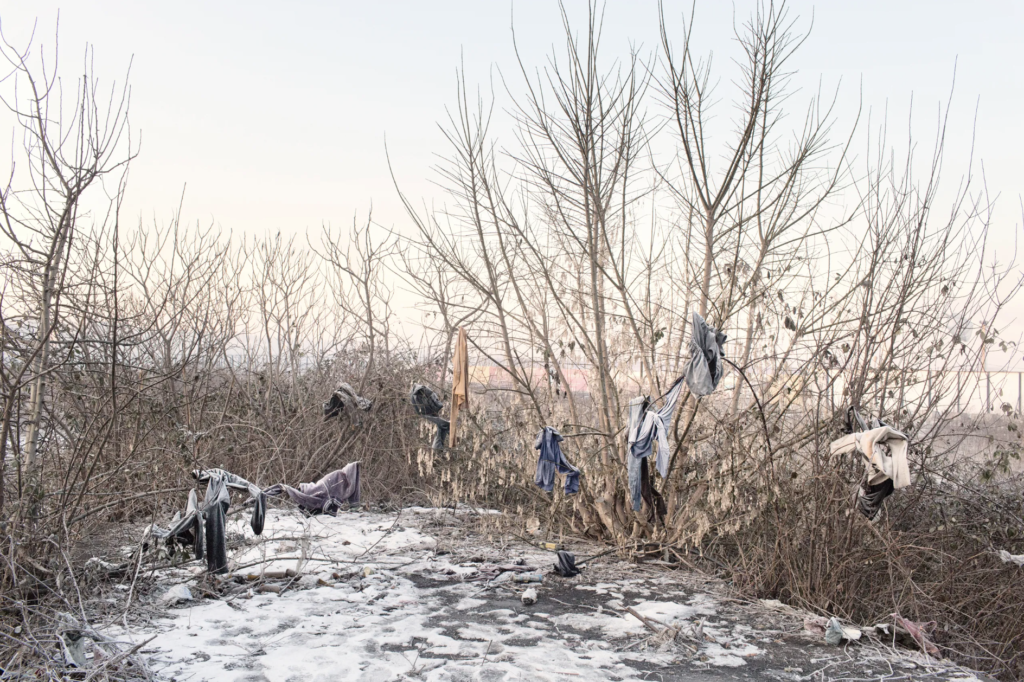
The image above was taken by Alessandro Penso on January 15th, 2017 in Belgrade, Serbia. Later to be published in Time Magazine, it is accompanied by a small paragraph of text explaining both the context and history. The image depicts frozen clothes left by migrants and refugees behind the city’s main train station. The text states: “After borders tightened along the Balkan route to Western Europe, more than 1,000 men and boys have lived in Limbo amid dire conditions in a crumbling warehouse complex. Relying on supplies from aid groups, they shower outdoors and build fires inside to stay warm.” For context, in the early 2010s, thousands of families fled Serbia in search of refuge. Serbia has been a transit country for migrants and refugees attempting to reach Western Europe. And In 2017, some individuals may have been passing through Serbia on their journey, fleeing conflict, persecution, or the challenging conditions in their countries of origin. Drawing from writers like Benjamin, Bair, and Berger, this blog will take a deep dive into how and why photography is used to portray feelings and emotions that cannot be written or spoken.
This image, along with the text that accompanies it, made me think back to our readings. Specifically, Walter Benjamin’s fascination with the “aura” of a photograph. Initially, he tries to define what an aura actually is, stating: “What is aura? A peculiar web of space and time: the unique manifestation of a distance, however near it may be. — Today, people have as passionate an inclination to bring things close to themselves or even more to the masses” (Benjamin, 20). While looking at the photo above, the image radiates an aura just like the one Benjamin mentions. It has a weight to it that can almost be felt through the screen, it encourages the viewer to put themselves in the shoes of the migrants and refugees, sharing their pain with them in a way that feels unparalleled compared to other works. The frozen clothes hanging on the leafless branches signifies a hopelessness and cruelty. It is almost as though the people didn’t just leave their clothes, they left a part of themselves. This feeling is also reinforced by the surrounding area and setting of the image. The sky is bleak and empty, completely devoid of emotion or color. While the snow on the ground makes the coldness and bitterness of the image stand out even more. There are no people in the image to add context, there are no faces that add more clues as to how they are feeling in this point in time. But still, the picture speaks a thousand words due to the aura and feelings it radiates. Circling back to Walter Benjamin’s ideas about bringing things closer to the masses, a lot can be said about what or who Penso was trying to reach. This photo was published in Time Magazine, an outlet that gets millions of viewers and audiences each day. By placing this image inside the article, he is trying to connect with the outside world and communicate feelings that maybe people have never felt before. The image is also taken from a human’s eye-level perspective, making the audience feel as though they themselves are in the environment. The barren landscape and trees completely engulf the image, making it feel as though the audience is surrounded. It challenges the viewer to feel what they are feeling. Even though this image does reflect some pretty heavy and sad feelings, I do believe there is a silver lining. The hanging clothes could represent the migrants unwillingness to give up. Everywhere they go, they leave traces of themselves, forcing people to take a step back and see their place in the world.
Not only can Benjamin’s themes of the aura be related to this image, but also to those of Nadya Bair when speaking on “Concerned Photography.” “Concerned Photography” is a term that originated in the mid-20th century to describe a form of documentary photography that goes beyond capturing aesthetically pleasing or “cool” images. Instead, it is driven by a commitment to social and political change. Photographers associated with this movement use their work to draw attention to pressing social issues, advocating for reform or raising awareness. When looking at the photo above, one can see the connection to the topic of Concerned Photography. Penso is not taking this photo to gain fame, he is not taking it because it simply “looks good,” he took it to expose the grim things that are currently happening in our world today. And by doing so, it can indirectly help the people in need by telling their story for them. This directly draws off themes and messages by Nadya Bair, who exclaimed in one of her articles: “until that point, “documentary” photography in the United States was mostly associated with the government-sponsored, socially engaged pictures of the 1930s and 1940s, referring to the work of Farm Security Administration (FSA) photographers. MoMA’s newcomers, by contrast, “redirected the technique and aesthetic of documentary photography to more personal ends” (Bair, 75). This quote argues that at some point in time, photographers and viewers wanted more than just photos with that looked aesthetically pleasing, they wanted something that they truly felt and experienced. Drawing this back to Penso’s photo, it is clear that it was taken to highlight the emotions present in the picture, thus drawing attention to such a dire situation.
Finally, this photo can also be connected to the ideas of John Berger, who argued: “Images were first made to represent something that was not there, and later acquired an extra level of meaning by lasting longer than the original subject” (Berger, 2). The quote can be connected to Penso’s photo in the way that it challenges the audience to think about the things not shown. By not directly showing the migrants and refugees, he makes the viewer ask questions that would not typically be talked about. Questions like “Did they make it to their destination?” “How many refugees are there?” and “Are they safe now?” These questions directly reflect Bergers idea above and ask the viewer to dig deeper into the situation. Overall, this was a deliberate choice that challenged the preconceived notions of what photography is supposed to mean and how we can use it to our advantage to see the things that are not revealed to the eye.
Taking all of this into consideration, Alessandro Penso’s poignant photograph captured in Belgrade, Serbia, transcends the visual realm, invoking a powerful aura and feeling that resonates with the themes explored by Walter Benjamin, Nadya Bair, and John Berger. The frozen clothes left by migrants and refugees become a symbolic representation of both despair and resilience. Penso’s deliberate choice to omit direct portrayals of individuals challenges the viewer to confront the unseen realities, while also raising thought-provoking questions about the fate of those who passed through this desolate landscape. Penso employs the language of photography to communicate a narrative that breaks down borders, urging viewers to reflect, empathize, and engage in conversations about the shared humanity that binds us all.
WORKS CITED
Bair, N. (2022). The International Origins of “Concerned Photography.” American Art, 36(2), 74–101. https://doi.org/10.1086/720917
Benjamin, W. (1972). A short history of photography. Screen, 13(1), 5–26. https://doi.org/10.1093/screen/13.1.5
https://booksite.elsevier.com/samplechapters/9780240516523/9780240516523.PDF

Leave a Reply