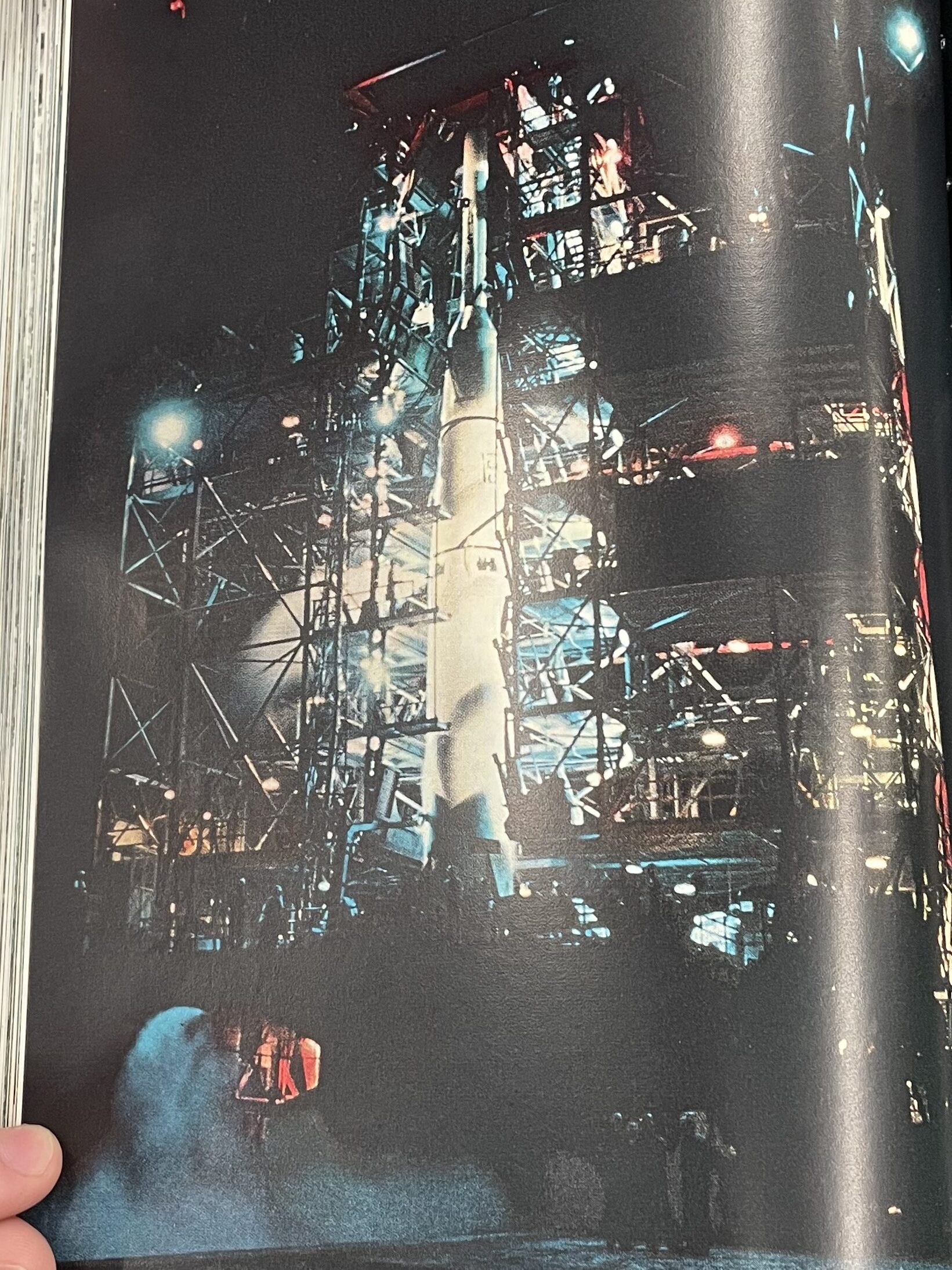
Pioneer, National Geographic Volume 115, 1959
The Pioneer spacecraft is photographed to lionize NASA and give it broad public appeal. Printed in 1959, Luis Marden’s photo attests to the spectacular allure of NASA with many bright lights and powerful scaffolding. The darkness surrounding the Pioneer works to push the viewers focus away from Earth and towards the rocket which is on track for the Moon. This photo in National Geographic works to document and advertise the human nature that is to innovate and explore. It could be classified as both government propaganda and a study of nature. At this point in time, NASA has yet to put a spacecraft on the Moon due to multiple projects failing in space and keeping the public in support of their goals is crucial for receiving funding from taxpayers. The Pioneer, as it glows in the vast darkness preparing to jet off, acts as a symbol of hope that can transport the U.S. ahead of its competitors. The U.S. government during the Cold War worked hard to plant anti-communist sentiment in its citizens. Marden helps to maintain a positive public image of space innovation by picturing the Pioneer as a beacon of the U.S.’s growing strength.
The 1950’s were the start of a period of rapid innovation with a large focus on transportation. This period is called the jet age. Photos like that of the Pioneer build on the American value of movement. NASA intended to harness the country’s interest in transportation to get support for space exploration. The jet age is the period of time when jet travel became accessible to much of America, building a culture of movement. Disneyland helped to define the jet age through its emphasis on transportation and focus on constant progress. Vanessa Schwartz states that Disneyland, as a result of the jet age, “aestheticized kinesis and transport itself”(9). Starting in the 1950’s, sleek design and convenience formed the basis for the American identity. The new form of transportation, jets, gave people a new respect for innovation as they felt their lives grow easier with vacations and business becoming more accessible. “Transport defined the space in every land from the moment of arrival”(10). The impact of new forms of transportation cannot be understated. America’s principle of speed and accessibility since the jet age has allowed for steady growth has helped many of its citizens enjoy lives of luxury. The 1959 Pioneer was another product of the jet age that had the opportunity to be accepted as a leading innovation to help America blossom as a dominant trailblazer. It just needed to be shown in the right light; Marden carefully waited until night to photograph the Pioneer so that it would shine brightly and the excess gas from the oxygen tanks would emanate from the rocket and create an luminescent aura around it. This, along with the very angular scaffolding, combined to show the beauty and intricacy of everything that went into creating the vehicle. Marden wanted to help show that a spacecraft like the Pioneer was not only a product of the jet age; he wanted to help the Pioneer define its time by giving it a platform to showcase its dynamism.
The blinding lights aimed at the Pioneer entrap it, giving the audience a clear view inside the cage of scaffolding. A panopticon is a prison that allows one guard to observe many prisoners by using lights pointed in the cells to ensure that the prisoners do not know when they are being watched. This type of prison was proved by Michel Foucault to strip the prisoners of their right to privacy and give their observer ultimate power over them. Foucalt describes the Panopticon as the “diagram of a mechanism of power reduced to its ideal form”(99). This means that we apply Foucault’s idea of the Panopticon to define power relations that we encounter. The ability to see is a powerful tool that can be used to imprison others: “Power has its principle not so much in a person as in a certain concerted distribution of bodies, surfaces, lights, and gazes”(98). In Marden’s photo, the powerful lights remind the audience of the panoptical relationship they have with the Pioneer. The reader is in the powerful position to see and judge the Pioneer while staying completely anonymous. Previous Pioneers have failed just after takeoff so ensuring the public doesn’t believe their tax dollars are being wasted is of utmost importance. The support of the audience is crucial given how important the American people’s opinion on the space race is for the future of NASA. By leading the audience’s eyes up from earth’s surface and towards space with the vertical path he captured with light, Marden hopes to implant the goal of space exploration in the audience. If the audience’s powerful support can be harnessed long enough for NASA to succeed in getting their craft in space, the Panoptical power can then be transferred to the Pioneer. Once in space, it can be the anonymous observer who can monitor all of earth’s people free from being seen. Because NASA standed to benefit so much from a successful mission, garnering support from the public was a top priority. Marden paints NASA in a hopeful light so that the audience will use its power to support the space race.
Despite being showcased in a National Geographic, this photo can be seen as an advertisement for NASA. ‘Ads’ like these were prevalent during this time and they gave America the support it needed to win the space race. Foucault’s model of the Panopticon helps us understand why subtle advertisements like these can be successful. Empowering the audience without explicitly pulling them in a certain trajectory can allow their subconscious to gravitate towards the underlying motive of the image. This is why undisclosed advertisements on social media are illegal. Giving someone panoptical power but then harnessing it for yourself is extremely effective. With this in mind, Marden empowered NASA to succeed in the space race by using the current U.S. ideals to picture the Pioneer as a symbol the American people could rally behind.
Sources
Michel Foucault, From Discipline and Punish (1977)
Vanessa R. Schwartz, Jet Age Aesthetic: The Glamour of Media in Motion (2020)

Leave a Reply