By Katie Hansen
Aging is not a new fear. In fact, people have been attempting to understand and, more specifically, prevent the process of aging for a long time. The Scientist, a news journal for the “life scientist,” dedicated an entire spread to the current research being done at the time on aging. The journal was published on February 5, 2001. While this journal is over twenty years old, the perspective on aging seen in the pictures and text are not aging themselves. The information that can be gleaned from studying this piece mirrors that of current themes of science and aging in current society. I argue that the fear of aging is truly a fear of our lack of objectivity and immorality and that is why people look to science, the “objective” and “permanent”, to save them from aging.
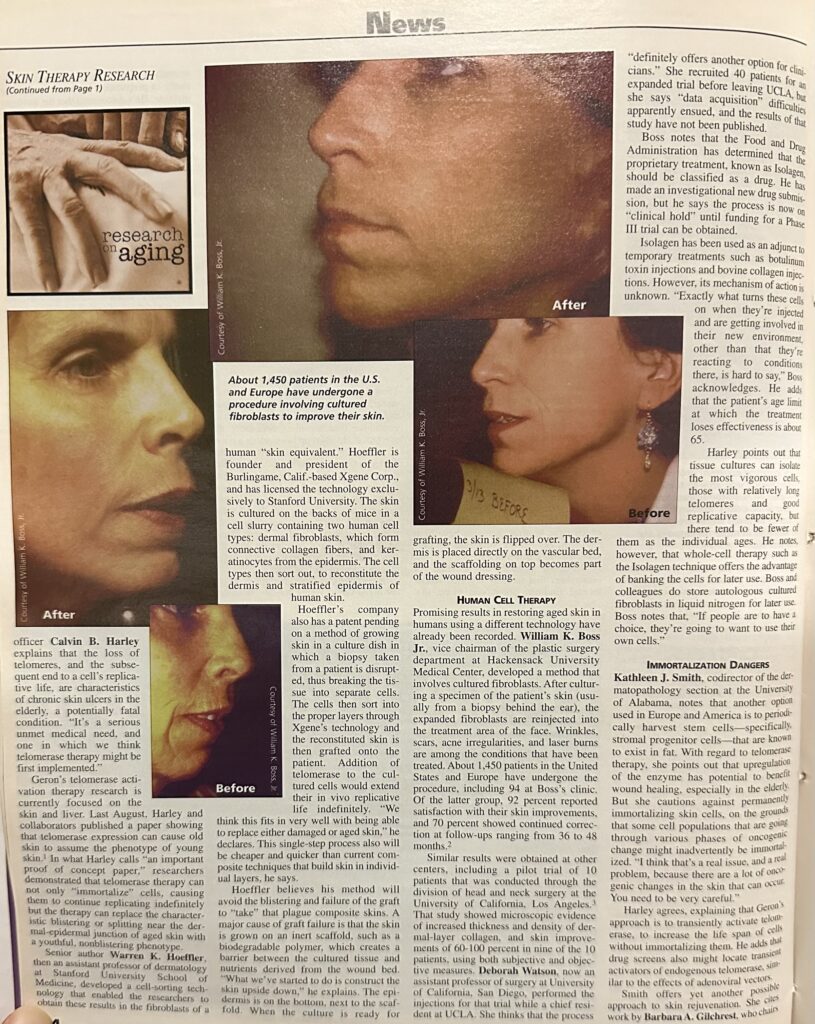
Science is society’s best attempt to be objective as scientists attempt to remove their individual perspectives through the process of repeated experiments and strict regulation of how to conduct scientific experiments. Datson and Galison, who explain the construction of the meaning of objectivity in their book Objectivity, define objectivity as “blind sight, seeing without inference, interpretation, or intelligence” (17). That being said, science is a very human and therefore non objective process. While the data that experiments produce may be objective, the experiments scientists choose to conduct and their interpretations of data are all done from an individual human perspective. This is why the findings and “truths” of science are constantly changing. However, science is regarded by society to be an objective, or unswayed, field of knowledge and study. Datson and Galison use atlases, early scientific books of nature, to show how the “objectivity” of science is relied upon by both the viewer and the producer. Atlases are “ the dictionaries of the sciences of the eye. For initiates and neophytes alike, the atlas trains the eye to pick out certain kinds of objects as exemplary” (22). The fact that the photos were presented in the atlases told people that the images were the ideal or true scientific example. The context of the photos primed people to accept the images in the atlases as objective. The viewer feels comfortable in not questioning the intentions of the author because of the “objectivity” of science and the author is able to introduce their perspective as unmediated “truth”. This same priming is occurring in The Scientist as it is also a scientific publication. The fact that the findings of the research on aging and human cell therapy are published in The Scientist is telling of two things. One, that the findings are regarded as objective by the scientific community; and two, people reading this publication will take the findings to be objective and true. The danger is that this perspective on aging is one that is being reinforced by the placement of the photos and the text surrounding them. The viewer feels comfortable in not questioning the intentions or perspective of the author because of the “objectivity” of science. Since science has an “objective” perspective, the findings of a process that reduces aging must work unlike other anti-aging processes that are sold by people who have a more flawed and individual perspective.
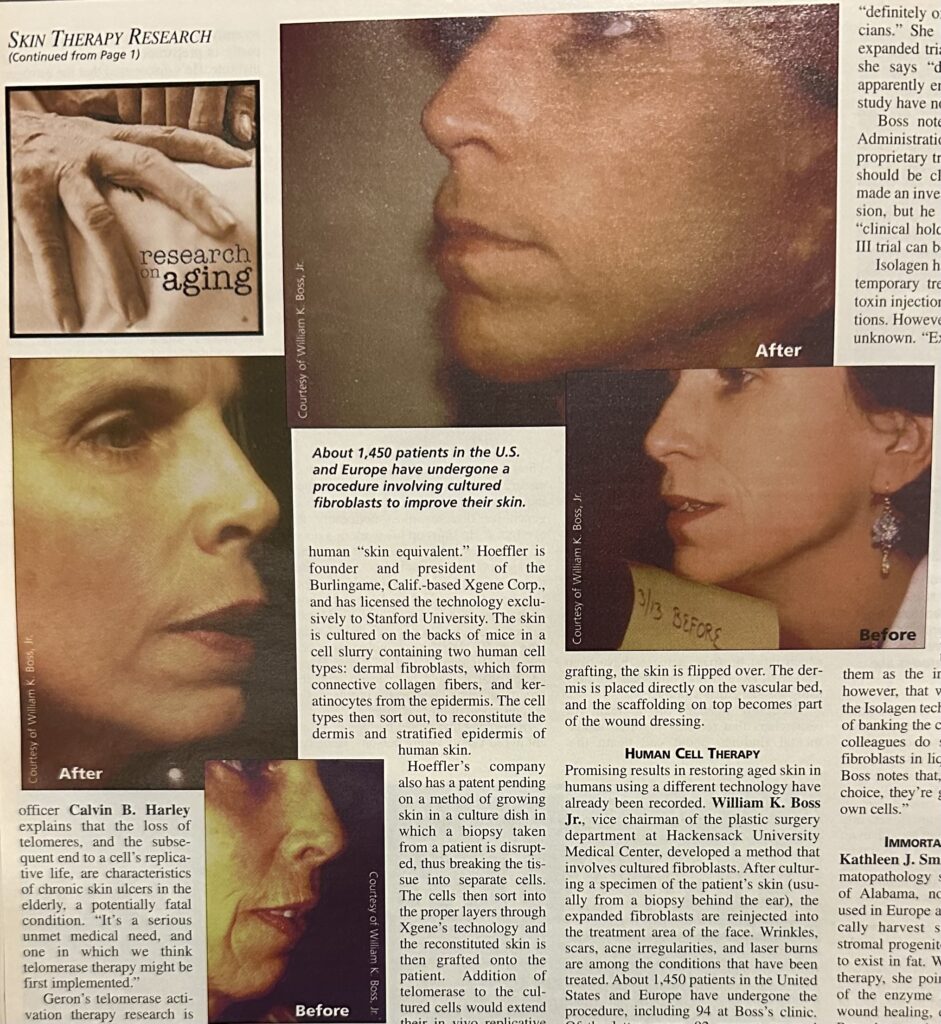
Four pictures show two women’s skin before and after having cultured fibroblasts introduced to improve their skin texture. Besides the fact that both pictures are both low quality in comparison to the photos that are taken today, the pictures are meant to show an objective difference between before the procedure and after. How is this attempt at objectivity demonstrated? Both pictures are taken of the profiles of the women. The viewer cannot see the women’s faces. Showing the profiles removes the individual from the focus of the photo and causes the viewer’s eye to focus more on the structure and features of the individual’s face. The photos are taken of the same side before and after so that the thing the viewer focuses on is the change in the skin texture. Using pictures to focus on and identify certain features has a long history that helps to explain why the photos are taken of the profiles of the individuals. Alphonse Bertillon, a Paris police official who created the first modern criminal identification process, took profile photos further. He made the capturing of the human side profile a science. He insisted on perfecting and standardizing the photography of criminals so that inconsistencies that detracted from the objective quality of criminal identification profiles were removed. Bertillon called for the standardizing of focal length, distance from which the photo was taken, and consistent lighting. By standardizing the photography process and focusing the camera on the profile, Bertillon succeeded in reducing the individual to their features. These features, Bertillon demonstrates, can be used as data in identification as the process allows people to quickly recognize differences in photos. He used a process called inscription which is “a transformation of the body’s signs into a text, a text that pared verbal description down to a denotative shorthand, which was then linked to a numerical series” (Sekula 360). The individual was ignored and turned into data for “objective” claims. The authors of this article in the journal encourage the reader to ignore the person and focus on the data. Here, the reader of The Scientist focuses solely on the change between the before and after photos because that is the most noticeable change between the images. This works to center the viewer on the results of the procedure, rather than to question whether the necessity of the procedure or whether the results are portrayed in an unmediated way. For example, the photos could be altered with or misconstrue the longevity of the results.
Aging can be scary because it is the process of change which reminds people that they are not perfect or in control. When the times constantly change, so do peoples’ perspectives on things. Looking back shows a different picture than when the picture was first taken. Knowing this makes it hard to just enjoy life because there is no “objective way” to experience life. People will have regrets and make mistakes. The fact everything changes is the only “truth” that one can count on. While The Scientist wants its readers to believe that aging is something that needs to be fixed, aging is not inherently bad. Just because aging is contrary to the ideals of science does not prove that aging is something to be feared. Not even science can stop time or give people the objectivity of a persistent and unchanging perspective. Science itself is subject to the changing perspective that time brings. People should choose their own perspective on aging because there is no “objective” truth.
Daston, Lorraine and Peter Galison, “Epistemologies of the Eye” in Objectivity, (New York: Zone Book, 2007), 11-53.
Russo, Eugene. “Forging a Palace For Research on Aging.” The Scientist, 5 Feb. 2001.
Sekula, Alan. “The Body and the Archive” in The Contest of Meaning: Critical Histories of Photography (Cambridge: MIT Press, 1989), 343–89

Leave a Reply