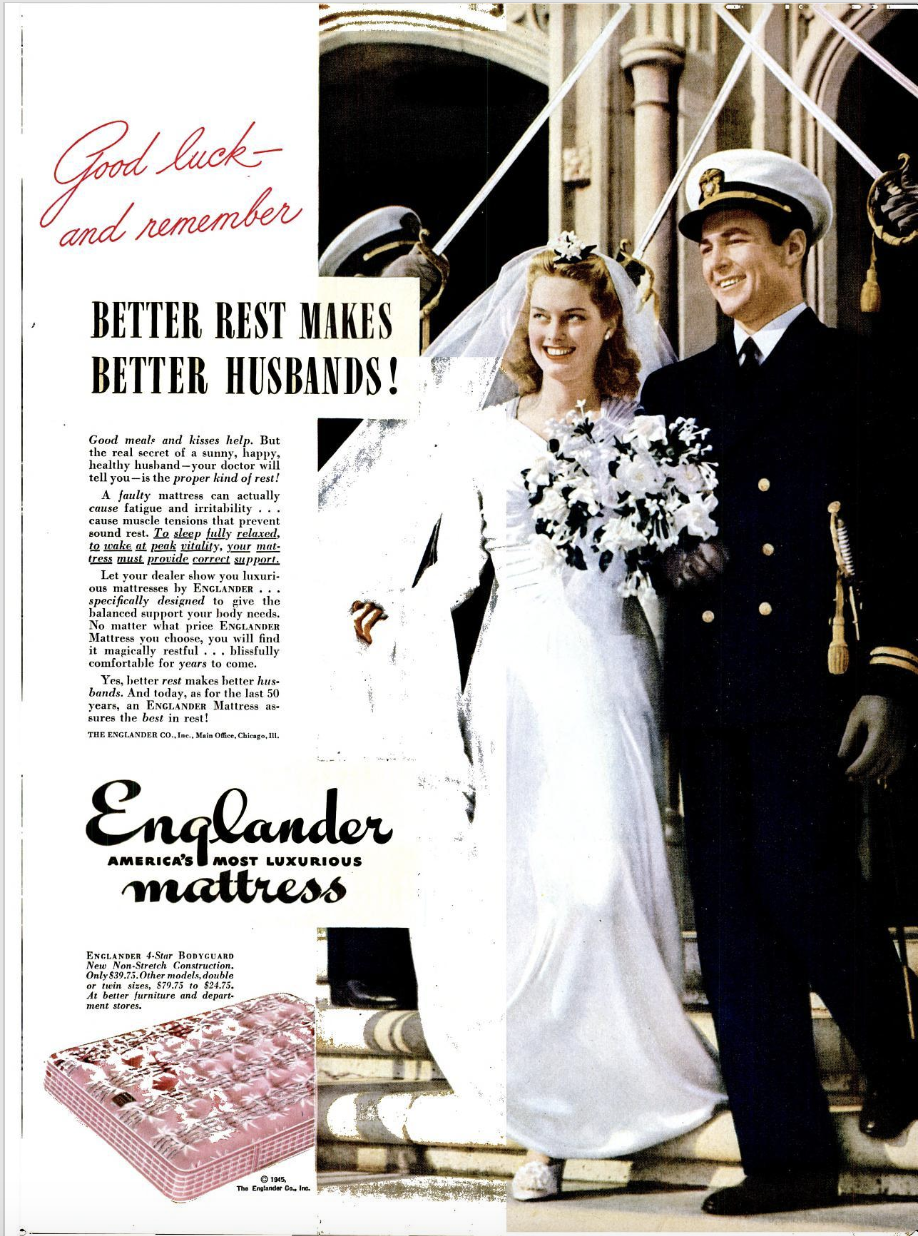
This visual piece is a mid-20th-century advertisement for the Englander Mattress, published in the summer of 1945 (June 2nd) by Time. It features a newlywed couple—the bride in a traditional white gown and veil, the groom in a navy uniform—poised at the top of a church's steps, radiating post-wedding bliss. This advertisement targets American consumers in the post-World War II era. This image not only promotes a product but also reflects and reinforces the social norms and gender roles of its time. The advertisement leverages the idealized vision of marital happiness to anchor the practical selling point of a mattress to broader cultural values of the period. The radiant smiles and direct gaze of the couple suggest contentment and a prosperous future, tying directly into the post-war American dream. The textual content, presented in a mix of bold and cursive fonts, emphasizes key phrases like "Good luck," "Better rest makes better husbands," and "America's most luxurious mattress," creating a hierarchy of information that guides the reader's attention. Color is also strategically used; the vibrant flowers and the crisp white of the bride's dress stand out against the groom's dark uniform and the subdued background, drawing the eye to the central figures. These elements collectively establish an overall tone of optimism and comfort, which is harmoniously aligned with the promise of the product. The Englander Mattress advertisement reflects gender and social norms from post-war America.

Andrzejewski’s “Work, Play, and Elephants in South Florida’s Leisure Landscape” article explores the complex roles that the elephants played within the social and economic development in Miami’s beach. The practice of employing animals for entertainment and work can be seen as a form of advertising to draw visitors. The use of elephants can be seen as reinforcing social roles and hierarchies, where the affluent (predominantly white) guests could enjoy leisure activities serviced by "exotic" animals and people of color, who were relegated to roles of service, whether it be entertainment or labor. Both the use of resort elephants and the mattress ad showcase a specific narrative that aligns with the marketing strategies of the time, where products or experiences were sold by tapping into societal values and aspirations. The elephants, Carl II and Rosie, in South Florida were the face of marketing that were directed to a “‘restricted’ or ‘selected’ clientele,” similar to the Englander which is marketing a similar privileged clientele which can be seen by the bride and the groom (Andrzejewski). There is a quote from Dalton and Galison’s Chapter one, “Epistemologies of the Eye,” in Objectivity which questions the authenticity (objectivity) of the advertisement:
“But almost all the atlas makers were united in the view that what the image represented, or ought to represent, was not the actual individual specimen before them but an idealized, perfected, or at least characteristic exemplar of a species or other natural kind. To this end, they carefully selected their models, watched their artists like hawks, and smoothed out anomalies and variations in order to produce what we shall call ‘reasoned images.’”
Dalton and Galison, 42
The advertisement is obviously a staged picture, which can be described as an “idealized, perfected” image curated by Englander Mattress. In the ad, the image of the newlywed couple is curated to represent an archetype of post-war domestic happiness rather than a candid snapshot of an individual couple's actual life. The representation is "smoothed out" to eliminate any imperfections or individual peculiarities that might detract from the ideal form the ad is trying to sell. Just as atlas makers selected and refined their images to depict a perfect exemplar of a species, so too does the advertisement present a perfected image of married life that consumers are meant to aspire to. The mattress in the ad is not merely a product but a conduit to a universally desirable outcome (in this case, a happy marriage), just as the atlas images are not mere depictions of individual specimens but icons of their entire species. The ad's image works to simplify and purify the concept of marital happiness, offering it up as a product of the right consumer choice—just as Daston and Galison's atlas makers offered up their images as products of scientific insight. It suggests that buying the right mattress is akin to acquiring a piece of this idealized life, playing on the consumer's desire not just for comfort but for the perfect domestic existence (marriage) that the mattress symbolizes.
The contextual analysis of this image reveals its attempt to sell not just a mattress, but a particular lifestyle—one of domestic bliss and the fulfillment of the American dream. By situating the product within the narrative of marriage, the advertisement speaks to the societal expectations of the time, where a woman's role was often defined by her success in the domestic sphere and a man's by his ability to provide. It also subtly hints at the post-war context where stability and comfort were highly prized after years of hardship and uncertainty. The assertion that "better rest makes better husbands" cleverly insinuates that the success of the marriage—and by extension, the husband's demeanor—can be influenced by a product, thus elevating the importance of the mattress to that of a marital aid. This kind of messaging aligns with traditional patriarchal roles where the domestic sphere is the woman's realm, and her role within marriage is supportive and nurturing toward her husband's needs. The ad does not overtly display misogyny, but it does play into gender stereotypes that uphold patriarchal structures. These stereotypes tend to limit both men and women to behaviors, like cooking a “good meal,” which are the first two words in the advertisement.
The big takeaway from this analysis extends beyond the advertisement's surface intent to sell mattresses. It invites reflection on the cultural narratives and values that are woven into marketing strategies. This Englander Mattress advertisement is a mirror of its era, encapsulating the optimism of post-war America while also perpetuating the gender roles and expectations of the time. It suggests that personal happiness and social success are intertwined with consumer choices, a notion that remains relevant in today's advertising tactics. The ad is a testament to how products are often presented as essential components to achieving idealized lifestyles.
Works Citation:
Lorraine Daston and Peter Galison, “Prologue: Objectivity Shock” in Objectivity, (New York: Zone
Book, 2007), 11-53
“Life.” ISSN 0024-3019 (Print) | Life | The ISSN Portal, Life, 2 July 1945, portal.issn.org/resource/ISSN/0024-3019., 42
Vanessa R. Schwartz, “Disneyland and the Art of People-Moving” in Jet Age Aesthetic: The Glamour of
Media in Motion, (New Haven and London: Yale University Press, 2020), 57-97.

Leave a Reply