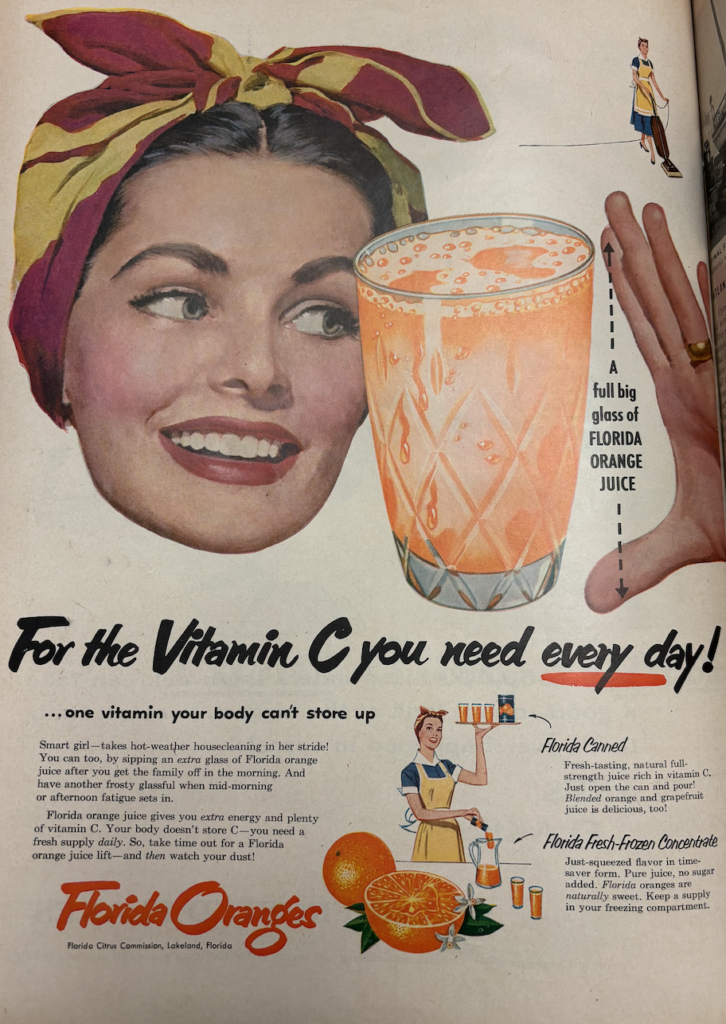
A 1953 edition of Life magazine included this advertisement for Florida Oranges’ orange juice. In this full page advertisement, the viewer is instantly drawn to the large glass of orange juice. The glass has condensation dripping down the side indicating the drink’s refreshing qualities. This advertisement’s text portrays the drink as a necessity rather than a product of desire. This can be seen through the heading’s use of the word “need,” the underlining of “every day” and the exclamation point. Additionally, the subheading emphasizes this as it draws on the concept of the body having a deficiency in what the product provides. Visually, this glass is not only the size of the woman’s hand, but also the size of her beautiful smiling face which can be very striking to the viewer. This woman can be seen smiling in each of her three appearances. She is dressed in the attire of a typical 1950s homemaker as she wears an apron and a bandana to protect her hair. This portrayal is complete with a wedding band that can be seen on the large hand. The woman aligns with the historical context of this advertisement as the 1950s included post-WWII society when men were able to return to being the financial providers for their families while women were expected to be homemakers (“Gender Roles in the 1950s,” Study.com). Due to the woman’s physical representation and its historical context, this advertisement, by Florida Oranges, promotes a societally idealized and unrealistic view of women as homemakers in the 1950s.
The human subject of this advertisement represents the views that society has on women during this period of time. She is portrayed as the ideal homemaker. This woman seems to have the perfect life. Not only is she physically attractive, but she is also illustrated as extremely happy. She demonstrates a sense of bliss and joy through her wide smile. She looks at the glass of orange juice with a big smile on her face, she is smiling while she vacuums, and she is smiling while she is serving the juice to her family. It can be interpreted that she has a family as the hand that outlines the juice includes a wedding band and she is carrying multiple glasses. Furthermore, her clothing such as her hair in the bandana and the apron in each pose in addition to her cleaning and making refreshments indicates that she is a homemaker. Moreover, she is depicted as the ideal housewife through her joyous and energetic way of completing all of her household tasks. As a female member of this society, she is doing her job and she is illustrated to be doing it with enthusiasm. As a result of the execution of her household tasks, her unwavering smiles, and physically perfect appearance in partnership with her wedding band and wardrobe, it is clear that she is intentionally being depicted as the stereotypical housewife.
This illustration can be interpreted as an example of Lorraine Daston and Peter Galison’s definition of objectivity. They state that ‘objective’ refers to what is “presented to consciousness:” Florida Oranges portrays this woman in a way that makes her appear in the viewers’ consciousness as the ideal housewife in the context of 1950s society (Daston and Galison 29). In other words, Florida Oranges and the advertisement’s viewers see and believe that a woman’s role in society is to be a homemaker in their consciousness, so the woman in this advertisement is intentionally aligned with this concept, making her the ideal woman. She is what society expects of women: she cares for her husband and children (indicated by the wedding band and making multiple glasses of orange juice), and she cleans and takes care of the home itself (indicated by her vacuuming) (“Gender Roles in the 1950s,” Study.com). Because this advertisement depicts what is expected and desired of women in 1950s society, the advertisement can be seen as applicable to Daston and Galison’s definition of objectivity.
This advertisement can be seen as corresponding to Daston and Galison’s definition of objectivity in another way as Florida Oranges portrays this woman in an unrealistic manner (Daston and Galison 29). The housewife has a full face of makeup. In reality, a woman that is busy cleaning her home and raising her children would not be wearing this much makeup, if any at all. She looks as though she is ready to go out on the town. Additionally, although housewives may feel happy with their lives, they would not be non-stop smiling while doing their tasks. Realistically, it would actually be rather concerning and creepy to see someone smiling this largely without stopping as she is literally smiling in every appearance in the advertisement.
Although this advertisement can be seen as the promotion of Florida Oranges’ orange juice, the company is really attempting to sell the 1950s housewife lifestyle. They utilize the drink as a tool to promote the societal standards placed on women to be successful homemakers. The beautifully made-up smiling face of the woman doing her household tasks and caring for her family is meant to be seen as a result of the woman’s consumption of the orange juice. Therefore, it is advertising and emphasizing the importance of women being successful homemakers in society. This is further demonstrated by the first two lines of the fine print of the advertisement: “Smart girl–takes hot-weather housecleaning in her stride! You can too, by sipping an extra glass of Florida orange juice after you get the family off in the morning.” Not only does this quotation explicitly state the relationship between women and their children and husband, but it also emphasizes the importance of housecleaning that is societally expected of women at this time in history. This woman and the women of this society were viewed to be needed in the home while their husbands were out at work financially providing for the families now that they were back from the war. Consequently, it is made clear that the orange juice is a tool used to advertise the lifestyle of the 1950s housewife, who is expected to clean and care for her children (“Gender Roles in the 1950s,” Study.com).
When looking deeper into the use of Florida Oranges’ orange juice as an instrument to promote the lifestyle of the homemaker, the state of Florida’s history comes to mind. As seen in Anna Andrzejewski’s article, Florida is known as being a landscape of leisure (Andrzejewski). The southern state is a place where tourists would golf and joyfully swim in the beaches (Andrzejewski). This article contains a link to the history of the Great Florida Land Boom of the 1920s where it can be seen that the migration of Americans to Florida during this time brought middle class Americans to the state along with their families (“Florida in the 1920s,” Floridahistory.org). The woman in this advertisement can be viewed as one of these middle class Americans. Additionally, during the 1920s developers such as Joseph W. Young and Addison Mizner “made Florida synonymous with palm trees and beaches, wide avenues and golf courses…Florida was a place to vacation, a place to have fun, a place to make money” (“Florida in the 1920s,” Floridahistory.org). Therefore, the name Florida Oranges makes the advertisement’s viewers think of this carefree and blissful image of Florida in association with the ideal smiling 1950s homemaker. This once again proves that the orange juice is an implement used to promote the blissful and familial lifestyle that women are expected to live as housewives which in reality is not always the case in reality as no one lives in bliss at all times of their lives.
Through the use of the woman’s physical appearance as well as the historical context of the advertisement, it is evident that Florida Oranges was not truly promoting their orange juice, but they were instead promoting the ideal and unrealistic lifestyle of the 1950s homemaker.

Leave a Reply