By Kendal Gray
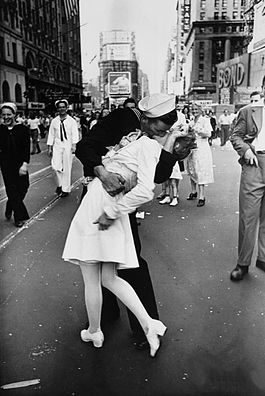
Alfred Eisenstaedt, V-J Day in Times Square, NYC. Printed LIFE Magazine August 27th, 1945.
Eisenstaedt’s V-J Day Kiss captures a pivotal moment in history, marking the end of World War II and the jubilant celebration that ensued. The photograph—taken August 14th, 1945—depicts a sailor passionately kissing a nurse amidst a crowd of carnival attendees. As per Life Magazine and the Power of Photography, “This photograph is known as one of Life’s most important commidities…it became an icon of public culture” (Bussard & Gresh, 185). This moment is made to encapsulate the collective relief and joy felt by millions as they learned of Japan’s surrender, signaling the conclusion of one of the deadliest conflicts in human history. The image resonates as an iconic symbol of victory, hope, and the human spirit’s resilience in the face of adversity. Through examining the the image’s historical context, individuals involved, and photographer’s intent a multifaceted significance of this image comes to light, furthering understanding of its enduring resonance in popular culture and its controversy.
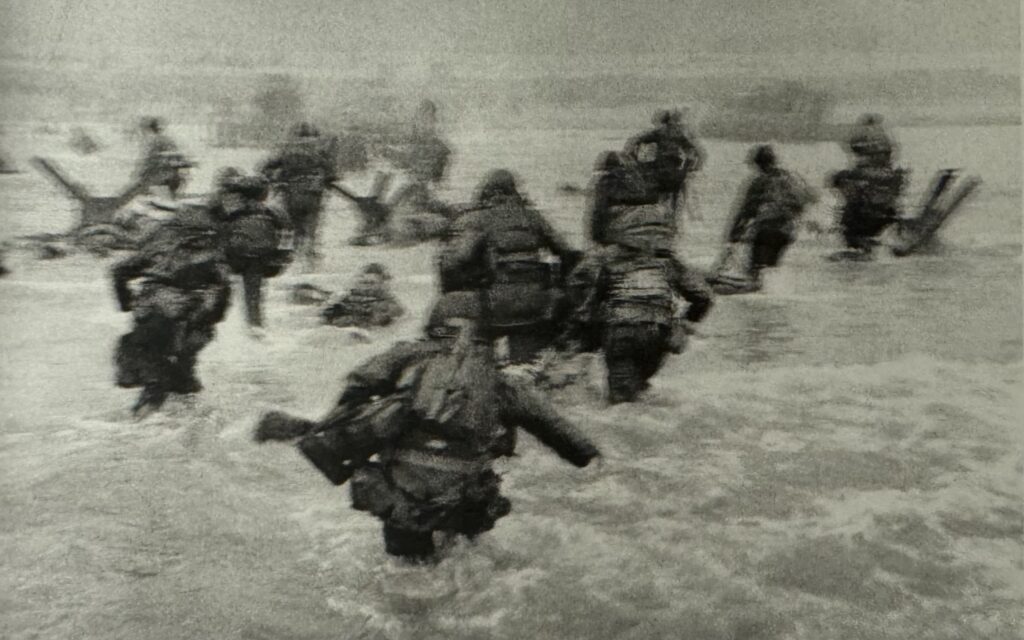
Robert Capa, American soldiers landing on Omaha Beach, D-Day, Normandy France, June 6th, 1944.
Historical Background of US in WWII & the Significance of VJ Day
Victory over Japan Day (V-J Day) marks the formal surrender of Japan, effectively ending World War II. The surrender was formally announced by Japanese Emperor Hirohito on August 15, 1945. The announcement came after months of intense fighting across the Pacific and brought about a sense of solace and celebration among the Allied nations worldwide. V-J marked a significant turning point in global history, beginning the reshaping of geopolitical dynamics and laying the foundation for the post-war era.
Implications of Eisenstaedt’s Image
The significance of Eisenstaedt’s kiss photograph is rooted in its formal composition. The main subjects, a Navy sailor and a nurse, are positioned centrally, drawing in immediate attention from viewers. The pair is balanced within the frame, with the sailor stooping down to press into the backward bend of the nurse. This classic swoon-like-gate resonates with the romantic ideals of dance and Hollywood films at the time, contributing to this image’s crafted sense of bliss and positive emotion. Additionally, the image’s backlighting emphasizes the silhouette of the couple, adding a dramatic focus. I feel as though it heightens the emotion of the scene. The pair alone perpetuates this sense of unity and promise entering into this new era of the world post-WWII.
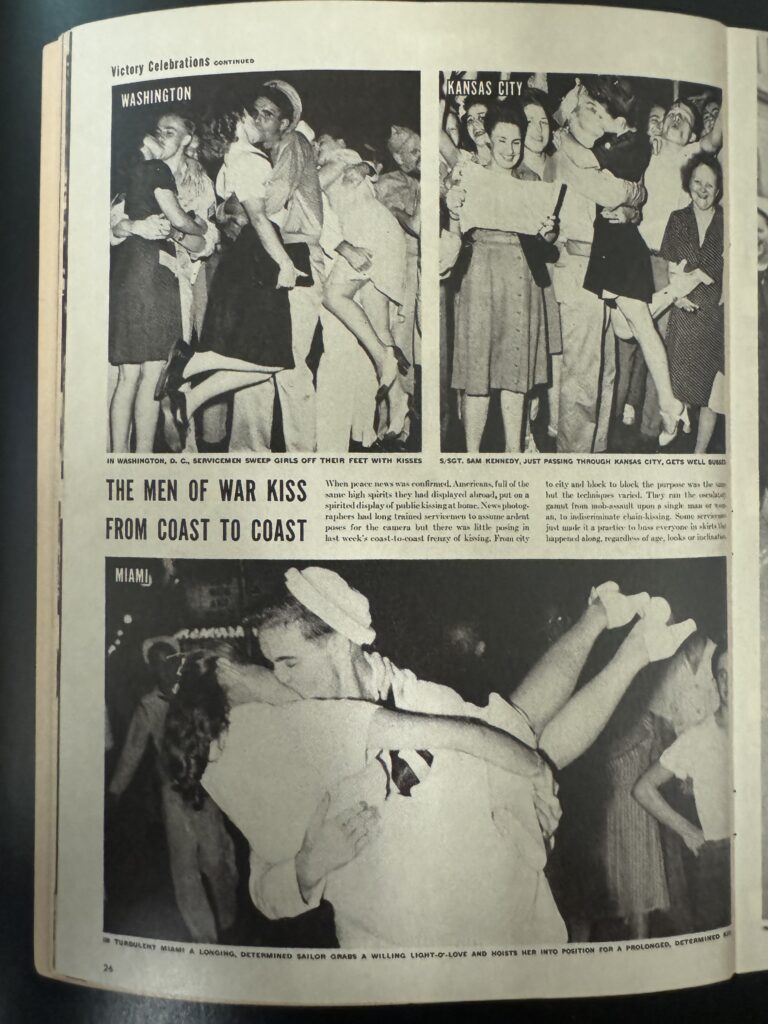
However, what I find most interesting is not the kiss itself, but the publicity of it. Pre-dating WWII, society enforced gender separation and constraints regarding displays of affection. Yet, Eisenstaedt’s image of a couple publicly embracing the act of kissing the war goodbye symbolizes both liberation from wartime restrictions and societal norms. In a time of such joy, regulations of conformity fall to the margins; instead, people focus on living in the moment and acting as they feel. This fusion of personal emotion and its public display encapsulates the beginning of a transition from war to a new world, as documented by Life magazine’s continued coverage of victory celebrations (see image below)
Connecting Course Discussions to the V-J Day Kiss
David Shneer’s article “Is Seeing Believing? Photographs, Eyewitness Testimony, and Evidence of the Holocaust” is connected to World War II through its exploration of the role of photographs as evidence of historical events and “Nazi atrocities” during the war (Shneer, 65). In stark contrast, Eisenstaedt’s V-J Day Kiss photograph represents a different aspect of the war – the positive emotion and human experiences associated with its conclusion. Yet together, the images Shneer selected and the V-J Day Kiss portray the feelings throughout war, beginning to end. Both Shneer’s article and the V-J Day Kiss photograph highlight the power of photography to capture significant moments and convey complex emotions.
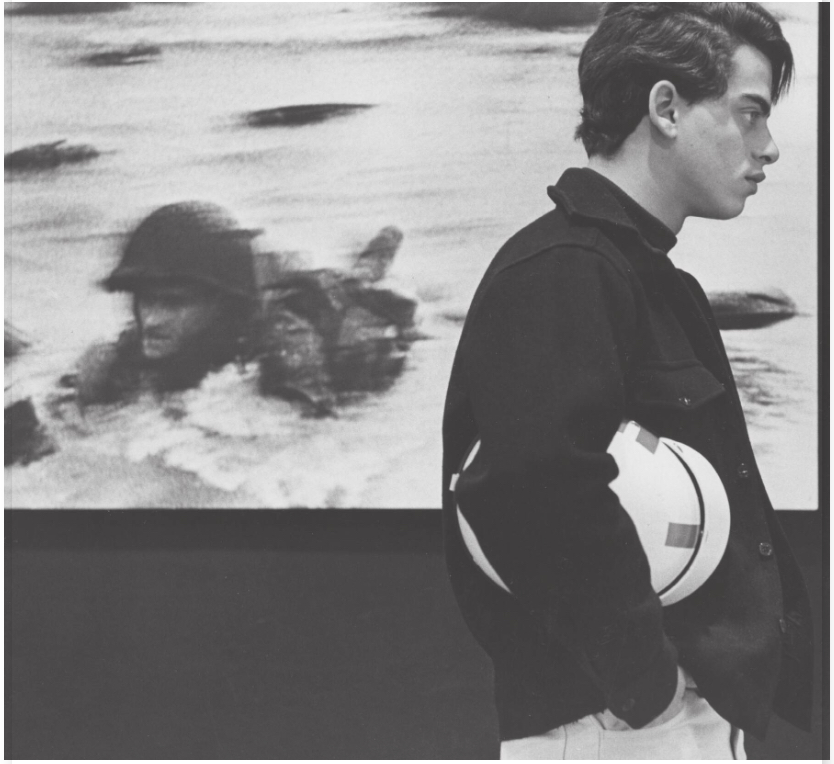
Viewer in The Concerned Photographer exhibition at Riverside Museum, Robert Capa, Omaha Beach during the D-Day Landing, Normandy France, June 6th 1944
Eisenstaedt’s photograph captures a spontaneous moment of celebration, however it is much deeper than that. It symbolizes the euphoria felt by people at the end of a long and devastating war, embodying a sense of unity and human connection. The concept of “concerned photography” can be connected to Eisenstaedt’s photo in the context of capturing significant moments that convey deeper meanings. Concerned photography, as discussed Bair’s “The International Origins of “Concerned Photography” Cornell Capa in the United States, Japan, and Israel”, aims to document and raise awareness about social issues, human rights, and global events with a sense of empathy and responsibility. While not explicitly categorized as concerned photography, Eisenstaedt’s image resonates with its themes of humanity, compassion, and the beginning of social reparations in the aftermath of war which are all central to the concerned photography movement.
However, it is worth noting that the subjective nature of concerned photography is quite controversial, as interpretations of the photographer’s intentions and the impact of the images vary amongst viewers. Thus, people may call into question the effectiveness of photography as a tool for social change and advocacy. In Bair’s work discussing concerned photography, she cited that many influential critics and artists saw the concept of it as “self-serving” accompanied with feelings of “mistrust” towards the art medium (Bair, 77). To counteract concerned photography being undermined as an art form, it is essential to maintain a balance between personal expression and ethical responsibility. Doing so helps to ensure that concerned photography images serve the greater good and contribute meaningfully to societal dialogue. However, that does not always happen.
In the case of the V-J Day Kiss, there are some problematic details regarding the image, calling into question its credibility and appriopriateness of “capturing” the post-war reality. A key issue is the lack of consent and agency exhibited by the nurse in the photograph. The image captures a moment of spontaneous celebration in which a sailor, caught up in the euphoria of victory, grabs and kisses the nurse without consent. This raises concerns about the portrayal of women in public spaces and the normalization of non-consensual behavior, perpetuating harmful gender and sexual dynamics. Rather than realizing the implications of such an image, Eisenstaedt manipulated the narrative of his image to portray a ‘happy’ scene of relief. He effectively glorified a Navy sailor committing sexual misconduct and proved to have quite an unethial, self-serving bias. Additionally, the photograph’s romanticized depiction of war’s end glosses over the trauma and suffering experienced by countless individuals during the conflict. Awareness deserves to be brought to those who gave the ultimate sacrifice or endured horrors within WWII. It could be argued that Eisenstaedt’s image sweeps these unpleasant realities of war under the rug in an attempt to conveniently move on from the horrors of WWII. If so, then that is in fact another self-serving bias within the image. By Eisenstaedt’s photo simplifying complex historical realities many people experienced in WWII, one can call into question the effectiveness of this V-J Day Kiss in promoting the post-war reality.
Works Cited
Bussard, Katherine A., and Kristen Gresh. Life Magazine and the Power of Photography. Princeton University Art Museum, 2020.
David Shneer (2015) Is Seeing Believing? Photographs, Eyewitness Testimony, and Evidence of the Holocaust, East European Jewish Affairs, 45:1, 65-78, DOI: 10.1080/13501674.2015.968827
Nadya Bair, “The International Origins of ‘Concerned Photography’: Cornell Capa in the United States, Japan, and Israel.” American Art 36, no. 2 (2022): 75–101.
“Victory over Japan Day: End of WWII.” U.S. Department of Defense, www.defense.gov/Multimedia/Experience/VJ-Day/#:~:text=V%2DJ%20Day%2C%20or%20Victory%20over,the%20world%20erupted%20in%20celebration. Accessed 18 Apr. 2024.

Leave a Reply