By Gabby Johnson

George Catlin, Osceola of Florida, 1838. Lithograph with hand coloring. Composition: 26 ¼ x 19 ½ in. Wellin Museum of Art at Hamilton College.
George Catlin was a prolific artist who extensively represented American Indian people throughout the nineteenth century, both in his paintings and writings. Among the many artworks he created is a hand-colored lithograph titled Osceola of Florida that was produced in 1838 and can be seen above. This work depicts the titular figure, Osceola, who was a relatively well-known leader of the Seminole tribe of American Indians in Florida. In this full-length portrait, Osceola has been represented in a mostly desolate landscape with one prominent rock in the foreground and is wearing multiple layers of clothing, including a tunic, a jacket, leggings, and boots. He has also been depicted with accessories such as bracelets, necklaces, a headband, and a satchel, in addition to a gun that he has propped against the ground, showing audiences that this weapon is almost as tall as he is. While this depiction of Osceola may appear highly detailed and realistic at first glance, understanding historical context such as the abusive treatment of American Indian tribes by the United States government, and knowing biographical information about both Osceola and Catlin, provokes questions about whether this lithograph is truly as documentary as it initially seems to be. Modern scholars still debate whether Catlin’s intentions were as benevolent as he claimed them to be and discussions about his true motivations for creating so many artworks of American Indians are ongoing. Regardless of his true intentions, Catlin produced artworks that romanticized American Indian life and culture in ways that were not always accurate, but that instead made his commercial success more likely.
The United States government has a long history of implementing policies that were intended to either assimilate or harm American Indian tribes, background that is important to know because it informs the context in which Catlin was working and the ideologies that he was exposed to and may have held. The American government began efforts to remove tribes from their Native lands beginning in the early nineteenth century and Congress passed the Indian Removal Act in 1830 (Dippie 1982, 68). This policy allowed the government to take over Native land and instead give it to White settlers by forcing tribes who lived east of the Mississippi River to march to their newly appointed territories in Oklahoma. These forced marches are most commonly known today as the Trails of Tears and not only displaced over sixty thousand American Indian individuals, but also resulted in over one thousand deaths. The Indian Removal Act demonstrates how the U.S. government clearly prioritized the lives and land rights of White Americans over American Indians in the nineteenth century and is a policy that most members of the American public were aware of. It is therefore likely that Catlin was also aware of this governmental action, and while it is possible that he commented on it in one of his many writings, there is also visual evidence in his artworks to suggest that he was aware of this harmful policy.
In Osceola of Florida, Osceola himself is the primary subject and there are few environmental features surrounding him to take the viewer’s attention away from him. Instead, he has been depicted standing within a hazy and desolate landscape; the only identifiable environmental elements in this lithograph are the few rocks that appear on the ground that Osceola is standing on. The barren landscape in this artwork was not unique to Osceola of Florida, however, and several of Catlin’s other artworks included similarly vague and unidentifiable landscapes in the background. This similarity is demonstrated by comparing Osceola of Florida to the painting We-chúsh-ta-dóo-ta, Red Man, a Distinguished Ball Player, seen below. In reality, the individuals that Catlin depicted lived in or near landscapes with identifiable elements, including local trees, flowers, rock formations, lakes, rivers, or other elements of the natural world. Knowing that Catlin could have included these types of environmental features in his artwork but evidently chose not to suggests that he may have made this representational choice for a particular reason. More specifically, representing American Indian individuals in vague and desolate landscapes, rather than within the identifiable landscapes of their respective homelands, may have been designed to denote the loss of homeland that many tribes were experiencing at this time. Depicting Osceola within an almost blank background rather than within the lush and semi-tropical environment that he had grown up in, for example, draws attention to the potential loss of that land for Osceola and the rest of the Seminole tribe. The desolate landscape represented in Osceola of Florida thus supports the idea that Catlin was not only aware of the policies that the United States government was enacting against American Indian nations, but also that he perhaps intended to draw wider attention to these situations.
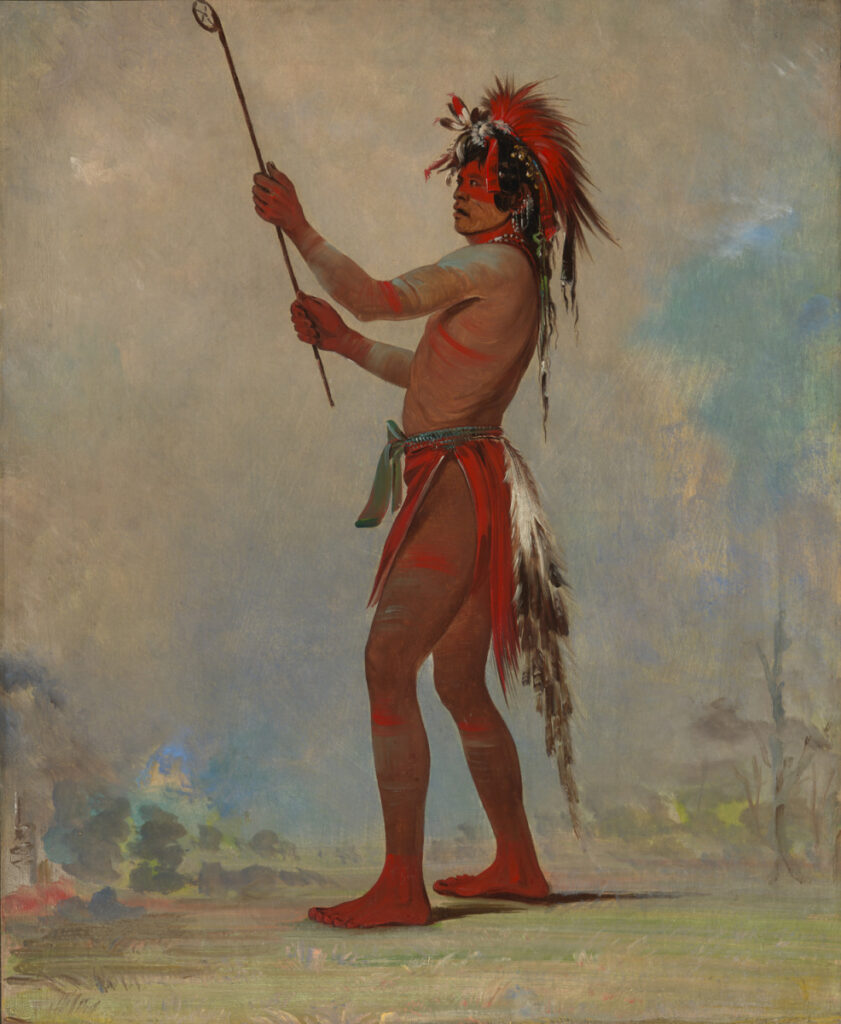
George Catlin, We-chúsh-ta-dóo-ta, Red Man, a Distinguished Ball Player, 1835. Oil on canvas. 29 x 24 in. Smithsonian American Art Museum.
While mostly barren, the landscape in Osceola of Florida includes a detailed signature that suggests that Catlin intended to draw attention to his artistic prowess in addition to pointing out the governmental policies and actions that were actively displacing American Indian tribes. This signature can be seen in the large rock in the bottom left corner of the lithograph, seen in the image below this paragraph. Although these rocks appear unassuming at first glance, the largest one looks as if it has been inscribed with information about the production of this lithograph, including its title, the name of the artist, its publisher, and the year it was produced. While Catlin’s motivation for including this information within the composition itself is not entirely apparent, it might have functioned as an alternative form of his signature that highlighted Catlin’s responsibility for the production of this artwork. Such motivations for including a unique signature were not unprecedented in art and can also be found, for example, in works produced by several artists working throughout the Americas in the late seventeenth century, including Cristóbal de Villalpando and Juan Correa. By including highly visible signatures within their work, artists working in the “New World” reflected their aspirations to deploy “European pictorial motifs and textual conventions” and to credit themselves with being the “inventor” responsible for employing these techniques (Hyman 2017, 104). Catlin may have had a similar motivation for including this unique and informative signature in Osceola of Florida, perhaps wanting to remind viewers that he was the “genius” responsible for creating this impressive portrait. By making his own name highly visible, rather than Osceola’s, Catlin emphasized his own role in producing this portrait and did not credit the fact that Osceola’s reputation helped draw significant attention to this portrait. This decision further suggests that he intended to produce commercially successful artworks by providing audiences with a strong reminder that he was the individual responsible for this impressive artwork’s production.

Detail from George Catlin, Osceola of Florida, 1838. Lithograph with hand coloring. Composition: 26 ¼ x 19 ½ in. Wellin Museum of Art at Hamilton College.
Policies like the Indian Removal Act were not the only governmental actions that shaped Catlin’s ideas about American Indian people, and military conflicts such as the Seminole Wars, a series of conflicts between the United States military and the Seminole tribe, likely further contributed to the ideologies he held. This conflict is particularly relevant to considerations of Osceola of Florida because Osceola was not only a member of the Seminole tribe, but was also a significant member of their military force in the first few decades of this forty-year long conflict. The Seminole Wars were “were a series of battles motivated by a Southern brand of settler colonialism, which aimed to expand the new United States by transforming all the American South from Indian land to the land of cotton,” further exemplifying the United States government’s aim to take land from American Indian tribes for the purpose of benefiting White settlers (Oertel 2023, 19). Most Americans, including Catlin, were aware of this conflict and the important figures involved in it, including Osceola. Being exposed to this knowledge about the Seminole Wars and about Osceola likely shaped subconscious ideologies that Catlin held and may have additionally influenced the way he chose to compose Osceola of Florida.
Knowing about Osceola’s biography and significance as a historical figure can further clarify Catlin’s motivations for making this portrait and for representing Osceola as he did because Catlin himself would have known, and perhaps been influenced by, this information. Osceola, who lived between 1804 and 1838, was a member of the Seminole tribe of Florida and was renowned for his “powers of fortitude, activity, and endurance,” qualities that resulted in his being named the first war-chief of the nation (Jerdan 1838, 364). Beyond being well known to other members of the Seminole tribe, Osceola also became known to more general American audiences due to his military significance. This recognition was further enhanced when Osceola was captured and imprisoned by U.S. military officials in late 1837, only months before his untimely death while in prison, which was caused by illness (Hight 1990, 121). Osceola thus occupied a semi-prominent position within the American imagination due to his military prowess and significant role in the Seminole Wars. This reputation likely influenced Catlin’s desire to depict Osceola because he knew that such a portrait would gain attention from a wide audience of Americans familiar with Osceola, attention that would in turn benefit Catlin by exposing more people to his work.
Having this background information about Osceola as a historical figure clarifies that his portrait in Osceola of Florida was romanticized, even though it initially appears to be documentary. Osceola appears to be in peak health in this lithograph and is standing strong, looking similar to what audiences would expect from a renowned military leader. In reality, however, Catlin created this image of Osceola only days before his death, a period during which he would not have genuinely appeared this healthy and strong (Hight 1990, 121). Instead, Osceola would have looked weak, pale, and otherwise unhealthy at this time. None of these traits have been depicted in this portrait, however, indicating that Catlin was not working entirely from life when he produced this representation but instead romanticized particular elements to make Osceola appear stronger than he looked in reality. Catlin likely took this approach because he knew that audiences would be more interested in seeing a portrait of Osceola that matched his reputation as a strong and fierce military leader than they would be in seeing a weak depiction of him, regardless of whether such a representation was true to life. Catlin’s decision to represent Osceola differently than he appeared in life when making this portrait demonstrates his awareness of and concern for the commercial success of his portraits, which was based upon their reception by audiences and thus the expectations and ideologies that these viewers held, particularly about people that they considered to be “Other” from them.
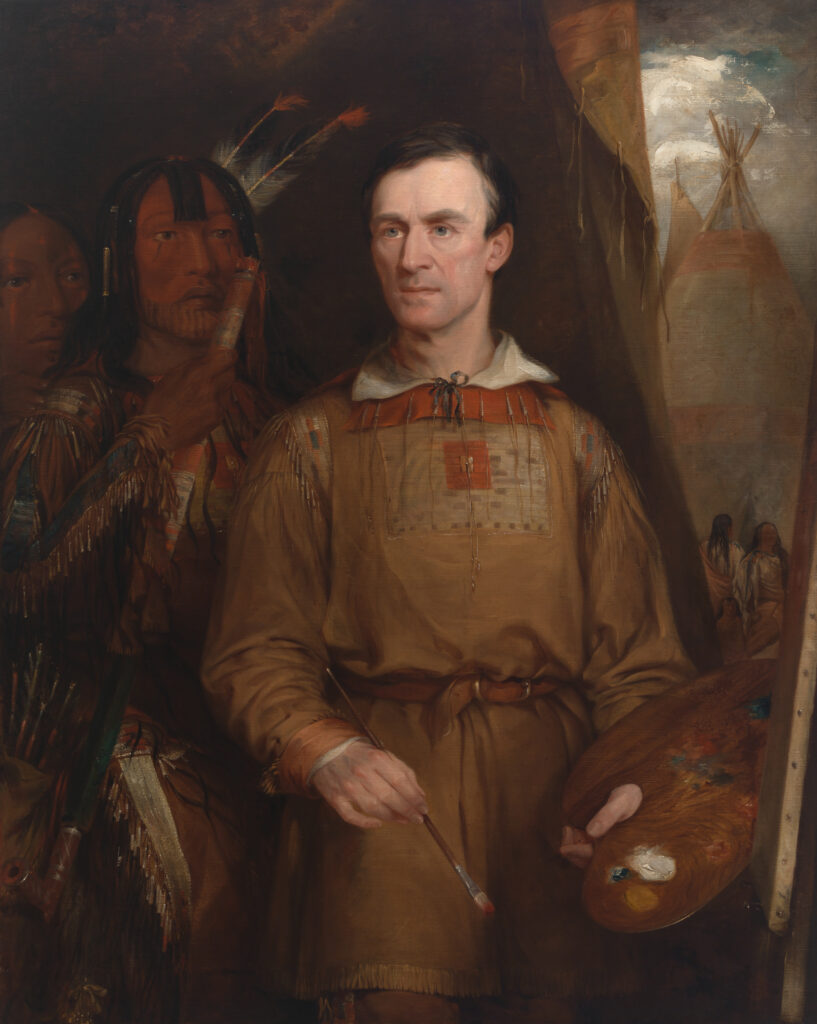
While it is necessary to know about Osceola in order to better understand Catlin’s reasons for producing this artwork, knowing information about Catlin himself can also make his motivations for producing this work clearer. Born in 1796, Catlin was a lawyer before he became an artist, author, and explorer who devoted himself to documenting the lives and cultures of American Indian tribes throughout the United States. He claimed that “The history and customs of such a people are themes worthy of the lifetime of one man, and nothing short of the loss of my life shall prevent me visiting their country, and of becoming their historian,” a goal that is particularly noteworthy in the context of the U.S. government’s contemporaneous attempts to remove tribes from their Native lands (Knox and Edward W. Root Art Center 1980, Introduction). Catlin’s goal to document as much of American Indian life and culture as he could prompted him to travel extensively and resulted in the production of hundreds of artworks and several writing collections throughout his life. Much of this work became of ethnographic interest to scholars both during and after his life, contributing to Catlin’s status as a renowned scholar and historian whose work remains highly discussed, if controversial, today.
William Fisk, George Catlin, 1849. Oil on canvas. Frame: 158.8 x 133.4 x 7 cm. National Portrait Gallery, Smithsonian Institution.
Catlin’s allegedly positive motivations for documenting the lives of American Indians is variously supported and discredited by certain actions he took, further complicating the way that his artworks and their imbued ideologies can be understood today. Evidence for Catlin’s good intentions partly lies in his efforts to hold the U.S. government and fur companies accountable for their abusive treatment of American Indian tribes, as well as in the fact that he did not explicitly discredit Indigenous knowledge in the manner that most scholars and colonists tended to do at the time (Knox and Edward W. Root Art Center 1980, A History Of Catlin’s Indian Gallery). Discrediting Indigenous knowledge was a particularly pervasive problem in colonial South America, where the contributions that Indigenous people (as well as women and African people) made to scientific, inventive, and artistic developments were often overlooked or ignored (Ospina 2023, 923). In particular, Indigenous communities in colonized areas often held particular local knowledge, such as about local materials and environments, that were used to create several products, including, for example, cosmetics. While most colonists and settlers throughout the world ignored the role that Indigenous communities played in providing environmental upkeep and information about local materials, it does not appear that Catlin engaged with these ideologies. Although he did not necessarily use resources that relied on the environmental knowledge of American Indian tribes, it is important to note that Catlin attempted to defend these nations from exploitative fur companies who did not credit American Indian communities for the methods they used to keep the population of fur-providing animals healthy, nor did these companies replicate such practices. Catlin was aware of these ideologies and yet fought against them, supporting the argument that he had genuinely good intentions in his pursuit to document American Indian life throughout the United States.
Although there is evidence to support the argument that Catlin chose to document the lives of American Indian people out of a true desire to help them in the face of abusive government policy, it must also be acknowledged that there were multiple instances in which he acted irreverently toward or harmed the very communities he claimed to be trying to help. One notable instance of his disrespect occurred when Catlin told members of the Dakhóta nation that he would be traveling to a particular quarry to collect samples of the iŋyaŋša stone found there. He blatantly ignored the tribe’s required protocols to access and obtain this culturally significant stone and instead journeyed there independently, taking pieces of the stone for himself once he arrived (Johnson 2020, 4-6). If Catlin was truly as focused on aiding and protecting American Indian communities, including the Dakhóta tribe, as he said he was, it seems as though he should have decided not to visit the site of the iŋyaŋša stone in this moment. His choice to disregard the usual protocols of this tribe and instead prioritize his own interests indicates that Catlin was not always as focused on helping or bringing attention to the plight of American Indians as he claimed to be. Additionally, Catlin later displayed the stone pieces that he collected from this quarry, an exhibition that ultimately promoted colonization of this area due to the mineralogical value of the stone, furthering the harm that Catlin perpetuated against the Dakhóta tribe (Johnson 2020, 7). Understanding Catlin as an individual, including his ideologies and motivations for producing his artwork, is important information to have when examining these works because it can clarify whether these implicit ideas are visible in any of his works and should impact the way we view them today. This information may also impact the way that modern scholars think about his traveling “Indian Gallery,” as he named it, and his motivation for curating this exhibition.
Several of the artworks and writings that Catlin produced were ultimately housed in his “Indian Gallery,” the construction of which further complicates an understanding of Catlin as solely benevolent toward and defensive of American Indian communities. In addition to the artworks and writings that he produced, Catlin included ethnographic artifacts that he had collected within this exhibition, such as the stone that he stole from the Dakhóta nation’s stone quarry. This exhibition not only traveled to cities throughout the United States, but also spent several years in London (Knox and Edward W. Root Art Center 1980, A History Of Catlin’s Indian Gallery). Although this exhibition was objectively popular and attracted large audiences, Catlin was disappointed that “the admission fees barely covered the cost of transportation, catalogs, showbills, and advertisements,” leaving little money left for him (Knox and Edward W. Root Art Center 1980, A History Of Catlin’s Indian Gallery). While this exhibition was designed with the apparently positive intention to educate “civilized” society about the lives and cultures of American Indians, this mission problematically reinforced the exoticization and othering of American Indian communities that was already imposed through U.S. governmental policy and general public prejudices against Indigenous populations. Additionally, this exhibition provided Catlin with his primary means of living for some time, making the sale of exhibition tickets important to him so that he could personally profit from them. Despite his allegedly educational and positive motivations for constructing his “Indian Gallery,” the fact that Catlin actively profited off of this enterprise complicates the idea that he designed it with only these ideas in mind and instead suggests that he was aware of and focused on marketing tactics that would allow him to be commercially successful.
The lithograph Osceola of Florida provides an effective case study for understanding the ideologies and motivations that influenced artworks produced by George Catlin. While he claimed that his depictions of American Indian populations were motivated by efforts to historically document and draw attention to the harmful policies that the United States government perpetuated against these tribes, it cannot be ignored that Catlin was also motivated by efforts to be commercially successful. This desire to gain professional and financial success through these artworks and his traveling ethnographic gallery prompted Catlin to romanticize some of the artworks he created, including his portrait of Osceola. Beyond demonstrating that Catlin was not always as respectful and well-intentioned as he portrayed himself to be, this information prompts additional questions about the ideologies that have informed the continued collection and discussion of Catlin’s work today. One wonders, for example, why Walter Beinecke, the previous owner of Osceola of Florida, was motivated to purchase this lithograph for his personal collection. Did he recognize the historical value that was imbued into this work through the identities of its subject and artist, or did he simply think it was an “interesting” representation of a Seminole man? Questions such as this have yet to be examined and provide a clear direction for future art historical scholarship that continues to consider figures like George Catlin, Osceola, or even Walter Beinecke.
Bibliography
Dippie, Brian W. 1982. The Vanishing American: White Attitudes and U.S. Indian Policy. University Press of Kansas. ACLS Humanities EBook.
Hight, Kathryn S. 1990. ““Doomed to Perish”: George Catlin’s Depictions of the Mandan.” Art Journal 49 (2): 119-124. https://doi.org/10.2307/777191.
Hyman, Aaron M. 2017. “Inventing Painting: Cristóbal de Villalpando, Juan Correa, and New Spain’s Transatlantic Canon.” The Art Bulletin 99 (2): 102-135.
Jerdan, William. 1838. “Osceola, of Florida.” The Literary Gazette: A Weekly Journal of Literature, Science, and the Fine Arts, June 9. https://www.proquest.com/docview/5088119?pq-origsite=primo&sourcetype=Historical%20Periodicals.
Johnson, Annika K. 2020. “George Catlin, Artistic Prospecting, and Dakhóta Agency in the Archive.” Art Journal 59 (1): 4-23. https://doi.org/10.1086/709258.
Knox, Peter Gaillard, and Edward W. Root Art Center. 1980. New Indian Gallery: American Indian Art and Prints by George Catlin. Edward W. Root Art Center.
Oertel, Kristen T. 2023. “The “First” Emancipation Proclamation: Black Rebellion, Removal, and Freedom During the Seminole Wars.” Civil War History 69 (4): 11-35. https://dx.doi.org/10.1353/cwh.2023.a912507.
Ospina, Catalina. 2023. “Indigenous Knowledge and Women’s Cosmetics: Mopa Mopa in the Colonial Northern Andes.” Art History 46 (5): 918-945.
Leave a Reply