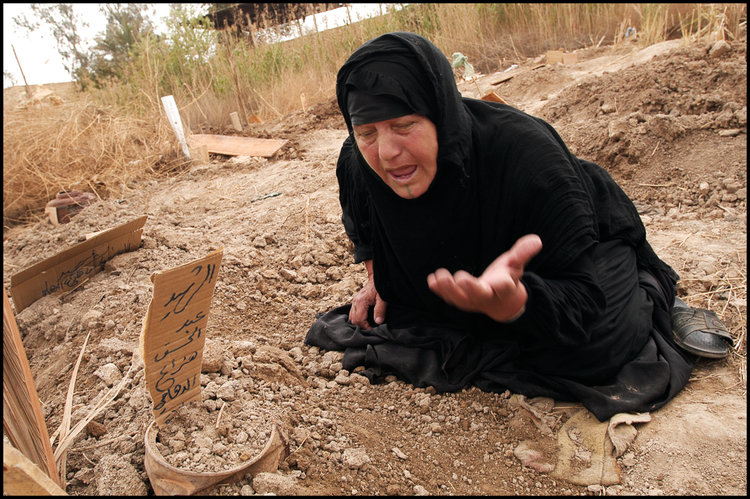
Baghdad, Iraq– The Bereaved Mourn the Dead in America and Iraq
Peter Turnley, a photographer who prides himself for showing the “realities of the human condition,” captures this image in his “War” series. This specific picture depicts an Iraqi woman mourning the death of her family member killed during the Iraq war in April, 2003. In March 2003, US forces invaded Iraq with promises of overthrowing tyrant Saddam Hussein and destroying weapons of mass destruction (WMD) (CFR 2023). From 2003-2011, over 100,000 Iraqi civilians died, along with over 4,700 American troops. By April 2003, Hussain’s government was overpowered, and President Bush declared “mission accomplished,” despite some unrest in the area (CFR 2023). The Iraqi army then disbanded, releasing armed and trained soldiers to the streets as unrest continued to grow following a move to purge Baathists from the government. Al Queda suicide bombings surged in 2004, killing hundreds and reinforcing sectarian resentment (CFR 2023). The next seven years of conflict resulted in bloodshed, turmoil, and destruction of resources. This image of a mourner then takes place at the very precipice of a bloody next seven years. Turnely’s picture of a grieving Iraqi woman represents the horrors of the conflict even at its inception, and the specific aura captured heightens its ability to function as concerned photography, furthering a humanitarian goal.
The woman’s traditional garb, the desert-like surroundings, and the Arabic written on cardboard all help to set the setting of the photograph within its global context. The text on the cardboard is hard to make out, however the final line is loosely translated from Arabic to “The Rule.” This snapshot of a translation represents the mere snapshot that the picture takes; we only get one moment, one piece of this woman’s life, just as we can only translate one portion of the text.
This relates the theoretical concept of the aura, or of the exact moment that a photograph is taken, including setting and surroundings at that very moment. Walter Benjamin explains this concept of the aura in theoretical terms, writing that it is “A peculiar web of space and time: the unique manifestation of a distance, however near it may be. To follow, while reclining on a summer’s noon, the outline of a mountain range on the horizon or a branch, which casts its shadow on the observer…” (Benjamin, 22). The aura of this photograph in particular emphasizes the fleeting moment of this picture, and how we don’t know more about her story, her grief, and her life. This speaks to the larger concept of how photos, and more broadly, photojournalism, functions. It cannot possibly tell the entire story of this eight year war, but instead offers one unique moment. The specific nature of this aura in fact emphasizes what this photograph leaves untold, and furthermore, what the American public remained unaware of. The question of what stories are told, and what stories are left untold, can all be analyzed by the lack of contextual information regarding this photograph, and the need to piece together what is happening based on the specific snapshot this work depicts.
Nadia Bair’s explanation of “concerned photography” directly relates to the political moment captured by this image. Starting with an exhibit in the Museum of Modern Art (MoMA) in 1967, the museum featured photographs that “redirected the technique and aesthetic of documentary photography to more personal ends” (Bair 2022, 75). This movement towards more human-focused, documentary-esque photography eventually gave way to the concept of concerned photography. Although Bair admits that concerned photography is “hard to define,” through an analysis of this movement of photography, she lands on an overall concept. To Bair, the term concerned photography itself is an invention. An invention with “a particular agenda and identifying links between historical narratives and national contexts that are not often seen as related to each other or to photography’s institutional history” (Bair 2022, 78). In other words, this new branch of photography concerned itself with historical and political contexts of the individual, marking the growth of socially-conscious photography, or photography with humanitarian roots.
The personal and yet also political underlying forces of concerned photography shine through with the specific angle of the picture. The photograph is taken level with the woman, who is on the ground. By lowering the camera to be at the same level as the woman, it creates a commitment to capture her grieving not from looking down on her from an above angle, but rather from a level perspective. This creates an emotional closeness between the subject and the photograph, representing a greater commitment to her story personally. Additionally, her centered position as the focal point of the picture further indicates the emphasis on the personal within this picture, and therefore the themes of concerned photography evident in this work. This whole collection aims to tell the “major stories of international geo-political and historic significance,” according to Turnley’s online collection (Turnley). Therefore, the concerned photography (that captures a specific and evocative aura) aims to inform the public on the humanitarian crisis of the conflict.
The entirety of Turnley’s collection, and specifically this gut wrenching image featuring a grieving woman, seemingly calling out in anguish, emphasizes the socio-political context of the moment, as well as the humanitarian crisis at hand. Therefore, the concepts of aura and concerned photography work hand and hand, capturing a specific horrifying and hauntingly human moment in the name of humanitarian awareness of the Iraq war. This image specifically then acts as a case study for awareness-as-photography, or activism-as-photography, indicating that evocative human images of specific moments can act as a tool in the digital age. In fact, Turnley’s images were so evocative, that one photograph from this same collection spurred a lawsuit that went all the way to the Supreme Court (Ford 2007). The photograph was of an open casket funeral for a fallen American soldier, and was protected by free speech rights. However, the ability for the public to be so affected by photographs that they bring about Supreme Court cases further reasserts the power of this humanitarian style photography, and therefore why it should be used thoughtfully and effectively in the future.
Sources:
Bair, Nadia. (2022). The International Origins of ‘Concerned Photography’: Cornell Capa in the United States, Japan, and Israel. American Art, 74-101.
Benjamin, Walter. (1972). A Short History of Photography, Screen, Volume 13, Issue 1, Pages 5–26, https://doi.org/10.1093/screen/13.1.5
Council on Foreign Relations. (2023). Iraq War: A Timeline of Events. Council on Foreign Relations. https://www.cfr.org/timeline/iraq-war
Ford, Paul. (2007). Supreme Court Upholds Appeals Court DEcision in Favor of
Harper’s Magazine. Harper’s Magazine. https://harpers.org/2007/10/supreme-court-upholds-appeals-court-decision-in-favor-of-harpers-magazine/
Turnely, Peter. (2003). War. Baghdad, Iraq– The Bereaved Mourn the Dead in America and Iraq. https://www.peterturnley.com/war

Leave a Reply