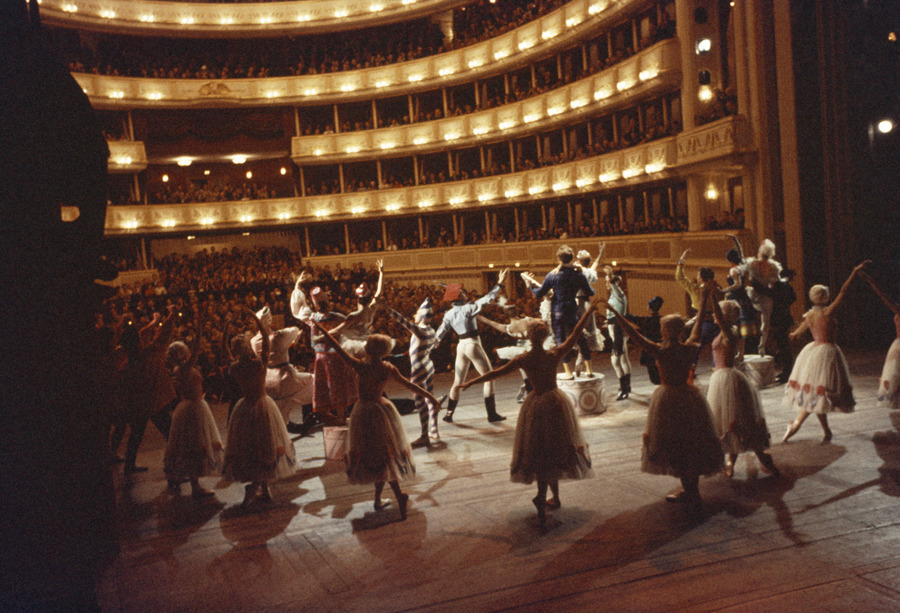
The contents of the photo above might elicit a sense of familiarity from within you, whether you recognize the depicted venue, have been to a similar performance, know where specifically the photo is from, or have any other experiences you can make connections to. Produced by renowned German photographer Volkmar Wentzel, this unnamed photograph is featured in an issue of National Geographic magazine from 1959. The radiant, post-performance scene at the Vienna State Opera of performers assuming their final poses during a curtain call—the photo’s focal point—was immortalized by Wentzel on an April evening of the same year, who did so from a ladder backstage. In the background, both the main auditorium and several floors of seating appear to be occupied by quite a large audience. On first glance, what may be most prominent about the picture, besides the aforementioned subjects, is its dark and richly warm colors, a feature which seems to instill a welcoming, comfortable sense of tenderness within the viewer. “This performance must have been a spectacle to witness in person,” or “It seems like such a lovely time,” you might be tempted to say. While certainly naught is inherently wrong about an evening of theatrical pleasure, perhaps within this seemingly innocent and normal photograph exists a simultaneously hidden yet conspicuous visuality that provides us with a concerned glimpse into a time when life was anything but innocent and normal.
On March 13, 1938, approximately a year prior to the beginning of World War II, Austria was integrated into Nazi Germany, an event which came to be known as the Anschluss and one for which the great majority of the Austrian population exhibited supposedly enthusiastic support. A month later, on the 10th of April, a plebiscite was held in both Austria and Germany, which indicated that an overwhelming 99% was in favor of Adolf Hitler as leader. Of course, individuals of Jewish origin were barred from voting and, shortly after, either forced to leave the nation or were put in concentration camps. During the latter half of World War II, the Austrian capital of Vienna was bombed a total of 52 times, resulting in the deaths of numerous civilians and great detriment to significant national architecture, such as St. Stephen’s Cathedral, Albertina Museum, and, of course, the Vienna State Opera on March 12, 1945. It would be over a month until April when the last German troops were driven out of the capital by Soviet troops as part of the Vienna Strategic Offensive—whereafter the nation became temporarily occupied by the Allies (the Soviet Union, United States, United Kingdom, and France). It would be over another decade until 1955 when the State Treaty was signed between Austria and the Allies, finally re-establishing Austria as the independent, sovereign, and democratic state it was prewar.
Well, what does much of this, besides the fact that the Vienna State Opera was destroyed during one of the bombings, have anything to do with what is depicted in Wentzel’s photograph? Albeit Austria gained full independence in 1955, reconstruction had begun ever since the war ceased in late 1945, which included that of the opera house. Not long after the Treaty was enacted, in the same year, the Vienna State Opera was fully reconstructed and had a reopening with Ludwig van Beethoven’s Fidelio, the composer’s only opera—what the National Geographic article wherein Wentzel’s photograph appears says is “an immortal hymn to liberty.” Furthermore, it also describes the the rejuvenation of the Viennese opera venue: “A triumph in elegant decor, a miracle in stage mechanism, the $10,000,000 reconstruction symbolizes the nation’s postwar recovery.”
Concerned photography, a concept of which Hungarian-American photographer Cornell Capa was a great proponent, refers to “the creation of socially and politically minded images that have the potential to educate and change the world.” When it was first mentioned and practically employed in the 1967 exhibition The Concerned Photographer by Cornell Capa, it did not have such a concrete definition as it does today. Back then, a concerned photographer was merely (in the sense of a short definition and not that the concept is simple) “vitally concerned with their world and times.” Nonetheless, the curator himself, Capa, admitted that searching for and giving a precise definition to “concerned photography” was no easy task. The 1967 exhibition featured the works of six photographers, who “had documented some of the most volatile issues in the twentieth century: urban poverty, racial strife, and civil wars and revolutions around the world.” Yet, upon closer inspection, it would be found that while a number of the featured photographs—such as those by Cornell Capa’s brother, Robert Capa—portrayed one or more of these unpleasant themes, others “delighted in the beauty of life.”
Would you deem Volkmar Wentzel’s photograph of ballet dancers posing for a curtain call, entertaining a large audience on a seemingly lovely evening, a work of concerned photography? Most might not, and it is perfectly reasonable to. Consider photographs that are widely regarded as works of a concerned photographer, such as The Falling Soldier or Omaha Beach during the D-Day Landings, Normandy, France, both by Robert Capa. They quite obviously depict war, suffering, and a sense of danger to life. Wentzel’s photograph, on the other hand, does quite the opposite. However, if you were to read the short article which features it, would you still be confident that it does not pertain to war in some way? Admittedly, it does not visually depict war, well or at all. Yet again, some selections in Cornell Capa’s 1967 The Concerned Photographer did not necessarily do that either, but they were still regarded as works of concerned photography. Perhaps, the visual absence of evidence for a grave humanitarian theme (death, pain, struggle) and instead the presence of the direct opposite (life, joy, prosperity) can also work to express concern. Arguably, one could even rephrase the message of a concerned photograph from “We should not make life worse by avoiding this” to “We should make life better by striving for this.”
If one finds the previous argument insufficient, let us turn to a different aspect of Wentzel’s photograph. The aura, a concept discussed heavily by German philosopher and cultural critic Walter Benjamin, can be defined as the particular time and space in which a photograph is produced. In his writing “A Short History of Photography,” Benjamin places tremendous importance on an image’s aura as it is responsible for its “uniqueness and permanence.” Furthermore, he seems to openly write against the reproduction of images, since it would result in the destruction of their aura. Two arguably significant aspects of the aura are its “magical spark of chance” and the fact that while a photo can be reproduced, its temporality can never truly be returned to. Perhaps, with the rise of photography and the increase in creation, or mechanical reproduction, of photos as a commodity and less as an art form at the time his writing was published in 1931, Benjamin recognized the deterioration of artistic quality in photography: “Today, people have as passionate an inclination to bring things close to themselves or even more to the masses, as to overcome uniqueness in every situation by reproducing it.”
How could the aura of Wentzel’s photograph be described? Considering that the photograph was created in 1959, a mere 4 years following the signing of the State Treaty and Austria’s independence, one could argue, and quite convincingly too, that the topic of war was not quite gone from the air. How strong was the aura? Unlike the rest of the audience, Volkmar Wentzel could be thought of as literally part of the performance, for he was on stage with the performers (albeit backstage and on a ladder), picturing the wonderful scene, so it could be said that it is quite strong. The opera performed when Vienna State Opera was Beethoven’s Fidelio, which was about a woman who is determined to rescue her husband who has been imprisoned by his political rival. Described as “an immortal hymn to liberty,” the opera could very well be extended to incorporate Austria’s regain of its freedom after a decade of warfare. Again, admittedly, such an aura is not quite visually apparent, but it is arguably one of the most crucial parts of an image.

Leave a Reply