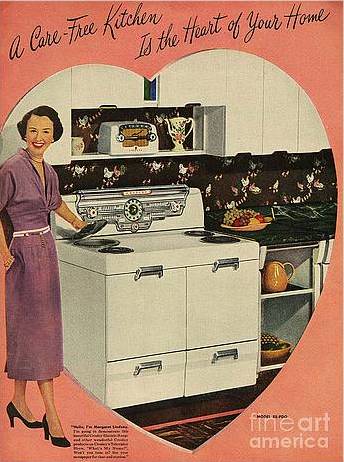
LIFE Magazine Advertisement, February 13, 1950
Cook this, clean that, take care of her – might be just a few phrases that women have adjusted to in our sexist society filled with extreme, domestic gender expectations. However, misogynistic visual images might be just as harmful, if not more disturbing than hearing these phrases. Hardworking women who finally get the opportunity to leisurely flip through an edition of LIFE magazine will be disturbed by the presence of an image blatantly supporting gender roles in the 20th century.
LIFE magazine included a Crosley Advertisement in their February 13, 1950 edition of LIFE magazine with an appearingly beautiful young woman, standing in the kitchen, happy as can be. This picture is wrapped in a heart shape with a warped title above the image stating, “A Care-Free Kitchen Is the Heart of Your Home.” The typical audience for an edition of LIFE magazine would be White, middle-class, families. For audiences of this type to view controversial images like these, poses an issue, since it only further results in unconscious support of these domestic roles inside middle-class lifestyle homes.
The casual placement of degrading advertisements in popular magazines only adds to the unconscious bias that many individuals start to hold toward women and that women start to internalize about their ingroup. This seemingly subjective piece of artwork produced by the Crosley company released in 1950, holds a high sense of control over how women live their lives and internalize sexist, domestic standards for women. These standards are emphasized based on the biased and subjective media produced and released by men and anti-feminist companies who are influenced by their own emotional beliefs while creating pieces of visual media.
The first formal element that is clear in Crosley’s advertisement is the shape he chooses to morph the picture into. Instead of having the picture take up the entire page, he morphs the picture into the shape of a heart. Because the picture includes a woman cooking in the kitchen, this portrays the notion that if the woman of the family stays in the kitchen, and cooks, the home will fill with love and joy. This heart plays a significant role in reinforcing the stereotypes of society, by visually including the positive outcome that will occur if the woman embodies society’s standards for her.
The tone of Crosley’s advertisement is very warm and inviting. The pink color, usually most associated with love and happiness, along with the heart shape, smile on the woman’s face, and the term “care-free”, all create a positive connotation with this image. Although the image might come back to stab women in the back, at first glance, the inviting tone of the advertisement draws viewers in and creates a desire to analyze it more. This inviting tone not only draws more attention to the message but also creates a false narrative about the happiness that abiding by these norms will result in. This is harmful to women because as the advertisement encourages them to feel happy and take part in culinary tasks at home, it limits their exploration of other activities that society labels as more “masculine.”
The social commentary in this image shows the lack of concern that the Crosley company uses while creating this image. Concerned photography represents the idea of creating change, and has social or political motivations that drive to reduce marginalization within and of a community. While this advertisement is not a photograph, all types of artwork can still hold concern. Instead of showing support for the marginalized female community, the image is instead in support of continuing to emphasize gender roles in society. This form of low art prioritizes mass consumption and the possible commercial and economic successes that the company could gain from the ad, rather than the depth of cultural and historical significance that could impact their viewers.
The Crosley advertisement portrays the idea of optical unconsciousness. The term optical unconsciousness is explained in A Short History of Photography stating, “Instead of a space worked through by a human consciousness there appears one which is affected unconsciously” (Benjamin, 7). While Benjamin refers to this concept through the idea of the camera obscura, the unconscious impact on human experience is present within this animated creation as well. While human consciousness does not necessarily realize the threat that the advertisement creates, it still results in women continuing to think the “norm” is to stay in the kitchen and provide for their families and the man of the home (for when he comes back from a day of work.) Instead, there is an unconscious state of abidance and reinforcement of her position next to the stove. The selling of this particular lifestyle is much more harmful than advertisements for most products. The reinforcement of these stereotypes diminishes the potential success that women would have out in the real world beyond the 4 walls of the kitchen. Because this image was created in 1950, it was a time when women faced an enormous amount of societal pressure to focus on pleasing their husbands rather than pleasing any sort of job. Because the optical unconsciousness limits the amount of conscious control women have over realizing the issue and creating change, they are instead forced to think that this is normal, since history has not shown us any better.
Additionally touching on the idea of using advertisements to sell particular lifestyles over products, relates to the case study of LIFE Magazine that we conducted in class. The ad for Charlotte Port released on December 19, 1957, shows the selling of an aesthetic, retirement lifestyle. The advertisement shows old people going to the beach and enjoying life. The Charlotte Port ad plays an active role in creating a fantasy and imaginative lifestyle that viewers of the ad get a sense of. Likewise, the Crosley woman in the kitchen advertisement also hyperbolizes a certain lifestyle, just instead for middle-class mothers rather than retirees. The technique of selling a misogynistic lifestyle as an aesthetic life expresses a lack of concern. Rather than using art to raise awareness about the misogyny of the world, it stimulates no type of empathy for the woman in the picture and instead encourages her that the kitchen is a “care-free” place for her to stay.
The image strongly lacks any sort of objective perspective. Objectivity is explained in the text, Epistemologies of the Eye, by Daston and Galison. The authors write that objectivity embraces “truth-to-nature”, and is “the suppression of some aspect of the self” (Daston and Galison, 36). Therefore, objectivity represents a subject matter that is not influenced by one’s personal feelings. This advertisement does not seem very objective, considering that it is influenced by the anti-feminine push for society in the 1950s. The production and spread of biased artwork and advertisements, not only in the 20th century but also in today’s society only deepen the struggles with gender socialization that exist in our world. Little girls should not have to grow up seeing papers and commercials that restrict their liberties to act in certain ways. To combat the issues of gender socialization and internalized sexism in the world, we must flip the negatives to positives. Instead of releasing advertisements like Crosley’s, we must spread concerned photographs and artwork that instead call for action to create a more equitable society.

Leave a Reply