Analysis by Casey Fiore
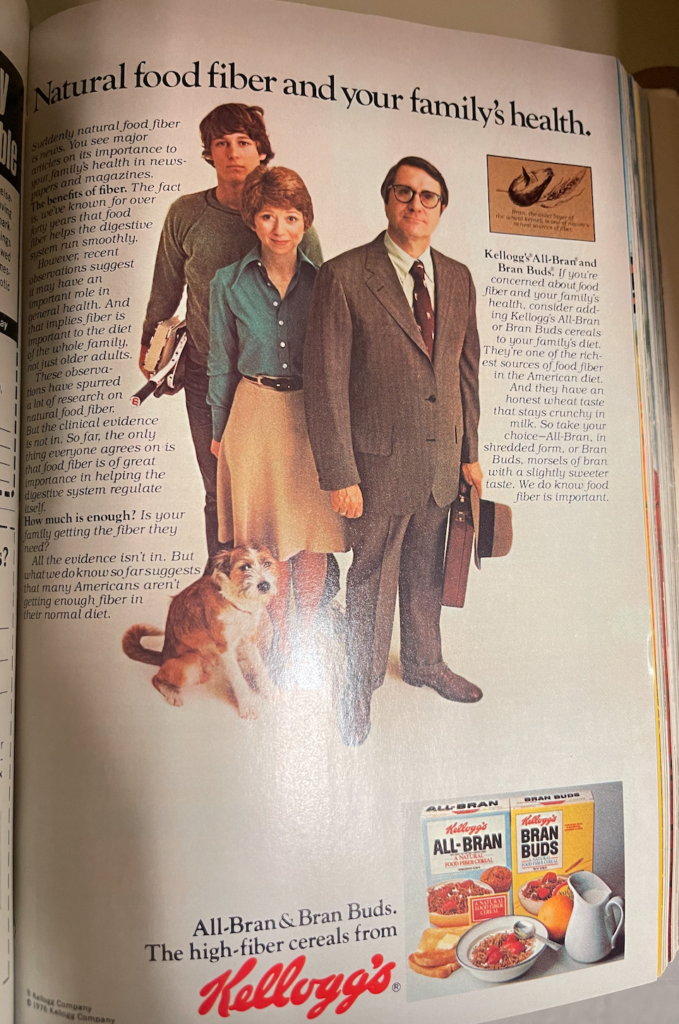
By centralizing these three individuals and animals within the advertisement, the creators of this piece are trying to connect to the viewer as a member within a family. None of the three individuals have traits that are particularly unique about them, and perhaps the intended viewer can relate to one of the three, or at the very least be prompted to visualize their own family when seeing this advertisement. By titling the piece “Natural food fiber and your family’s health” fiber is immediately connected with health, prompting the reader to associate the two as having said connection. Certain lines within a large chunk of text are bolded: “The benefits of fiber” and “How much is enough?” This is perhaps to capture the attention of the viewer and direct them to the most important aspects of the advertisement given the understanding that complete attention may not be paid to every word of the advertisement. The brand name, which also serves as the logo, sitting at the very bottom of the page alongside the two brand cereals, serves as the final lasting impression of the advertisement before the flip of the page. It essentially culminates the advertisement imprinting a visual of what a potential consumer ought to scout when making their next cereal purchase.
“Natural food fiber and your family’s health” is a 1976 Kellog’s advertisement released within an edition of National Geographic in that same year. In the foreground of the image stands a middle-aged man wearing glasses dressed in a suit and tie who holds a briefcase and hat. Behind him is a woman dressed in a collared button down shirt and a modest length skirt with a dog at her feet. A young man, her junior, stands behind her holding a tennis racket and thick textbooks. At the bottom of the advertisement is the Kellog’s logo in its traditional bright red thick font next to its two most popular cereals at the time, “All-Bran” and “Bran Buds.” On either side of the three individuals and dog are chunks of text which provide the written portion of the advertisement. In regards to content and appearance, it is not much different from ads of today’s age in the sense that there is some sort of symbolic group utilized to portray an overall message in combination with a message itself that includes information about the product’s benefits. Given that Kellog’s as a company continues to garner successful business in 2023, analyzing its advertisement approach from roughly fifty years ago gives insight toward its success as a corporation. In its attempts to gain more consumer engagement, the 1976 advertisement serves to persuade the viewer into buying Kellog’s cereal by implicating the health and perseverance of “the nuclear family.”
The efforts of this piece of visual media is two-fold: It is first attempting to capture the attention of the viewer, and if successful in this first step, it is subsequently trying to sell this viewer a product, cereal. By centralizing the family, there is an established attempt to relate to the viewer. Similar to the methods of Francis Galton, who sought to establish “a criminal type,” the creators of this advertisement have established “a familial type,” a generalization of the nuclear family to which any and all could relate. This family consists of an employed father, a modest mother, a son who is concerned with both academics and athletics, and a family dog invites the viewer to draw connections to their own family. Given that the advertisement draws on health concerns, the viewer in turn is motivated to address their own family’s health. Ultimately, the creators of the advertisement likely wished to instill a motivation powerful enough to increase consumer engagement with the product. Drawing on the work of Andrzejewski, who acknowledges the blurred line between work and leisure through the parading of the elephants at Miami Beach in the efforts to sell land, the distinction between health and family is blurred through this advertisement. A healthy lifestyle comes to mean both Kellogg’s cereal as well as the nuclear family as they are centralized in the piece. Thus, it can be argued that Kellogg’s not ultimately is advertising its product, but attempting to sell the lifestyle of the heteronormative nuclear family by making one “the poster children” of health.
A major takeaway of analyzing this piece of visual media is that advertisements are strategically cultivated to appeal to what has the potential to motivate, even if it does not at first seem explicitly implicated. By looking at this advertisement from 1976, it is clear that Kellog’s marketing team at the time felt as though promoting the heteronormative nuclear family alongside its cereal was the most efficient route in boosting sales. This speaks to the cultural climate of the age, that healthiness not only looked like an abundance of daily fiber, but two straight parents, at least one child and a dog.
Sources:
Andrzejewski, A. (2023, April 28). The hidden history of resort elephants at Miami Beach. Edge Effects. https://edgeeffects.net/miami-beach-elephants/
Bolton, R. (1992). The contest of meaning: Critical histories of photography. MIT Press.

Leave a Reply