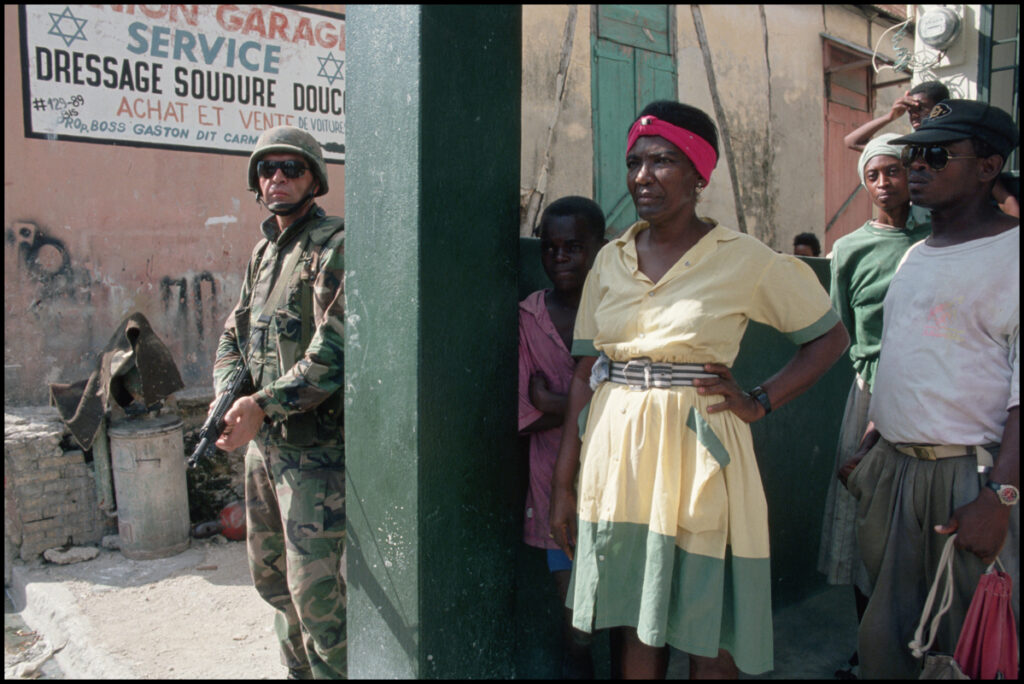
Peter Turnley is a famous photographer known for capturing the hardships, social injustices, and beauties of human life through traveling and photographing people in over 100 countries (“Moments of the Human Condition,” 2023). He understands and utilizes the power of photojournalism as a means of communicating a message, provoking raw emotion, and documenting history. Turnley values how storytelling and photography intertwine to reveal aspects of human courage, kindness, and beauty. He clearly establishes how these traits found in his work intentionally oppose the use of photography to project one’s material wealth or surface level beauty. The image above is one of the works from Turnely’s “War” series entitled Haiti (1994), which the photojournalist took in Port-au-Prince, Haiti. Other photojournalism series Turnley created to reveal the harsh truths and joys of the human experience include “Moments of the Human Condition,” “Refugees – The World’s Homeless,” “Personal,” and “Mclellan Street” (“Moments of the Human Condition,” 2023). The group of residents standing near the American soldier in Haiti (1994) includes a combination of men, women, and children, with a middle-aged woman standinding firmly in the front of the group with one hand on her hip. On the right side of the photo stands the group of Haitian residents, and on the left side an American soldier stands holding his gun ready to fire if needed. Peter Turnley’s War series, including Haiti (1994), is significant because it uses photojournalism to bring awareness to the realities of the social injustices present worldwide and forces society to acknowledge and care about these political, historical, and humanitarian issues.
For historical context regarding Haiti (1994), United States soldiers were sent in to defend the local citizens of Haiti from horrific mass homicides at the hands of a military regime that overthrew the democratically elected official Jean-Bertrand Aristide in 1991, and to aid in taking down this coup. This war effort by the U.S. was referred to as “Operation Uphold Democracy” (Bunyan, 2019). Turnley leaves space to the left of the U.S soldier in the image to expose the bare, dirty ground that appears to be made of clay that has a stack of bricks, trash bins, and a pile of miscellaneous items on the side of the clay path. Its inclusion in the photograph hints at the filth and ruin undoubtedly a result of the violent attacks by the group that overthrew Jean-Bertrand Aristide. In 1994, American troops were established in Haiti and by that October, Aristide was restored to office (Bunyan, 2019). Turnley could have chosen to photograph this scene straight on, but choose to position himself slightly to the side in order to keep this aspect of the subjects’ environment in the frame which helps the viewer form a fuller image of the scene’s circumstances. Haiti (1994) represents hope, power, unity, and the bravery of human beings, and the name “Operation Uphold Democracy” highlights the United States’s own value for democratic government and democracy’s ability to give a voice and agency to its citizens.
Power dynamics between the U.S. soldier and the group of Haitians can be seen in the photograph as well. The Haitians and U.S. soldier are physically separated by a wall, maintaining the separation between the two groups. One might also consider the perceived racial hierarchy at this time between the white American troops and the black Haitian citizens. This observation could be reflective of the American suspicions of Biden’s potentially racist reasoning for not supporting the deployment of American troops in Haiti, given that he was in support of sending U.S. troops into Bosnia the following year, a country consisting primarily of white Europeans (Scahill, 2021). A connection to philosopher Michael Foucault’s panoptic surveillance may even be drawn in the spatial distribution of the subjects in Haiti, in that distance exists between the surveyor (the American soldier) and those being surveyed (the Haitian civilians) but surveillance is still maintained regardless.
Concerned photography, a concept coined by 20th century photographer Robert Capa, is an approach to photography focused on the ability of photos to tell stories and show the essence of the human beings they are capturing (Bair, 2022). It highlights historical and political narratives, providing a somewhat more objective way of viewing the world. In the United States, concerned photography opened opportunities for the European and Jewish photojournalists whose legacies Capa wanted to preserve, and also allowed Capa and the other concerned photographers to redefine American history through photographic documentation (Bair, 2022). On a greater scale, it contributed to the integration and social mobility of immigrants in the United States. As a product of Capa’s concerned photography, Haiti (1994) documents injustice and the real human condition. Turnely attempts to capture the true human emotion in an objective manner. His entire “War” series aims to depict the full range of the human experience, from the most beautiful feelings to the most deeply painful moments (“Moments of the Human Condition”). For Turnely, that is what being alive and being human means: experiencing all of the ups and downs, joys and sorrows of life.
Turnley acquires a similar appreciation for the power of photojournalism in defining history that photojournalist Fritz Kline demonstrates in his photographs capturing the Jewish experience during World War II. Magnum Photographers, the photo agency established by Robert Capa, Henri Cartier-Bresson, George Rodger and David “Chim” Seymour who deemed themselves concerned photographers, demonstrated how social welfare was their primary goal. Through the popularization of Magnum Photographers, concerned photography spread throughout the United States but also internationally and created a mission for photographers to document history from the most raw and emotional perspective (Bair, 2022). The level of closeness to the subjects Turnley established for the viewers in Haiti (1994), places the viewers seemingly mid-action, throwing them into the tension. Furthermore, the photograph’s subjects themselves clearly exhibit concern, as they are in a vulnerable position surrounded by clear threats.
Walter Benjamin’s optical unconscious can also be applied to Turnley’s Haiti (1994), in that every aspect of the work was chosen in a way where it allows moments that viewers otherwise wouldn’t notice to be captured and added to our preexisting perception of history. The lack of eye contact with the camera the subjects’ show alludes to something off camera that isn’t revealed to the audience. Photojournalism can also show us a different way of looking at what we might see as reality. An individual’s “reality” is tainted by their own experiences, morals, and implicit biases, and photojournalism acts as an attempt at challenging this reality.Photojournalism, especially the works created by concerned photographers such as Peter Turnley, allows for the documentation of critical historical events, reveals a new way of seeing for the viewer that Walter Benjamin refers to as the optical unconscious, and can act as a mode for social liberation. Through their work, concerned photographers are able to humanize the subjects they are capturing, inspire emotional reactions in the photograph’s viewers, share the full range of the human experience with the world, and encourage conversation and change regarding the world around them. Peter Turnely’s Haiti (1994) represents all of these qualities and so much more.

Leave a Reply