
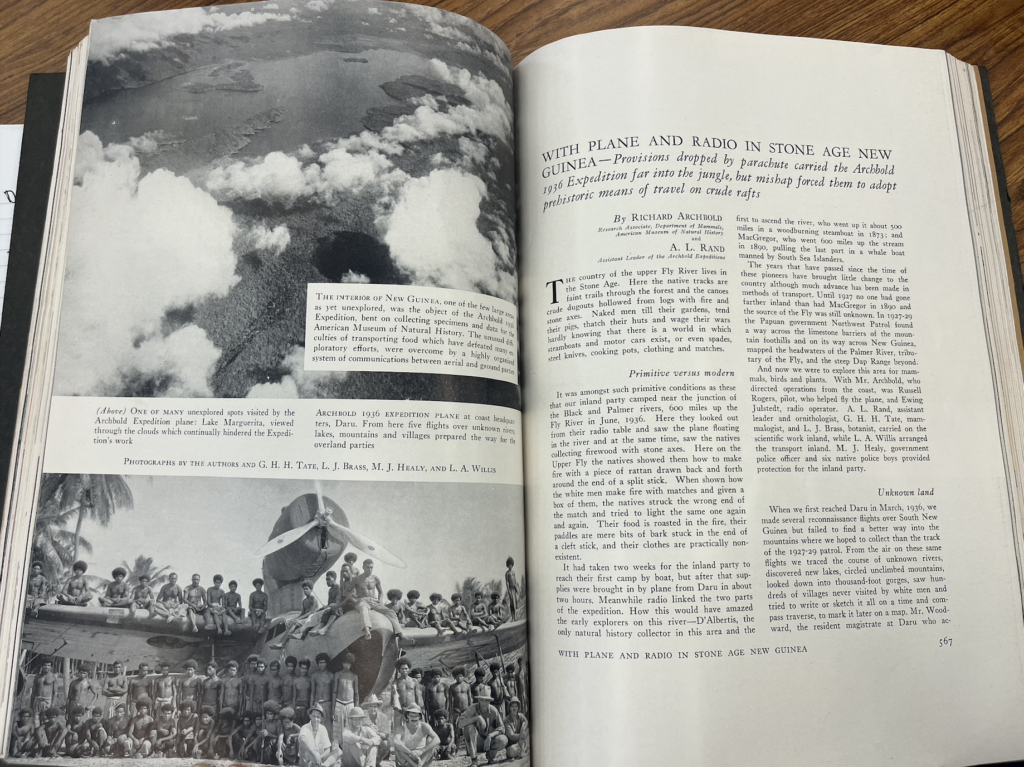
America in the 1930s was full of publications that brought images from all over the world to readers in their own home. More than ever before, it was easier to explore the world from the comfort of your couch. Natural History Magazine was one such publication that sought to connect the everyday person to images and stories from across the globe and instill in them an appreciation of science and nature. However, Natural History was not immune to social biases of the time and reflects a sense of superiority felt by the average American citizen over others. This article and accompanying photos are no different, they are from a 1937 edition of Natural History and depict an aerial photograph of New Guinea and a photograph of the white journalists and black natives together with an airplane. The accompanying article describes how the purpose of the expedition was to study the ecological and geographical relationships of animal species living in New Guinea. While the article itself recounts the adventures of the explorers, it is fraught with a sense of white male superiority that is reflected in the photographs and fits neatly into the larger history of using photography and media to establish a social hierarchy.
The top image is an aerial photograph of New Guinea, presumably taken from the plane shown in the second photo. According to the caption, the aerial shot is of “One of many unexplored spots visited by the Archbold Expedition plane: Lake Marguerita, viewed through the clouds which continually hindered the Expedition’s work.” The caption implies that these areas of land were previously difficult or even impossible to explore, but the introduction of the plane makes the task much easier. The land itself in the photo is entirely untouched by man, there are no buildings in sight, which enhances the idea of foreignness with which the reader is encouraged to view New Guinea and its people. It also has the effect of literally placing the white explorers above the native people, adding to the implied superiority.
The second photo shows the explorers and native people with the Archbold Expedition plane. The white explorers are fully clothed with shoes and hats and seated in the center of the photo with the plane directly behind. Branching out on either side of them and sitting on the plane are the black native people. In contrast to the explorers, the native people are not wearing shirts and in most cases seem to not be wearing shoes. A few of the men seem to be holding guns and while it is difficult to say what kind they were, they were likely slightly dated. The clothing differences also enhance a sense of civility versus primitivity that is highlighted in the article. In addition, by placing all the men on the plane, the photographer highlights its great size and invites the viewer to marvel at the technological achievement. The shiny modern metal plane also serves as a contrast between the unclothed native men with their less advanced weapons. The ground is made of dirt, which would have been different than any airfield in the “civilized” world, and it is possible to just barely make out the trees in the background. There are no buildings in sight, which further serves to draw a distinction between the modern world and the primitive one. However, the fact that both the explorers and native people have come together in the photograph implies a sense of meshing of the two ways of life, with the superior white man bringing the marvels of the future to the “primitive” black people. The overall effect of these photos reinforces the narrative created in the text of the article that the people of New Guinea are in desperate need of education about the so-called civilized world. The article begins by describing how “Naked men till their gardens, thatch their huts and wage their wars hardly knowing that there is a world in which steamboats and motor cars exist, or even spades, steel knives, cooking pots, clothing, and matches” (Natural History Vol. 40, no. 3, 1937. 567). Just as the words break down the native people’s way of life, the image of the men beside and on the plane serves to further trivialize the lives of the native people as they are placed in direct contrast with the plane, a representation of the might of modern society and technology.
The narrative created by these photos fits within a long history of photography being used to establish a hierarchy where the white man is on top. In an article by Krista Thompson titled, “The Evidence of Things Not Photographed: Slavery and Historical Memory in the British West Indies.” In the article, Thompson analyzes photos such as Cane Cutters, by James Valentine and Sons, in 1891, which were used as propaganda to show how British colonialism was improving the lives of Jamaican people. The photo is very clearly staged, and shows Jamaican field workers at rest, and was intended to show viewers how Britain was bringing in an era of a “New Jamaica” that was modernized and open for tourism. Thomas writes that, “Crafters of Jamaica’s new image enlisted British, American, and local photographers to produce, perpetuate, and project a new vision of the post-emancipation era in the British colony” (Thompson, 45). As was discussed above, similar ideas are at play in the photograph with the airplane. Like in Cane Cutters, the subjects of the plane photo are clearly posed and photographed in a way that highlights the apparent positive influence white men bring to “primitive” societies. These connections to Thompson and Cane Cutters helps further exemplify how the Natural History article and photographs fit within the larger history of using photography to establish white male dominance. The photographs can also be connected to the concept of advertising, although they were not selling a good, the photographers and writers of Natural History were selling a story, a narrative, to their readers and the images were just as important as they would be in any advertisement. Anna Andrzejewski’s essay “Work, Play, and Elephants in South Florida’s Leisure Landscape” explains how photographs used elephants to create an idea of Florida as an exotic place of leisure. Just as the elephant acted as a prop to signal how Florida could be a “place of play,” the plane functions as a prop to signal how New Guinea is a place of primitivity.
The concept of controlling how images are received is one that predates the idea of photography, dating way back to how paintings were arranged in museums. However, it is still an idea people were returning to in the 1930s, and into the modern day. The photos used in this article, particularly when put in conversation with the article itself, create a striking image of the blurring boundaries between the “civilized” and the “primitive” and establish the explorers as the saviors bringing modernity to the ignorant world.
Sources:
Andrzejewski, Anna. “The Hidden History of Resort Elephants at Miami Beach.” Edge Effects, 28 Apr. 2023, edgeeffects.net/miami-beach-elephants/#:~:text=The%20laboring%20of%20the%20elephants,between%20human%20and%20more%2Dthan.
Archbold, Richard, and A. L. Rand. “With Plane and Radio in Stone Age New Guinea.” Natural History, vol. 40, no. 3, 1937, p. 566. Thompson, Krista. “The evidence of things not photographed: Slavery and historical memory in the British West Indies.” Representations, vol. 113, no. 1, 2011, pp. 39–71, https://doi.org/10.1525/rep.2011.113.1.39.
Thompson, Krista. “The evidence of things not photographed: Slavery and historical memory in the British West Indies.” Representations, vol. 113, no. 1, 2011, pp. 39–71, https://doi.org/10.1525/rep.2011.113.1.39.

Leave a Reply