Sandy Thai
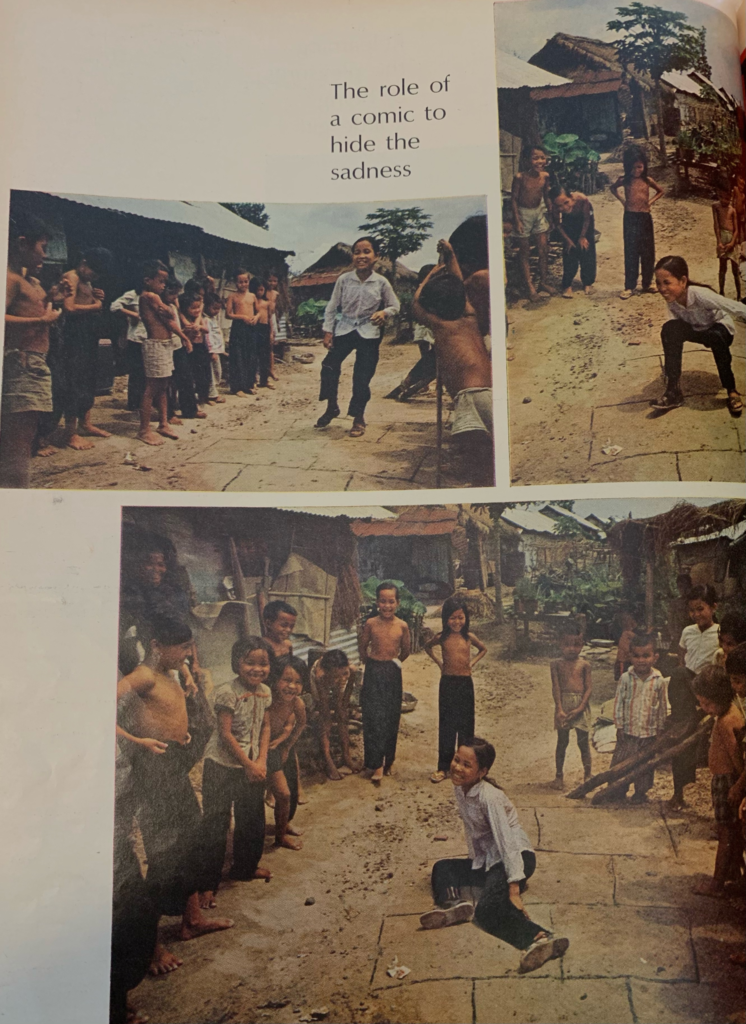
The Edge of Peace, 1968, LIFE.
Larry Burrows’s “The Edge of Peace” centers around a young Vietnamese girl named Tron and her family’s evacuation to the village of Adien as tensions between Americans, South Vietnamese, and the Viet Cong increased. Tragedy strikes when Tron and her friends venture into a ‘free-fire zone,’ resulting in Tron losing her lower leg. Beyond being the image’s focal point, this moment prompts a critical examination of the relationship between concern for social welfare and visibility being a trap. The exploration of this connection delves into whether the focus on Tron encapsulates genuine care for her well-being or incorporates a form of deliberate, possibly controlled observation or framing of her narrative. By intertwining concern with a Foucauldian lens on visibility as a trap, the photograph raises a critical question: Is Tron truly the subject of concern, or is her narrative strategically employed to evoke broader sentiments about the Vietnam War among Americans by Larry Burrows? This inquiry delves into the complex ethical considerations inherent in photojournalism, revealing the potential dual nature of attention—one driven by authentic care for the individual and the other shaped by intentional narrative framing for broader societal impact.
As we analyze Larry Burrows’s “The Edge of Peace,” Bair’s concept of the “concerned photographer” emerges as a crucial lens through which we scrutinize the narrative. This concept underscores a photographer’s ethical responsibility to engage with the social and political contexts surrounding their subjects, prompting a critical examination of the alignment of this photojournalism piece with these principles (Bair, 83). While Bair’s concept of the “concerned photographer” was initially applied to photojournalism in WW2, its relevance persists here. Examining this specific image within the piece, we encounter the bold declaration, “The role of a comic to hide the sadness,” positioned above the image, portraying Tron as a comic using humor to mask her underlying sadness. Instead of framing it as an attempt to mask pain, could it not be seen as a genuine expression of happiness, a shared moment of children having fun? The consistent portrayal of Tron as a victim raises a vital question: Why can’t these children, including Tron, be seen simply as children, experiencing the joy of play and camaraderie, free from the weight of war-induced trauma? This portrayal raises concerns about the potential manipulation of the narrative by Larry Burrows to cast Tron solely as a victim. The intentional focus on Tron, coupled with a persistent victim narrative, leads us to question whether the genuine concern centers only on her or if she is strategically employed to evoke broader sentiments about the Vietnam War among Americans. In exploring this aspect, we draw connections to Foucault’s concept of visibility being a trap, suggesting that Burrows may be crafting a specific perception of Tron to serve a broader agenda (Foucault, 97).
The concept of Foucault’s assertion that visibility is a trap vividly exemplifies in Tron’s narrative in “The Edge of Peace.” The comparison to a panopticon, a circular prison where occupants are seemingly under constant observation, underscores how this form of surveillance becomes a method of control (Foucault, 97). In Tron’s case, her story, captured by American journalists and published in a widely circulated American magazine, transforms her into a subject constantly under the watchful eyes of a wide audience. The narrative explicitly portrays her trauma, emphasizing the loss of her lower leg and her subsequent struggles. This intense visibility, shared with millions, strips Tron of the agency to control her own narrative. The portrayal of her daily activities, interactions, and playtime, meticulously framed by the journalists, reinforces the idea of a panoptic gaze shaping her story. The chosen sequence of images and accompanying text strategically shapes her identity into a predetermined narrative, limiting the complexity of her individuality and story. In this way, the visibility becomes a trap for Tron, constraining her portrayal within a predefined framework that aligns with the journalists’ agenda and the broader sentiments they aim to evoke about the Vietnam War among Americans. The visibility, intended to raise awareness, paradoxically becomes a form of confinement, restricting Tron’s representation and autonomy in the narrative created around her.
The deliberate choice to publish the piece in an American magazine and present it in English underscores a strategic effort to target a wide American audience. This prompts a reflection on how Americans, already opposed to the Vietnam War, would emotionally respond to witnessing its impact on innocent children, with Tron as a focal point. Choosing Tron, a young girl from an impoverished village, will further garner sympathy from the American audience. The Vietnam War not only affected villages but also cities. While photojournalists could have chosen to tell the story of an adult living in the city impacted by the war, it would not have been as impactful as portraying a young girl living in already destitute conditions, now severely injured from the Vietnam War. The strategic choice to not only feature Tron but constantly paint her as a victim, even in a moment of game and play, further supports the idea that Tron is strategically used to fuel anti-war sentiments rather than being the sole concern of this piece.
Bair’s concept of the “concerned photographer” invites reflection on whether the narrative choice to consistently depict Tron as a victim aligns with the ethical responsibility to present a nuanced understanding of her identity beyond the confines of war-induced trauma. The discussion prompts a critical assessment of whether the photojournalists authentically engage with the social concerns or are driven by a specific agenda, challenging the ethical foundation of concerned photography. In tandem with Capa’s strategic positioning of exhibitions aligning with broader American values, my analysis underscores how “The Edge of Peace” is narrated through these values, ultimately compromising Tron’s individuality and story outside of a victim (Bair, 86). The juxtaposition of Tron’s visibility within the panopticon metaphor, drawing from Foucault’s theories, adds another layer, highlighting the trap of visibility and its impact on shaping her narrative; she is now forever known to the millions of strangers who have read this piece as the young Vietnamese girl who is disabled because of the Vietnam War, and nothing more.
References
Michel Foucault, “Panopticism” from Discipline and Punish (1977), in A Critical andCultural Theory Reader, (Toronto: University of Toronto Press, 2004), 94–101.
Nadya Bair, “The International Origins of ‘Concerned Photography’: Cornell Capa in the United States, Japan, and Israel.” American Art 36, no. 2 (2022): 75–101.

Leave a Reply