By Aden Soroca
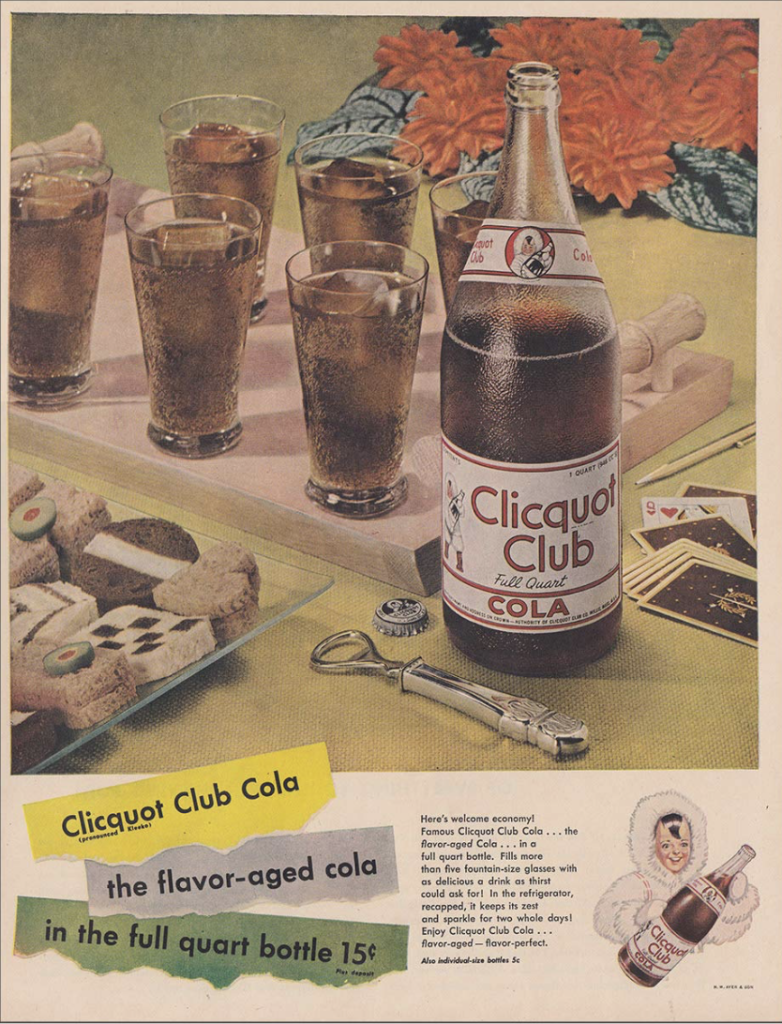
A 1948 edition of Time Magazine features an eye-catching advertisement from a beverage company formerly known as Clicquot Club. The company produced beverages such as cider, ginger ale, and other flavors of soda during its existence from the late 19th century until the mid-late 20th century. The full page advertisement attempts to sell the company’s full quart bottle of Clicquot Club Cola by creating a piece of visual media that is appealing to consumers and portrays necessary information to sell the product. The style of the media adopts a common look for a 1940s advertisement: hand drawn and aesthetically pleasing images, little words and no clutter to distract from the main attraction, and information about the price in bold letters. The year 1948 occurs at a time just slightly prior to the Jet Age, an era where air travel boomed and became more of an entertainment and luxury experience, as well as the creation of DisneyLand. Both the Jet Age and DisneyLand usher in a time period in which experiences and advertisements were designed to lure consumers in to spend money and feel like they were part of something exclusive. The advertisement published by Clicquot Club in a 1948 edition of Time Magazine attempts to take a common good, like soda, and display it in a way that makes it seem like a luxury good.
During the Jet Age, passengers would dress up to enjoy food and drinks on the flight as opposed to air travel today where passengers sport casual clothes and fly to get to their destination as fast as possible. Trans World Airlines (TWA) published an advertisement in the 1950s that was titled “Have dinner tonight with the stars!” The ad depicted three white adults dressed up while being served drinks in glasses and food with fancy plating. The ad also implies that air travel was exclusive to wealthy people and that traveling will make you feel like a star. The Jet Age was all about a certain aesthetic that made people feel like they were indulging in an experience that was unique and otherworldly: the ad for the Clicquot Club Cola is no different. Prices for air travel were very high during the Jet Age because of advertisements like the TWA’s that essentially limited air travel to wealthy white people who drove up the prices on high demand. While the price of the Clicquot Club Cola depicted in the advertisement is relatively low, even when converted to modern money, it still attempts to make consumers feel like drinking their beverage is a luxury. A choice made by the company was to call their beverage “Club Cola” instead of “Soda” to invoke a fancier feeling. Club Soda relates to images of country clubs and fancy restaurants where guests sip on sparkling beverages that could simply be advertised as cheap carbonated water with tonic. Furthermore, the ad features a cartoon image of a little white boy wearing a fur coat and holding a large bottle of the beverage. Adding onto the Jet Age Aesthetic, a fur coat is a symbol of wealth and style: if there was a little boy wearing rags instead of the boy in the coat, the beverage would seem much less appealing. By taking an object as basic as soda and advertising it in a way that is rooted in “profound visual and sensory design and intention”(Schwartz, 9) like the Jet Age Aesthetic, Clicquot Club was able to enjoy success and employ tactics to make their beverage feel like a luxury.
During 1955, the height of the Jet Age, Walt Disney introduced the world to a futuristic and architectural masterpiece that is DisneyLand. The parks were carefully crafted to “unfold a narrative” through “visitor motion” and create entertainment experiences that transported people to new realms (Schwartz, 8). Each building, road, form of transportation, and any other aspect of DisneyLand had a purpose for its existence and exact placement. For example, visitors of DisneyLand could have made their way through the park on a wide variety of transportation devices that “were set in an evolutionary relation to each other, from the simplicity of the Indian War Canoes and the Mike Fink Keel Boats, to the sophisticated beauty of the three-masted Sailing Ship Columbia”(Schwartz, 22). The purpose of each form of transportation was to tell a story through time. Similarly, the placement of accessory objects in the Club Cola ad help to convey the image of luxury. The overall feel of the ad is a fancy table, maybe at a country club, or a restaurant, or someone’s home. In the left corner, we see cookies on a glass platter that don’t look like ordinary chocolate chip or sugar cookies; they are textured and cut to look fancy and clean. If one is drinking this beverage, it is implied that they should enjoy it with a snack that is held to the same standards of luxury. The six glasses of the beverage are designed to look crisp and cold with ice cubes and bubbles that can make one’s mouth water. The wooden board that the glasses are served on, along with the textured-steel glass opener, the playing cards, and the flowers on the top of the ad all serve the purpose of creating a fake environment that transports the consumer to a place of luxury and class. For example, a person drinking the Club Cola in the kitchen of their cramped apartment in New York City may feel like they are drinking it around a lunch table of men wearing suits and smoking cigars. Like DisneyLand, the ad attempts to tell a story, or paint a picture, of how they advertise the classiness of their beverage by creating a fancy environment as somewhat of a ‘hype man’ to the main event.
The extras in the advertisement can also be viewed as a distraction, as previously discussed, and used to make the drink seem of higher status than it really is. Similarly, Carl Fisher initially wanted elephants at his resort to “get a million dollars worth of advertising” out of the elephants (Andrzejewski). He attempted to use the elephants to foster a different environment at his hotels: one that excluded black workers who were replaced by the elephants. The elephants were used to spruce up the resort; a new element of prestige that was also designed to bring in more customers. Relating this concept to the ad, the cookies, fancy glasses, steel bottle opener, playing cards, and the flowers are all in the advertisement to distract the viewer and make them purchase the drink.
The goal of advertising is to take a good or service and sell it to the consumers in any way possible. It is a game of deception and lies that relies on false imagery to make an object seem greater than it is. Clicquot Club plants accessories around their beverage to spruce it up and sell it to the consumer: similar to the Jet Age Aesthetic of promoting travel as a high-class experience that was much more than getting from point A to point B. The precise placement of each object tells a story of the manner in which the beverage should be consumed, just like how DisneyLand brings guests on a story through time by using different modes of transportation at a specific moment. In an era of fake news and artificial intelligence, one can wonder how the world of advertising will change going forward. Maybe companies will falsify their advertising even more, maybe it will get to a point where we as consumers have no clue what is real and what is AI. However, one thing can be certain in advertising: companies will continue to have their goods and services backlit by fancy accessories to persuade consumers into purchasing their goods.
Sources:
Schwartz, Vanessa R. “Jet age aesthetic: The glamour of media in motion.” Yale University Press, 2020.
ANDRZEJEWSKI, A. (2023, April 27). Work, Play, and Elephants in South Florida’s Leisure Landscape. Edge Effects.
RETRO AD OF THE WEEK: TWA, 1952. (n.d.). MASCOLA GROUP BLOG. https://mascola.com/blog/retro-ad-of-the-week-twa-airline-marketing/

Leave a Reply