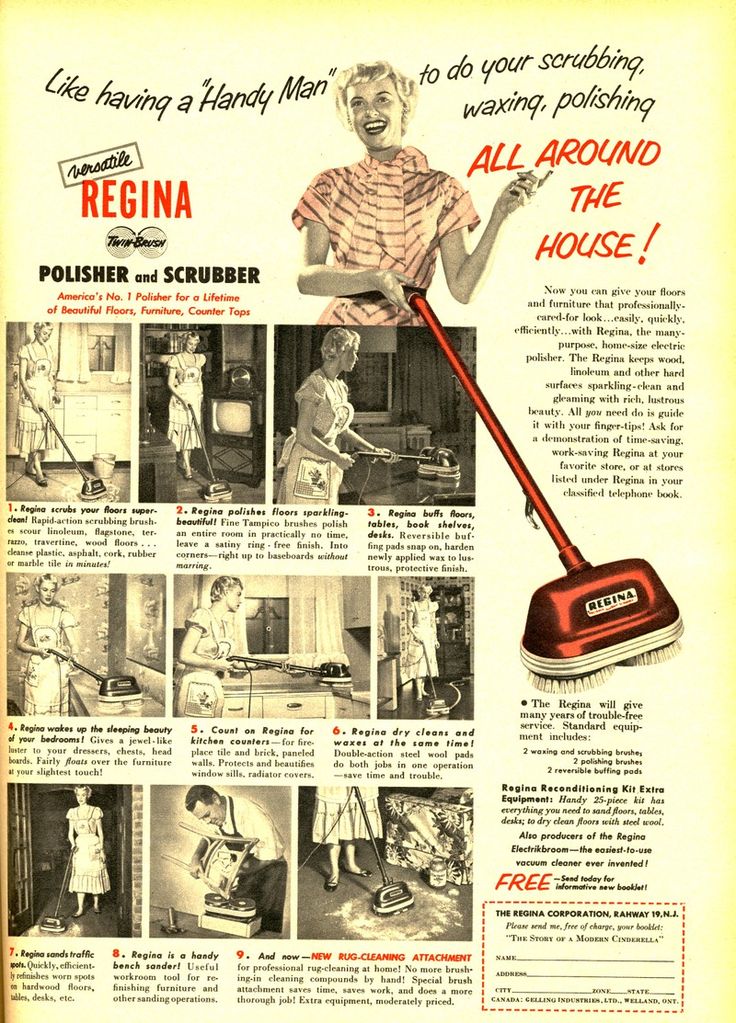
This is an advertisement made by the Regina Corporation for the Regina polisher and scrubber published in LIFE magazine in 1953. This advertisement depicts various ways to use The Regina in different rooms in a home. Eight of the nine pictures show a woman, wearing an apron on top of a dress, using the Regina on various surfaces and rooms. The one other picture shows a man using it as a sander. Under each of these pictures is a bold statement, and a one sentence description of the new way The Regina is being used in the picture. At the top of the page is the woman again, holding The Regina, which takes up a larger portion of the page. In addition, it is also the only element of the image that is in color. This emphasizes that the Regina is the product that this advertisement is aiming to sell. Since this woman is in the majority of these pictures, it can be assumed that this scrubber is being marketed towards women. This advertisement ultimately portrays stereotypical gender roles during the 1950s through marketing this cleaning product to women, implying that women should be the person in the house who is cleaning.
The idea that women should be the member of the household who cleans is implied in this advertisement because the woman is almost always the one who is shown using The Regina. When the woman is shown using the tool, it is portrayed as a cleaning or polishing tool. In contrast, the one and only time a man is shown to be using it is when it is portrayed as a workroom tool. This implies the stereotypical gender roles of the woman in the house being the one who cleans, and the man as the one who should be doing the manual labor, and working in the “workroom”. Advertisements like these enforce the ideas of these gender roles into the readers of the magazine. In “A short history of photography”, Walter Benjamin states “However skilful the photographer, however carefully he poses his model, the spectator feels an irresistible compulsion to look for the tiny spark of chance, of the here and now…”. This statement is referring to the idea that no matter which way the photographer takes a photograph, the contents of the photograph will have an effect on the viewer, either consciously or subconsciously. Even if the Regina Corporation did not have the intent of portraying stereotypical gender roles in this advertisement, the readers of the magazine will be affected by what they see. This was a common theme in advertisements and other media in the 1950s. Each time a person is viewing one such advertisement or piece of media, the gender roles are instilled into them. These types of advertisements are harmful, as they reinforce the sexist idea of the domesticated woman.
Through portraying these gender roles, this advertisement is also showing the influences of the television. The television was an impactful invention at the time, as it came about in a post-war time, and so it influenced the redefinition of the idea of normal: “Television quickly redefined what constituted membership in a society” (Crary, 79). The television became an essential part of each household, it can even be seen in the background of this advertisement. As a result of the television, the nuclear family was a popular ideal at this time. It was often portrayed both through advertisements for the television, and the shows that were played. The nuclear family is the idea of a married couple with kids, where the father works and the mother stays home, takes care of the kids, and cleans. Often, television shows would center around a family with a working father, and a stay at home mother, or advertisements would show one happy family sitting around the television. Once again, this goes back to the sexist ideas of gender norms.
Through advertising their cleaning products in this way, the Regina corporation is further promoting these sexist ideals. This advertisement would be just as compelling if a man was shown in these pictures instead of a woman. So why did they choose a woman? This advertisement was marketing toward the idea of the nuclear family. As previously noted, this advertisement portrays the gender norms seen in a nuclear family through showing the wife as the cleaner, and the husband as a blue collar man.
Through portraying the husband as a manual laborer and the wife as a cleaner, this advertisement is portraying the “ideal” domestic family at the time. This is a harmful image to be portraying, as it perpetuates the idea that women should be domesticated and should not be working. This advertisement further contributes to the already existing stereotypes and biases of domesticated women. This is just one of many examples of advertisements and media at this time that portray these sexist stereotypes. Each of these images have an effect on the viewer. If these viewers are young girls, it begins to put these stereotypes into their heads already. This will affect how these girls think about themselves and will impact how they contribute to society. If a girl were to see this advertisement, it would make her believe that she is meant to clean, and the men are supposed to be working. Not only would this affect girls, but if a young boy were to see this it would also affect his perceptions of women. When children are raised in an environment that accepts these biases towards women, it defines how that generation will act when regarding gender. Advertisements such as these ultimately perpetuate social norms.
Works Cited
Benjamin, W. “A short history of photography.” Screen, vol. 13, no. 1, 1972, pp. 5–26, https://doi.org/10.1093/screen/13.1.5.
Crary, Jonathan. “24/7: Late Capitalism and the Ends of Sleep.” (2014): 61-89

Leave a Reply