Looking for a winter getaway? A trip to the West Indies with Pan American World Airways may be what you are looking for.
This 1948 edition of Life magazine advertises Pan American World Airways, the first airline to fly worldwide and the pioneer for numerous innovations of the modern airline industry. Known as the “world’s most experienced airline” Pan American advertisements enticed travelers with the endless possibilities of the glamorous destinations they could visit. This advertisement features one of those destinations- The West Indies. Through this magazine page, Pan American advertises that by flying with them, “you get there in only a few hours!” The advertisement displays three different picturesque images of the West Indies. The photos capture the warmth and relaxation behind vacationing on the island. The biggest image shows the relaxing and scenic blue Caribbean with vacationers lounging along the beach. The bottom left image depicts a “beautiful and restful” beach that is filled with palm trees and people. Finally, in the bottom right image, a couple walks alongside the water. All of these photos create a picture perfect view of the West Indies. The photos direct themselves through the tourist’s viewfinder and into a spectacle that can be consumed. With these depictions, I argue that this advertisement uses a photographer’s gaze to create an idealized version of the West Indies that obscures the harsh realities behind its historical narrative.
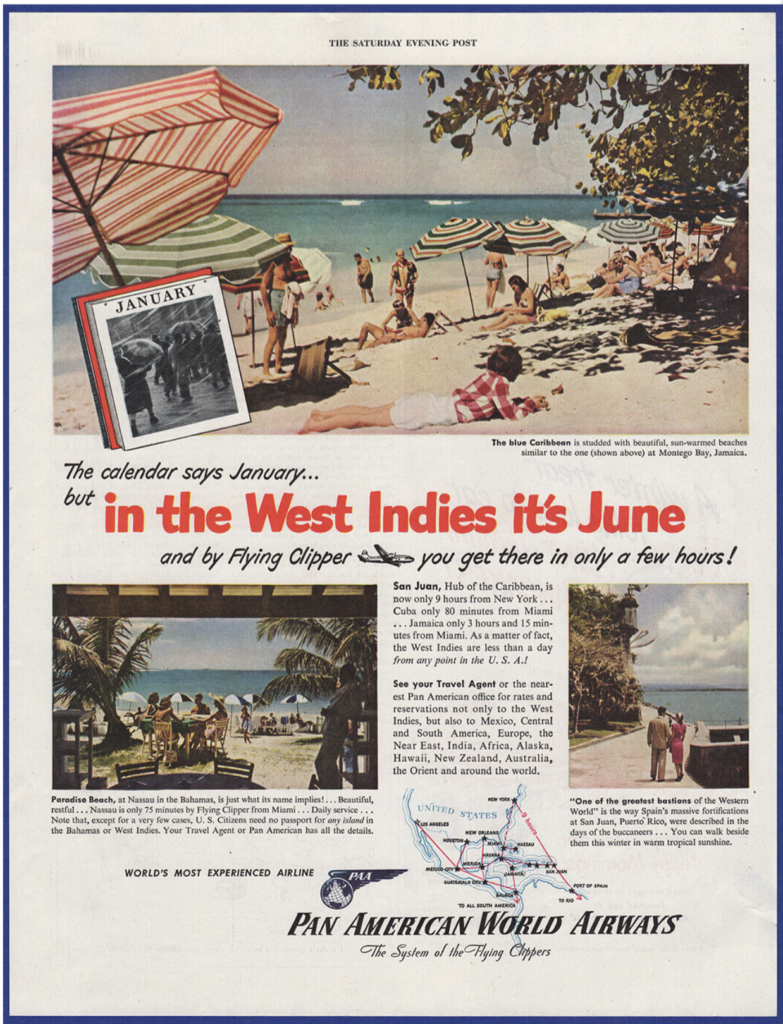
Through the advertisement, Pan American Airways is selling a particular lifestyle. They are expressing the idea to the audience that by flying with Pan American, travelers can take part in this relaxing getaway. With all of the color and warmth that these photos encapsulate, it creates a reality for the viewer that may not be so accurate. Krista Thompson highlights this idea through her research of the West Indies. Thompson explains how the enslavement period within the West Indies has been obscured by the new, idealized version of the island that was created. She describes that in order to bring about “‘the New Jamaica,’ promoters discerned that they had to create images to dispel widespread fears or the tropics as the place of death and disease… they had to debunk concerns that Jamaica had been ‘ruined’ by emancipation” (45). Therefore, picture perfect ideas of Jamaica were created in order to hide the harsh realities of its past. Through the Pan American advertisement, a redemptive potential is crafted of the West Indies. The advertisement shows the island’s tropical and bountiful appearance while obscuring its somber past. Through the gaze of the photographer, representational practices are used to change or hide the historical past.
Pan American Airways hooks the audience with their choice of aesthetic pictures as well as an enticing slogan. Their catchphrase “the calendar says January… but in the West Indies it’s June” leaves the viewer longing for a trip to the island. The advertisement also includes a black and white photo of a rainy day to create a contrast between weather in the West Indies versus elsewhere. Another interesting take away from the advertisement is the lack of diversity on the beach. In each image, only white people are being depicted. Using Walter Benjamin’s concept of aura, we can look at the advertisement and try to develop a sense of the time that the image was produced. The aura of the image may be influenced by the social inequalities such as racial segregation during the time the photo was taken. With the advertisement being produced in 1948, this was an important time in the civil rights movement. During this year, President Truman banned racial segregation in the armed forces and federal civil service. Despite this, the image illustrates a lack of integration which may actually contribute to what Benjamin calls fog. Whereas the aura develops a “web of space and time” in a photo, the fog opens up new creative possibilities about what is occurring (20). While we know when the advertisement came out, it does not seem to line up with the newly founded desegregation laws. Therefore, fog is created as a result of the disruption to time and space. While these photos appear to be dated in 1948, it still contains a contrast between the racial dynamics that should be existing at the tie. Ultimately, with the loss of aura, it creates new space to think about moments in time from before and after the image was taken.
Ultimately, this advertisement fails to show an objective truth about the West Indies. Instead, it uses images to transform the West Indies into a spectacle that can be consumed by travelers. The photos that the advertisement depicts work to create an obscuration, abstraction and erasure of the enslavement that was once present in the West Indies.
Benjamin, Walter. A Short History of Photography* Walter Benjamin the Fog …,monoskop.org/images/7/79/Benjamin_Walter_1931_1972_A_Short_History_of_Photography.pdf. Accessed 15 Apr. 2024.
Thompson, K. (2011). The evidence of things not photographed: Slavery and historical memory in the British West Indies. Representations, 113(1), 39–71. https://doi.org/10.1525/rep.2011.113.1.39

Leave a Reply