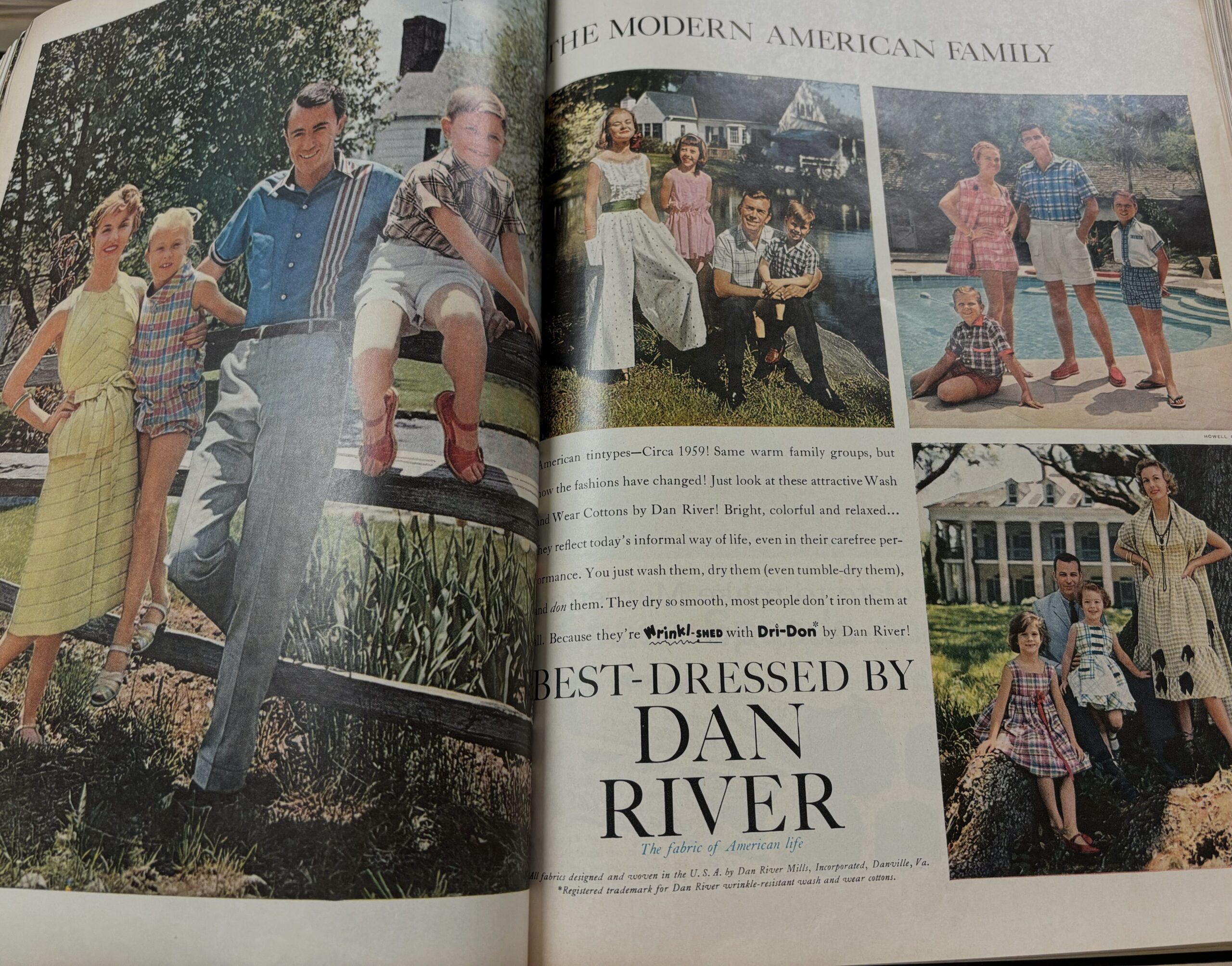
The above piece of chosen visual media is an advertisement for “wrinkle-shed” clothing by Dan River. The advertisement appeared in Life Magazine in 1959 (V. 46). As shown, It depicts four separate images of white, heterosexual, and seemingly married couples wearing the bright-colored clothing being advertised. In this way, the advertisement makes a statement beyond clothing, and into the kinds of people and communities the clothing is suitable for because of its lack of inclusivity among other types of people and families.
The way in which the advertisement is set up, the use of photography really jumps out at you. The main mode of advertisement is through the pictures and the text seems to be more of an afterthought. The words that jump out the most are that of the name of the company, Dan River, as it is printed in such larger text. Moreover, perhaps when one is scanning through a magazine the company is associated directly with the photographs because that is what the eye is drawn to first.
Now let’s take a closer look at the photographs.
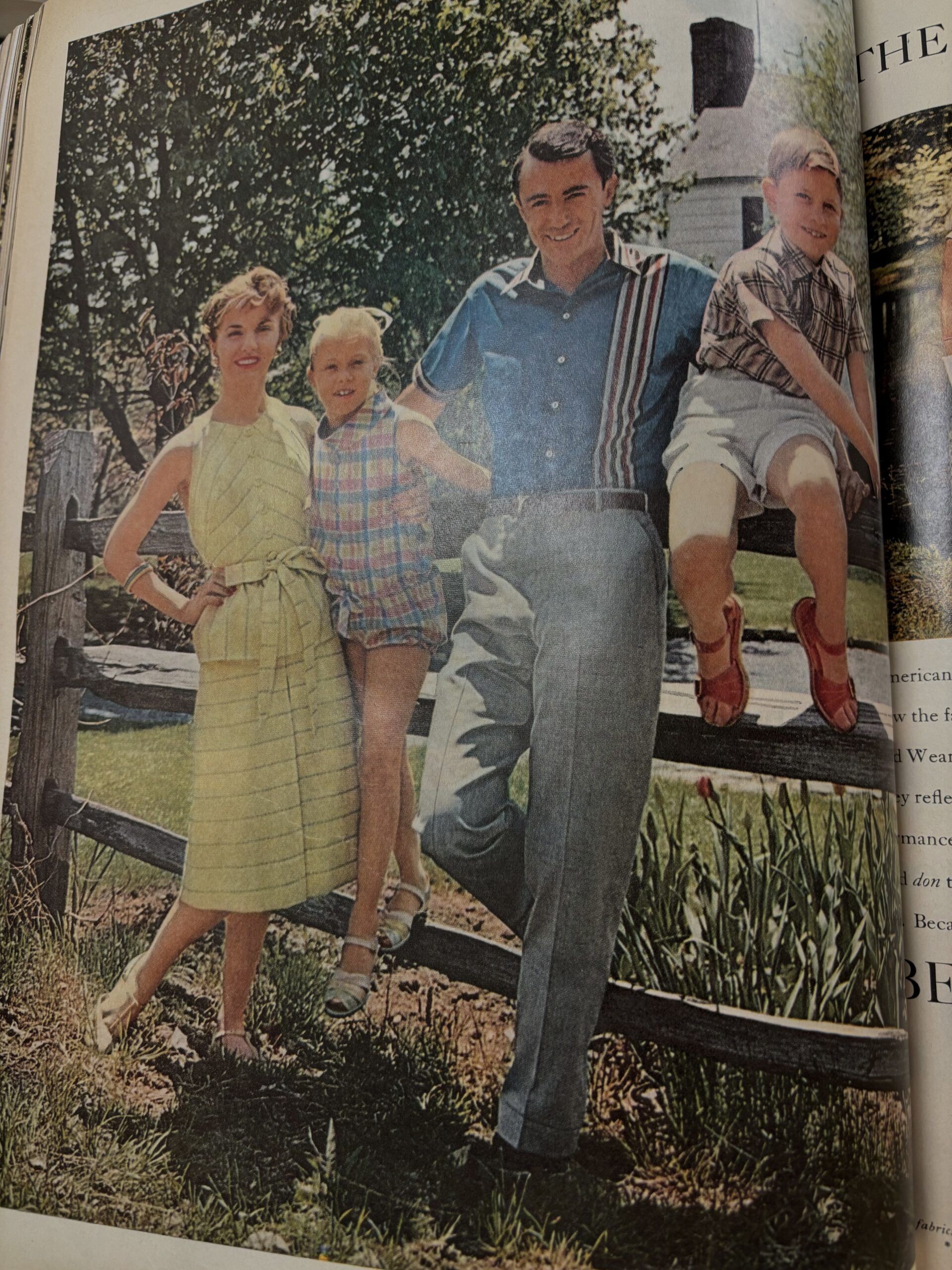
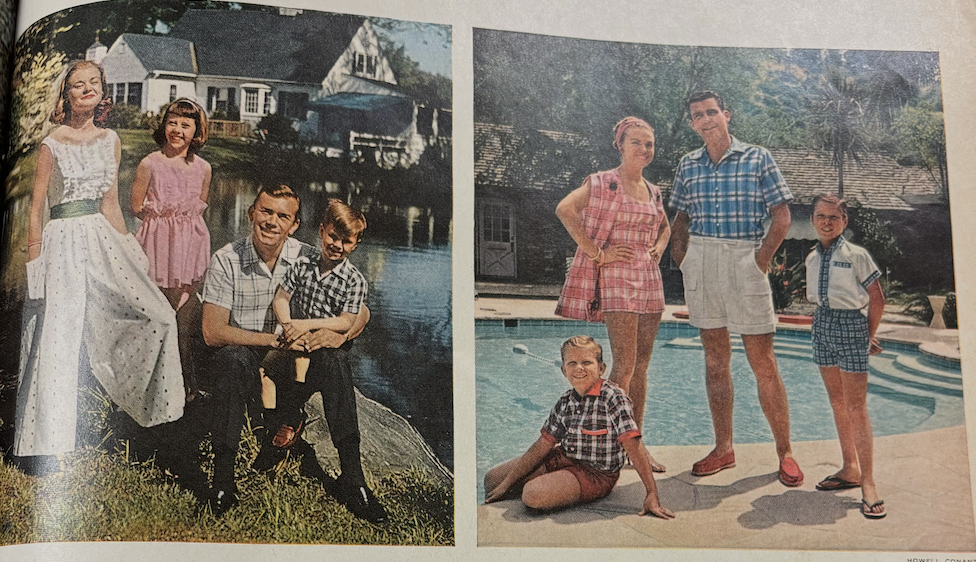
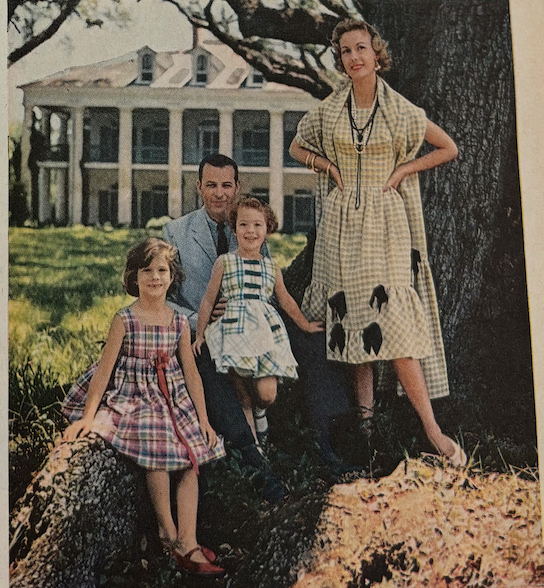
The way the photographs are set up are very congruent, given that they picture what seems to be a married man and women, and two kids. Each picture gives a different combination of children: two boys, two girls, and then one boy and one girl. In this way, it allows for white upper class families to identify with one of the pictures if they too have two children they need clothing for. It is clear that the families within the photographs are quite wealthy, considering the backgrounds to which the photos are taken – large backyards, mansion-like houses, and a swimming pool.
However, aside from the pictures, one of the most important elements of the advertisement is the text at the top which says, “The Modern American Family.” In this way, the advertisement directly links the photos used to what it means to be a family in America. Therefore, it places white, heterosexual, upper class families in a “normal” category and then displaces other kinds of families to a group, perhaps considered as “other.” This then places an approach to the advertisement that may differ depending on the year and climate it is being viewed. For example, when we see this advertisement in today’s day and age, many people would recognize the flaws in labeling the photos a “modern American family” as we know that families have much more variety than those showcased within the advertisement. However, when one would see that advertisement during the time it came out in 1959, those who identify with the families are then validated, and perhaps able to perpetuate this idea of othering families that do not fit the certain criteria within the advertisement.
In addition, it is clear within the photos that they were very manicured and unrealistic of what a family dynamic may look like. For example, each photograph displays posing similar to that of a family portrait with each individual wearing bright and cheery clothing, and positioned in order to see the things like their houses and swimming pools in the background. The families in the photos are smiling creating this artificial world in which the photographs live. This establishment of a perfect reality is not something unique to this advertisement, but something we encounter all the time. In the chapter, “Disneyland and the Art of People Moving” from the book Jet Age Aesthetic: The Glamour of Media in Motion by Vanessa Schwartz, the construction of Disney is discussed. As a whole, Disney creates fabricated images representative of Florida, in order to advertise and build a material place. In doing so, according to some critics it creates images of “[a]merican expansion; consumerism; the racial constructions of whiteness, racism, and racial exclusion; and the perfection and conformity of the environment. To these critics Disneyland is a very dangerous place indeed, especially because it performs its content as ideological mystification with a smile on its face to an unwitting audience” (Schwartz 6). Of course, the construction of Disney is on a much larger scale than an advertisement in a magazine, but nonetheless, we see a similar thing happening where it builds this “material” representation of what a modern American family is like which contributes to issues such as social class and race.
Moreover, the advertisement may be expressing approval of these specific lifestyles – those, as said above, of upper class families. In turn, the advertisement allows for the brand to position itself into a domain in which only these types of people are wearing the clothes, and since white, upper class individuals held the most power and prestige within America during the late 1950s, then this brand too would hold that same power or level of esteem.
Despite the advertisement coming out in the late 50s, that does not mean that the issues and feelings it raises are thrown away in the modern day. Moreover, an interesting component of the advertisement is its ability to evoke emotion and feeling over eighty years later. In this way, perhaps it is able to transcend time and space causing a disruption in its aura. As Benjamin writes, “[a] peculiar web of space and time: the unique manifestation of a distance, however near it may be” (Benjamin 20). While there are certainly characteristics within the photos that place the image in a respective time and place such as the clothing worn, the concept of family photographs is something that still has value today. In this way, the photos evoke what Benjamin refers to as the “fog” in which time and space becomes disrupted. While yes, these photos may appear dated to a modern lens the emotions they evoke of family, class, and race dynamics are still prevalent today. Therefore, it leaves a viewer in modern day in a strange position between the old and new “world.”
So, in conclusion, what we take away from this advertisement is that it makes much more of a statement beyond selling clothes, but that of a lifestyle as well. From a modern perspective we are able to see a juxtaposition between moving away from selling a lifestyle like this to how white, heterosexual, and upper class families are still highly regarded within American society.
Benjamin, Walter. A Short History of Photography* Walter Benjamin the Fog …, monoskop.org/images/7/79/Benjamin_Walter_1931_1972_A_Short_History_of_Photography.pdf. Accessed 15 Apr. 2024.
Schwartz, Vanessa R. “Chapter 2. Disneyland and the Art of People-Moving.” Jet Age Aesthetic: The Glamour of Media in Motion, 2020, pp. 57–97, https://doi.org/10.37862/aaeportal.00209.003.

Leave a Reply