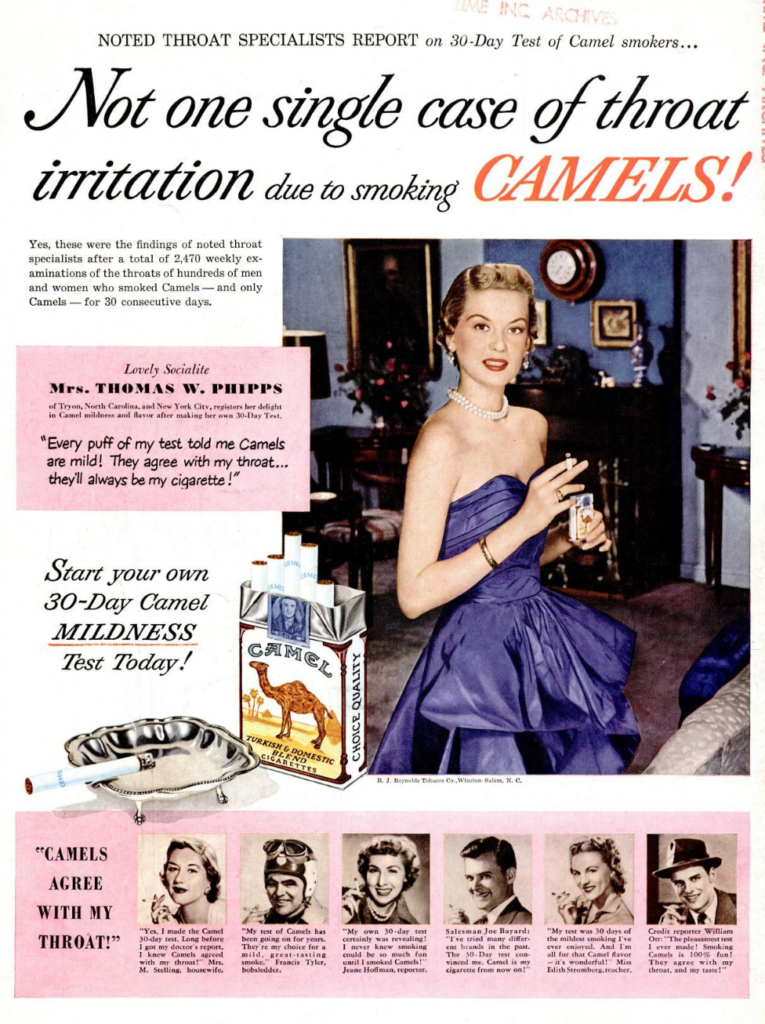
In the January 2nd, 1950 edition of Life lies an advertisement by Camel cigarettes. This full-page advertisement follows a whiskey ad and serves as the final page of the magazine, allowing the company to leave a lasting impression on readers. With the help of a large header, Camel’s goal is easy to identify: promotion of their product with the promise that smokers will not experience throat irritation. The company makes good use of its given space with a photo of a stylish woman, a close-up of the product, and various positive statements from users. The woman, identified as a “lovely socialite,” serves as the star of the page as she poses elegantly with a cigarette in hand. Her raving review is accompanied by six others, all of which urge readers to try a Camel for themselves. Camel’s depiction of this beautiful woman leads viewers to associate the brand with luxury and affluence. This encourages them to purchase their product in hopes of living like a celebrity.
Beyond this woman’s photo, this advertisement doubles as a scientific report of a 30-day experiment in which participants exclusively smoked Camels. With hundreds of people involved in weekly throat examinations, the experiment seems both trustworthy and thorough. The impressive results help to promote Camels as no cases of irritation were discovered during this trial period. By providing this data, Camel encourages readers to start their own 30-day journey to experience the mildness of their products. Thus, this advertisement sells Camels in two ways: promoting their health benefits and selling the lavish lifestyle that comes with smoking these cigarettes.
A closer look at this advertisement generates insight into how Camel promotes their product. At first glance, viewers will promptly notice the eye-catching colors of red, pink, and dark blue against the white background. The header, written in the largest font on the page, immediately draws attention to the company and its product. Its placement ensures that even if readers skip the rest of the ad, just seeing the header gets the entire message across. The rest of the page has little white space as it is packed with information.
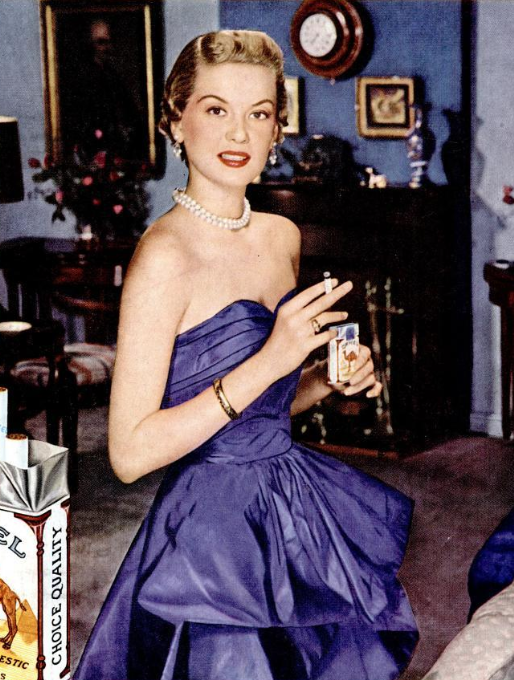
From the header, viewers’ eyes are likely to move to the picture of the woman. She is the epitome of perfection, with flawless makeup, an elegant hairdo, tasteful jewelry, and a stunning dress. All this is expected as she is a socialite, a fact revealed to the reader alongside a quote in which she refers to Camels as “my cigarette”. This is significant in establishing a sense of personal attachment, encouraging viewers to form their own bond with Camels. Moreover, the advertisement creates a feeling of intimacy and relatability by implying that consumers who purchase Camels can feel closer to the elite by using the same product. Thus, Camel’s utilization of a prominent woman acts as a persuasive tool, suggesting to readers that by purchasing cigarettes, they can embody the desirability and glamour associated with the socialite lifestyle.
However, despite Camel’s intention, there is another way of viewing this photo. This interpretation involves a subtle irony in the woman’s portrayal as she is flawless to the point of unattainability. Although consumers are motivated to look like her, it is unlikely that anyone will ever achieve such a standard. This relates to the idea of objectivity, as discussed by historians Lorraine Daston and Peter Galison. According to their book, objective images are characterized by “an idealized, perfected, or at least characteristic exemplar of a species” rather than an “actual individual specimen” (42). This parallels Camel’s picture in that this woman, with her polished presentation, is displayed objectively. Every element of her appearance, from her neat hair to classy makeup, has been orchestrated to maximize her appeal. However, in reality, her beauty is not readily achievable whether or not someone smokes Camels.
In addition to objectivity, the concept of an aura is also linked to this photo. Coined by cultural critic Walter Benjamin, this term refers to the uniqueness of a piece of art that emerges from the “web of space and time” (20) in which it originated. In other words, the aura of a photograph is determined by its context, singularity, and authenticity. In his essay “A short history of photography,” Benjamin discusses how the rise of reproduction technology has led to the diminishing of the aura. This is especially true with photography since copies are easily mass-reproduced and distributed. Applying this concept to Camel’s photo reveals that it lacks an aura, especially since Camel has likely used this woman’s picture for several other ad campaigns. There is no way of determining the circumstances in which the photo was initially produced, such as the time or location. Thus, it has since been removed from its original context and significance.
Beyond the picture, viewers will also notice an image of Camel cigarettes accompanied by a tagline encouraging readers to purchase their product. The colors of the packaging stand out well against the background. Below this graphic is a strip of six reviews, all of which praise Camels for their mildness. Just like the socialite, they are all clutching a cigarette in between their fingers. Among these six include an even spread of men and women, suggesting to readers that Camels are made for all, no matter the gender. The occupations of these reviewers are included as well and range from housewife to bobsledder. This tells consumers that Camel caters to a wide range of demographics across different professions and lifestyles. Camel’s inclusion of these details allows them to reach a wider audience, furthering the narrative that their cigarettes are suitable for everyone.
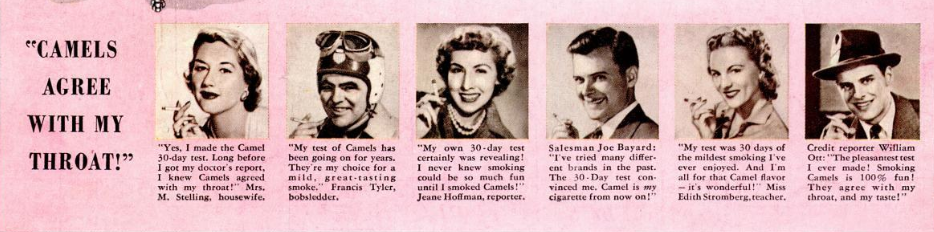
In creating this advertisement, Camel employs two distinct strategies to sell its product: highlighting the health benefits of smoking their brand and associating the brand with luxury and elegance. By showcasing the absence of throat irritation and conveying a sense of refinement through the endorsement of the wealthy, Camel appeals to both the rational and aspirational desires of its consumers. Moreover, the ad acknowledges that socialite status is not achievable for everyone with its incorporation of reviews from ordinary individuals with regular jobs. This inclusive approach aims to reach a diverse audience as it caters to those easily influenced by the elite as well as those who identify more with everyday experiences.
However, viewing this ad leads readers to question the credibility of those who promote brand products. This is especially true when considering concepts like objectivity and the aura, both of which discuss the context and authenticity of photos. Although the pictured socialite is shown with a cigarette in her hand, it is impossible to determine whether she smokes Camels or if she even smokes at all. This also applies to the six other reviewers of the product. Thus, it’s crucial for viewers to approach advertisements with a critical eye and an understanding that what is shown does not necessarily align with reality. By doing so, consumers can make more informed decisions when considering which products to purchase.
Works Cited
Benjamin, Walter. “A short history of photography.” Screen, vol. 13, no. 1, 1972, pp. 5-26.
Camel advertisement. Life, Jan. 1950.
Daston, Lorraine, and Peter Galison. Objectivity. Zone Books, 2007.

Leave a Reply