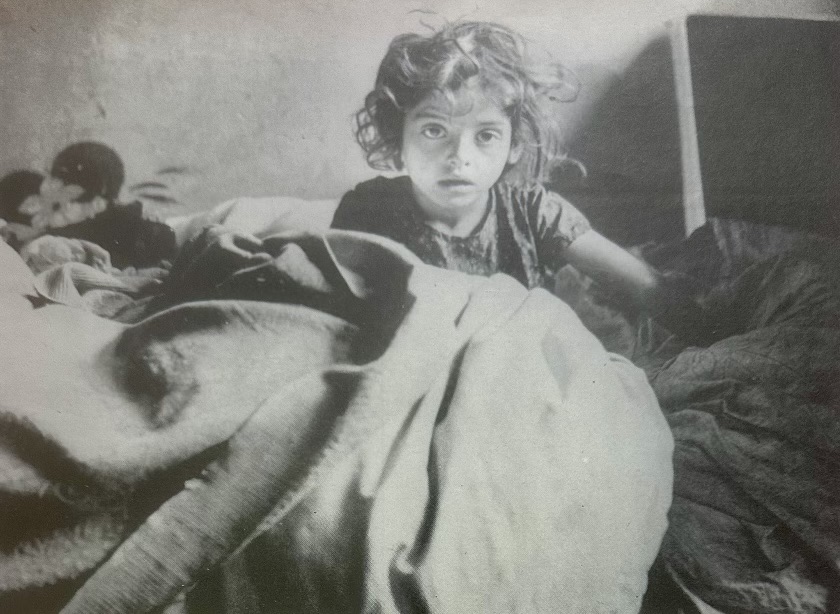
This image titled Europe’s Children Are Hungry: Victims of Mass Starvation, They Will Be Permanently Subnormal Unless Help Comes Soon is from the May 8th, 1944 edition of Life Magazine. The image was taken by Dorothy Dunbar Bromley, a widely published journalist and writer. As a freelance writer, Bromley extensively covered topics including divorce, voting rights, women’s issues, criminal law, and educational legislation in both Britain and France. The black and white photograph depicts a young girl who appears to be disheveled and malnourished under blankets, looking straight into the camera. This image is important since child starvation was tragically prevalent in Europe during World War II, as children were among the most vulnerable populations affected by the widespread food shortages and disruptions to daily life caused by the conflict. The impact of child starvation during World War II left a lasting scar on the collective memory of Europe and reinforced the urgency of humanitarian efforts to protect children during times of crisis. Overall, this image, and the text incorporated with it, constructs a narrative of concern around World War II and inspires collective action within the American people against the inhumane actions of Nazis.
When interpreting photographs of historically catastrophic, horrific, or significant events, it is important to consider how an image constructs narrative. Walter Benjamin, in his essay “A Short History of Photography,” explores the ways in which photography influences narrative, perception, and order. Benjamin explains that ultimately, photographs are instantaneous flashes in time, positioning history as what is on the verge of disappearance. The image that Bromley provides in this section of Life Magazine captures a single moment of one little girl. How is it that this singular, vague and detached image serves to represent the larger narrative about World War II and specifically, the Nazi use of starvation genocide against European children?
Benjamin explains that photographs serve as visual records of the past, capturing moments that might otherwise be forgotten. He argues that photographs are not neutral representations of reality. Instead, they are selective in nature, privileging certain events or perspectives while omitting others. In the case of Bromley’s photograph, its inclusion in Life Magazine and the decision to publish it contributes to shaping a specific narrative about the war, one that emphasizes the suffering of innocent children under Nazi oppression. Even though Bromley focuses on one perspective, that of the little girl, the image is meant to represent all of the starving and malnourished European children. Therefore, Benjamin’s examination of memory and history in photography underscores the complex interplay between image, narrative, and collective memory, revealing how seemingly detached images can become powerful symbols that shape our understanding of historical events and their broader implications.
In this image, the photographer is positioned directly in front of the child as she stares straight into the camera. She does not smile in the picture as a subject would in a typical photograph, due to the harsh conditions she is facing. She appears to be emaciated, weak, hollow-eyed, and thin-haired, all visual indicators of malnourishment. In addition, both the positioning of the photographer and the lack of elements in the background places emphasis on the little girl in the foreground. Furthermore, the strategic choice of the photographer to create a black and white image rather than a color image indicates the harsh reality and brutal food scarcity faced by children in Europe. All of these visual elements combined are meant to create a sad and helpless tone that aims to make the viewers recognize, and want to take action against, the Nazis’ policy of starvation genocide/extermination.
The context of the image, in the midst of World War II, is crucial to keep in mind when interpreting the piece of visual media. World War II was a time of unparalleled human suffering, with its impact felt across continents and generations. The atrocities committed by the Nazis during World War II are well-documented, but one lesser-known aspect of their regime’s brutality was the deliberate use of malnutrition as a tool of genocide. Under the guise of wartime rationing and economic policies, the Nazis implemented strategies aimed at systematically depriving certain populations, particularly children, of adequate food and nutrition. The Nazis weaponized malnutrition as a means of achieving their genocidal aims on multiple fronts. In concentration camps and ghettos, food shortages were deliberately engineered to subjugate, weaken, and ultimately exterminate prisoners, including children and young people. Furthermore, the Nazis implemented policies that systematically deprived certain populations of access to food and nutrition. In occupied territories, particularly in Eastern Europe, food supplies were plundered to support the German war machine, leaving local populations, including children and adolescents, to starve.
The text that accompanies the image discusses how, at the time, the government was re-examining whether they wanted to implement a child feeding program for Europe. During World War II, the goal of the Nazis was to “destroy at least one-third of the population of all adjacent territories” (Bromley, 1944). As explained by the German Field Marshal von Rundstedt, “We can best achieve this through systematic malnutrition – in the end far superior to machine guns… starvation works more effectively especially among the young” (Bromley, 1944). Despite this, the United States government was taking no action to help the starving children in Europe.
Turning back to “A Short History of Photography”, Benjamin explores how the interplay between text and image plays a crucial role in constructing narrative and shaping interpretation. Benjamin argues that photographs often present fragments of reality that require interpretation. Textual elements such as captions, titles, and accompanying essays serve as interpretive frameworks that guide viewers in understanding the context, meaning, and significance of photographs. By providing textual context, Bromley influences how viewers interpret and engage with this image of a little girl, shaping the narrative that emerges. In addition, textual elements can provide essential historical background, helping viewers situate images within a broader historical framework. By linking photographs to specific events, places, or cultural phenomena, text enhances our understanding of the socio-political, cultural, and historical contexts in which they were created. In this way, text enriches the narrative of photography by offering insights into the circumstances and motivations behind the images. Bromley utilizes the title, subtitle, and written article to accompany this singular vague and detached image of a little girl to construct a larger narrative of concern around World War II and the Nazi use of starvation genocide against the youth.
As mentioned, the photograph attempts to incite concern and collective action amongst American viewers regarding the Nazis inhumane and unjust treatment of European civilians, specifically the youth. Nadya Bair’s article, “The International Origins of ‘Concerned Photography’: Cornell Capa in the United States, Japan, and Israel,” delves deep into the essence of concerned photography. Bair defines concerned photography as “the invention of one individual with a particular agenda and identifying links between historical narratives and national contexts that are not often seen as related to each other or to photography’s institutional history” (Bair, 2022, p. 78). Concerned photography refers to a genre of photography that emerged in the mid-20th century and is characterized by its social and political engagement. Concerned photography, as described by Bair, goes beyond mere documentation of events or aesthetic concerns. Instead, it is deeply rooted in a photographer’s social and political consciousness, aiming to raise awareness about social issues, advocate for change, and bear witness to human suffering and resilience. This form of photography often addresses issues such as poverty, war, inequality, human rights abuses, and environmental degradation. Through their lens, concerned photographers illuminate the plight of marginalized communities, expose injustices, and challenge prevailing narratives. Their images serve as potent catalysts for empathy, awareness, and action, compelling viewers to confront uncomfortable truths and engage with pressing societal issues.
Bromley’s photograph in Life Magazine is considered an example of concerned photography that aims to raise awareness about the Nazi’s starvation practices used to harm Europe’s youth population. Through the image, Bromley shines light on the brutal reality of starvation as a weapon of genocide against children, exposing the atrocities committed by the Nazis and demanding accountability. The photograph seeks to evoke a visceral emotional response from viewers, eliciting feelings of outrage, sorrow, and compassion. Overall, this piece of concerned photography strives to galvanize public opinion, mobilize humanitarian aid, and advocate for policies and interventions to help Europe’s starving children.
In conclusion, Dorothy Dunbar Bromley’s photograph, accompanied by insightful textual commentary, serves as a poignant reminder of the harrowing realities faced by European children during World War II. Through the lens of concerned photography, Bromley captures a singular moment that speaks to a broader narrative of suffering, resilience, and urgent humanitarian need. In addition, the accompanying text provides crucial historical context, cultural signifiers, and interpretive cues that construct viewers’ understanding of the image and its socio-political implications. By shedding light on the Nazi regime’s use of starvation genocide against European children, Bromley’s photograph and text inspire collective action and advocacy for the protection of vulnerable populations during times of crisis.
As a closing thought, it is interesting to consider this photograph to other World War II images that we have discussed in class. The majority of these photographs incorporate many subjects, rather than one like the Bromley image. I believe that without the text, the narrative of concern and historical context are lost from the image, and you are left with just a black and white image of a girl who appears to be sick in bed. However, with multiple subjects such as in Margaret Bourke-White’s Buchenwald photograph or Fritz Kline’s “Newly liberated inmates crowd into a barracks in Buchenwald” photograph, the multiple subjects make it clear that the photographs were taken during the Holocaust and World War II. Suffering in these photographs is visualized as a collective experience amongst the Jewish population, rather than an isolated, individual lived experience. This makes me wonder, are there pros and cons to having one subject, rather than multiple, when capturing moments of concerned photography?

Leave a Reply