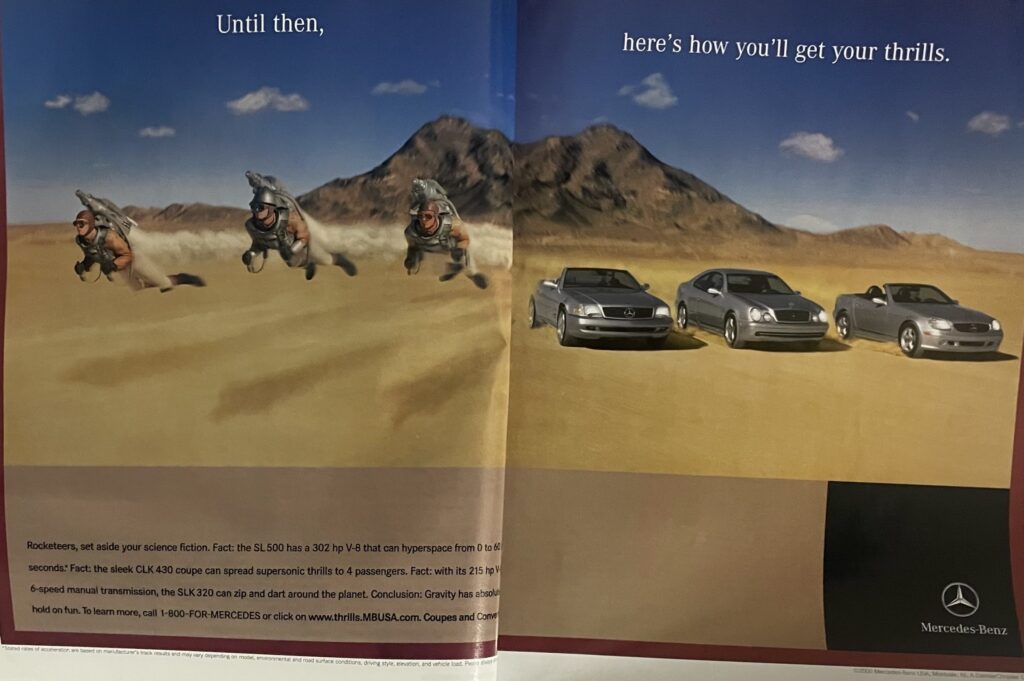
Although jetpacks are quite a way away from being a mainstream form of travel, a Mercedes Benz is the closest you can get right now. This is what the Mercedes Benz marketing team tried to argue in their advertisement shown in Gourmet Magazine published in June of 2000. Gourmet Magazine was the first U.S. based publication solely devoted to food and wine, and was published from 1941 until 2009. Gourmet was centered around the image of luxury. Expensive cars, fine wine, exotic delicacies and expensive international trips lined the pages of the magazine. The New York Times stated “Gourmet was to food what Vogue is to fashion(New York Times). The Mercedes Benz advertisement goes along with the decadent theme. Set in an expansive desert with mountains in the background, three Mercedes sedans are accompanied by three men clad in silver jetpacks on the left. The text reads “Until then, here’s how you’ll get your thrills.” In other words, the advertisement states that until the future becomes the present, a Mercedes car is the closest thing you can get to the future, citing the performance metrics of the vehicles, allowing for unlimited adventure. This advertisement is a prime example of the lack of objectivity in advertising, the importance of aura when viewing images, and finally how environments impact the viewers perceptions of images.
At first glance the advertisement looks stunning. The sand around the cars and jetpacks is perfectly flat, the mountains rise up majestically in the background, the cars and jetpacks match perfectly and there is not a single deformity on the vehicles. This is intended to sell the idea that if people were to buy a Mercedes, they could have the opportunity to zoom across a desert. However, this advertisement is far from objective. As Daston and Galliston argue, objectivity is the blind sight of an image, without interference, with zero interpretation or intelligence(Daston and Galliston). This advertisement is void of all of those components. Aside from the perfect landscape and alignment of the vehicles, which already lack objectivity, the inclusion of the jetpacks is solely up to artistic interpretation. Mercedes Benz employed the jetpacks to represent the future of travel, but any depiction of the future cannot be objective because it requires artistic interpretation to represent the future. This advertisement is far from objective and is intended to sell consumers on the dream of a life of luxury and exploration, a dream that is difficult to achieve for the average consumer.
When viewing this futuristic ad from Mercedes Benz, it is necessary to consider the environment in which it is displayed. As noted by the New York Times, Gourmet Magazine was on the cutting edge of luxury food and drink in the United States, and everything in the publication matched the theme. Gourmet is an environment of pure luxury and all of the advertisements in the magazine contribute to the environment. This is very similar to the advertisement tactics during the development of southern Florida. Anna Andrzejewski writes “Nestled within a palm-studded landscape with one of Fisher’s swank hotels rising in the background, the elephant stands within Miami Beach’s carefully curated landscape of leisure.” (Andrzejewski) The inclusion of elephants in Miami Beach contributed to the extreme image of leisure the developers intended to cultivate, very similar to Gourmet Magazine. In the magazine’s efforts to display expansive luxury, the magazine relied solely on luxury brands in advertisements. The Mercedes advertisement is one small piece of the environment of luxury. However, this image of wealth is not feasible for the everyday American, but all of the advertisements allow people to view the environment that people may not be able to partake in otherwise.
Finally, the Mercedes Benz advertisement harkens back to Walter Benjamin’s idea of aura, or lack thereof in this advertisement. Benjamin believed that the aura of an image was the picture’s presence in space and time, and he asserted that an image that lacked aura loses touch with reality(Benjamin). The advertisement published in Gourmet Magazine is completely stripped of its aura because of the futuristic jetpacks, which makes it extremely difficult to discern the advertisements’ place in time. As I noted earlier, the intent of the advertisement is to sell a dream of luxury and futuristic that is hardly attainable for the majority of the population, but I believe that the images lack of aura makes it quite difficult for people to truly believe the message that purchasing a new Mercedes Benz sedan will be akin to flying through space and time. The advertisement fits perfectly with the message and goal of Gourmet Magazine; the average American can take a look at all things luxury in food, and might even buy a car that would help fit the image. However, components of the advertisement beg the question: is it truly believable?
Mercedes Benz’s marketing team understood the thesis of Gourmet Magazine quite well. Gourmet wanted to show Americans a glimpse of high end food and drink and give people a chance to live the high life for a night with a luxurious recipe that most people could cook at home. Mercedes strived to give the same message to the readers: you may not be able to have everything in luxury, but at least you could explore the world in a cutting edge Mercedes Benz sedan. Thus, the advertisement perfectly contributed to the environment Gourmet attempted to cultivate and the dream the magazine displayed. However, the advertisement fell short in its believability. So focused on contributing to Gourmet’s environment, the image appeared too perfect. The image displayed a pristine desert and vehicles in perfect condition in the desert which made the advertisement far from objective. Second, the image’s inclusion of jetpacks as the future of travel completely uprooted any place in time the advertisement could have, stripping the essential aura from the image, taking it further out of touch with reality. The Mercedes Benz advertisement created a stunning image that meshed with everything else included in Gourmet, but it fell short in making the argument that their sedans are ideal for exploring in luxury and the best thing until jetpacks.
Works Cited
Andrzejewski, A. (2023, April 27). Work, play, and elephants in south florida’s leisure landscape. Edge Effects .
Clifford , S. (2009, October 5). Condé nast closes gourmet and 3 other magazines. New York Times . Retrieved from https://web.archive.org/web/20220617120735/https://archive.nytimes.com/www.nytimes.com/2009/10/06/business/media/06gourmet.html.
Benjamin, Walter. “A short history of photography.” Screen, vol. 13, no. 1, 1 Mar. 1972, pp.
Mercedes Benz Advertisement, Gourmet Magazine, June 2000,.
5-26. Oxford Academic, https://doi.org/10.1093/screen/13.1.5. Accessed 9 Apr. 2024. Datson, Lorraine and Peter Galison. Objectivity. Zone Books, 2007.

Leave a Reply