
Looking for a digestive aid after a big meal? Camel cigarettes have you covered according to their advertisement in the November 23, 1936 edition of Life magazine. Published two days before Thanksgiving, this campaign caters to those planning to indulge in a large dinner to celebrate the holiday. Everyone knows that post-Thanksgiving dinner slump where the thought of ever eating again makes you sick. However, Camel cigarettes claim to be the tool to facilitate digestion throughout your meal. According to the advertisement, you should smoke at least one between every course “for digestion’s sake.” The ad, as a whole, positions smoking as a health benefit as it argues it aids digestion. Utilizing a widely celebrated occasion like Thanksgiving, which resonates with a broad audience due to its association with abundant meals, makes the advertisement more relatable and enticing to diverse groups of people. If they can persuade individuals to consider smoking and demonstrate its purported benefits in aiding digestion during a feast as substantial as Thanksgiving, they have a better chance of convincing consumers to use Camels during every meal.
The colorful advertisement spans an entire page, with the top two-thirds of the page showcasing images of the different courses of a Thanksgiving meal. Each course is accompanied by a text box giving the reader step-by-step instructions on how they should take on their large feast. There are six panels showcasing the courses of the meal:

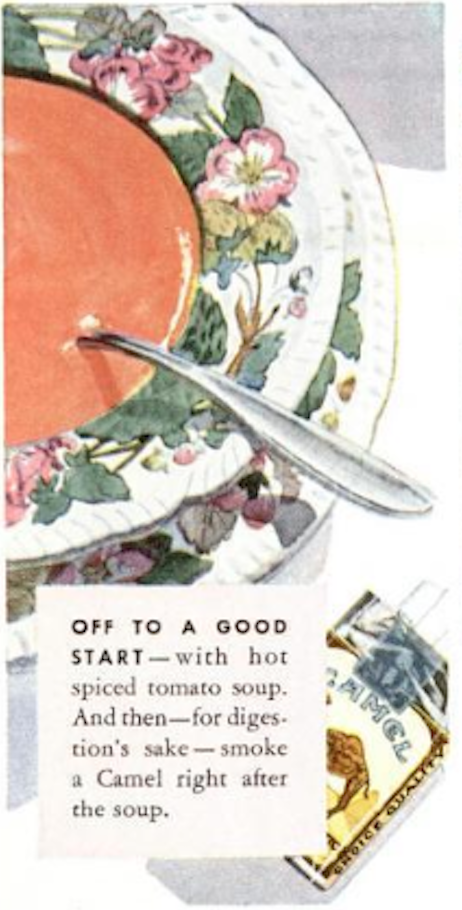
The first panel serves as the ad’s “title” and sets up the intended message and intended audience. The panel reads: “Thanksgiving Dinner… and then the peaceful feeling that comes from good digestion and smoking Camels!” Given that this panel is on the top left corner of the page, it is the first thing the reader sees. The image of the cigarette and the smoke that encircles “Thanksgiving Dinner” in large decorative letters immediately relate the holiday to cigarettes in the viewer’s mind. The message tells the reader the following images will be a step-by-step guide on how to use Camel cigarettes to aid digestion throughout their Thanksgiving meal. The second panel shows the first course of the meal: a bowl of hot spiced tomato soup in a flowered bowl. A pack of Camel cigarettes lies next to the bowl, and the image is accompanied by instructions reading, “And then – for digestion’s sake – smoke a Camel right after the soup.” Even after one course of the meal, a Camel’s cigarette is needed to aid the digestion process from the beginning.
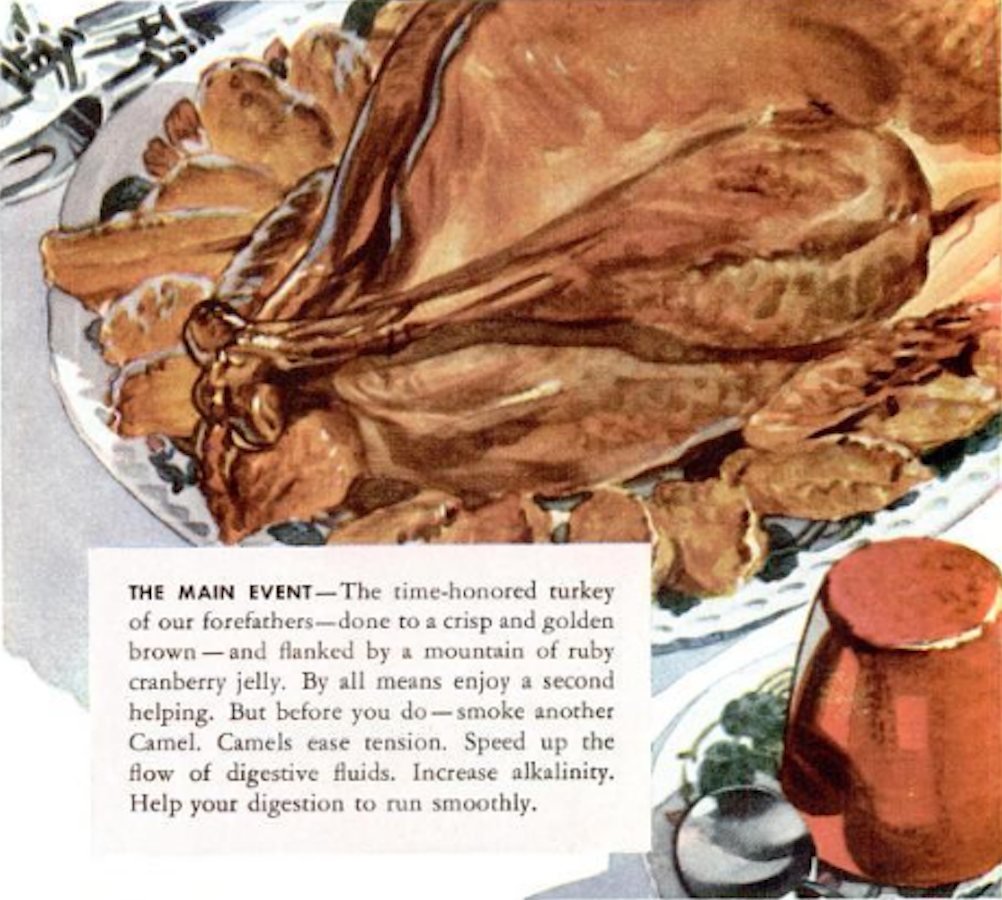

The next panel is entitled “The Main Event,” which showcases the turkey with a mouth-watering description of the golden crispy bird viewers will next eat. The reader is even encouraged to enjoy a second helping, but of course, not before smoking another cigarette as “Camels ease tension. Speed up the flow of digestive fluids. Increase alkalinity. Help your digestion to run smoothly.” In the fourth panel, readers see a Waldorf salad and a hand holding a pack of Camels, and it looks like the person is taking one of the cigarettes out. This panel is called “Double Pause,” the eater is encouraged to pause once for the salad and once again for Camel’s cigarette as the “double pause clears the palate.” In these two panels alone, these cigarettes have claimed to accelerate the digestive process, boost alkaline levels, and cleanse the palate.
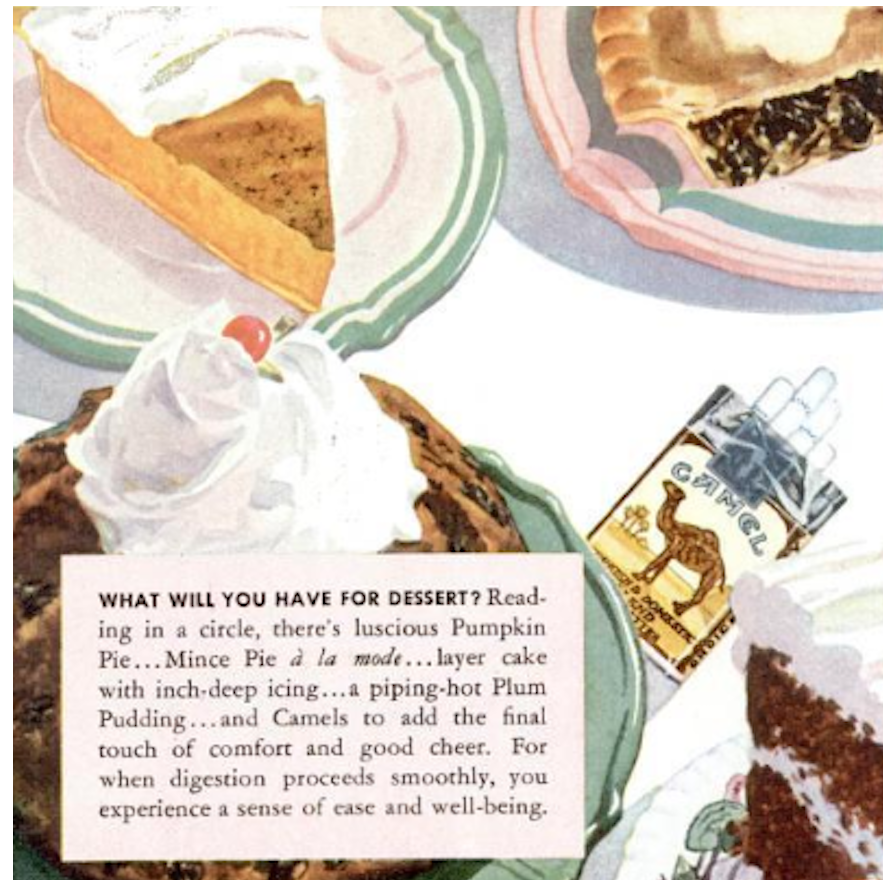

We have now shifted to dessert. The fifth panel shows several options for dessert ranging from cake to pie to pudding. However, dessert could not be served without Camels “to add the final touch of comfort and good cheer.” They claim that when your digestion process goes smoothly, your overall well-being will be at peace which can be accomplished with a Camel cigarette. The sixth panel is entitled “So to a Happy Ending,” showcasing a post-meal hot cup of coffee and cigarette in hand. The writing in the panel sums up the collage’s overall message, reading: “Enjoy Camels–every meal time– between courses and after eating–and you can lean back in your chair feeling on top of the world.”
By putting these photos in a collage, it really paints a picture for the reader. The collage format of these photos, in combination with the text, work together to form a story. The way this advertisement has been crafted relates to Walter Benjamin’s idea of the aura and fog. The collage of panels has been put together to tell a story. Benjamin refers to the aura as “a peculiar web of space and time: the unique manifestation of a distance, however near it may be” (Benjamin 20). Benjamin believes the aura is about the unique presence of artwork existing in a particular space and time and is also connected to the historical and cultural context. However, he does not see the removal of the aura as a negative thing, he actually sees it as a positive. With the creation of this college, we lose the aura and create fog, but this loss has created a story that the advertisement tells. When we lose the aura, it allows for new creative possibilities. The loss of the aura has allowed advertisers to position photos in relation to other photos that construct a narrative that cigarettes lead to healthy digestion. While there is the loss of aura and the creation of fog, for Camels, the loss of aura is a good thing as it helps them tell the readers a story.

If the picture collage wasn’t clear enough, The bottom third of the page contains comments from the food editor, Miss Dorthy Malone, and a salesman, William H. Ferguson. The salesman even goes as far as saying, “The best meal I ever ate would be a disappointment if I couldn’t enjoy Camels.” The paragraph next to their reviews is titled, “Good food and good tobacco go together naturally!” enforcing the idea that tobacco is a healthy digestive aid.
All of these elements work together to convince people that smoking is a health aid. In 2024, we know the harmful effects of smoking and that it, in fact, does not help digestion; it actually harms it. However, in the 1930s, there was no definitive evidence that smoking was bad for you and was a common indulgence of many. That does not completely disregard the fact that Camels was falsely advertising cigarettes as a digestive aid. This ad has certainly set up an idealized Thanksgiving meal and provided an ideal way to avoid uncomfortable digestion. This idea can be related back to the notion of objectivity, as explored by Lorraine Daston and Peter Galison. They describe objective images as “an idealized, perfected, or at least characteristic exemplar of a species” (42). This mirrors the depiction of the perfect Thanksgiving dinner with a healthy tool for digestion. However, in reality, no amount of cigarettes will be effective in making you feel better following a hefty meal.
The ad for Camel’s cigarettes works to prove that smoking is a health benefit that aids digestion when you smoke when having meals. The collage of Thanksgiving dinner serves as a step-by-step manual of how to integrate Camels into your meal. While this arrangement of photos may be lacking Benjamin’s aura, the fog is what makes the advertisement effective. A story of the ideal Thanksgiving meal is laid out for the viewer all accompanied by Camels cigarettes. While advertising, in general, does not necessarily claim to be objective due to its hidden agenda, the idealized depiction of Thanksgiving dinner in this ad contributed to the viewer’s belief that cigarettes aid digestion. Ultimately, the unrealistic health benefits of smoking being portrayed undermine the objective truth and aid subjective perceptions that help promote Camels cigarettes.
Works Cited
Benjamin, Walter. “A short history of photography.” Screen, vol. 13, no. 1, 1972, pp. 5-26.
Camel Advertisement. Life, Nov. 1936.
Daston, Lorraine, and Peter Galison. Objectivity. Zone Books, 2007.

Leave a Reply