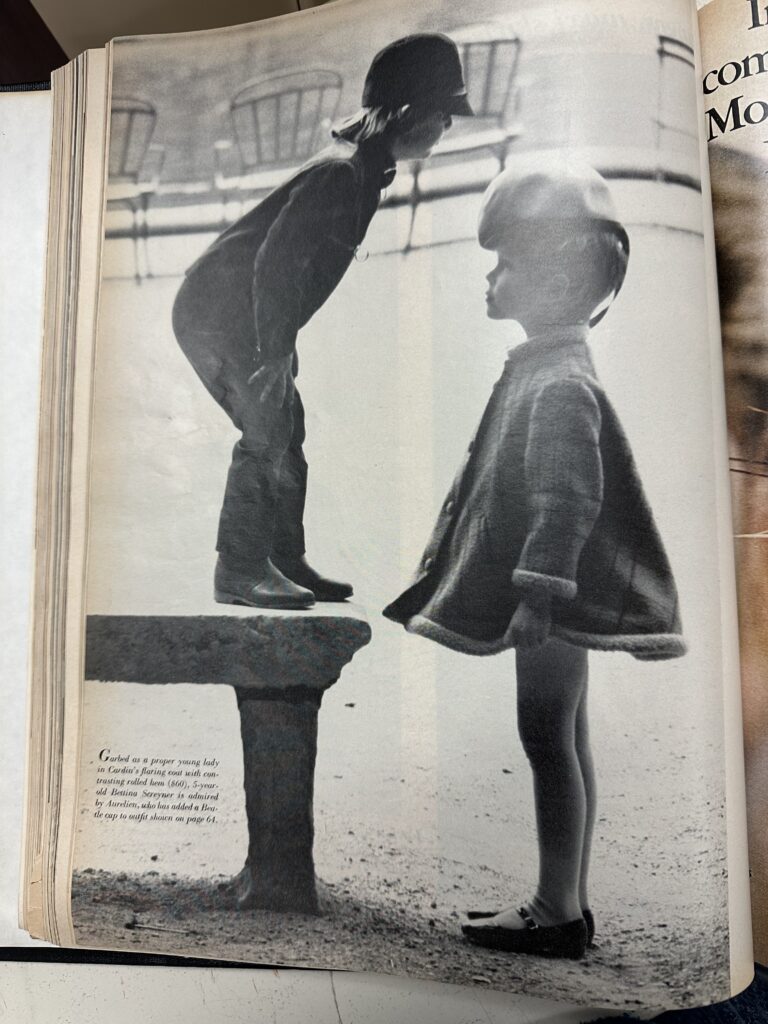
A clothing advertisement? Or two young children candidly playing? At first glance this image from Cardin’s 1967 clothing collection feels like it could have been a simple familial moment captured and put in the magazine, but in reality it showcases a major fashion movement led by Pierre Cardin during the Space Age. Pierre Cardin, a French fashion designer, launched his first children’s clothing line in 1966, focusing on “simple, clean, streamlined outfits” and showcasing children in more grown up clothes (Lesso). The advertisement that appeared in the September 22, 1967 edition of Life Magazine, entitled “Paris for Young Swingers,” showcases on one page three young Parisians in Space Age, geometric fashion, and on the other, two young Parisians—Bettina Screyner and Aurelien—dressed in Cardin’s children’s line that takes heavy inspiration from adult fashion at the time. Appearing separate from the photo of the three kids, Bettina and Aurelien don’t feel like part of an advertisement, but instead represent an endearing moment captured between kids. Through this photo, and the initial reactions one has to it, we see how advertisement photography blurs the boundaries between objectivity, reality, and what actually constitutes an ad.
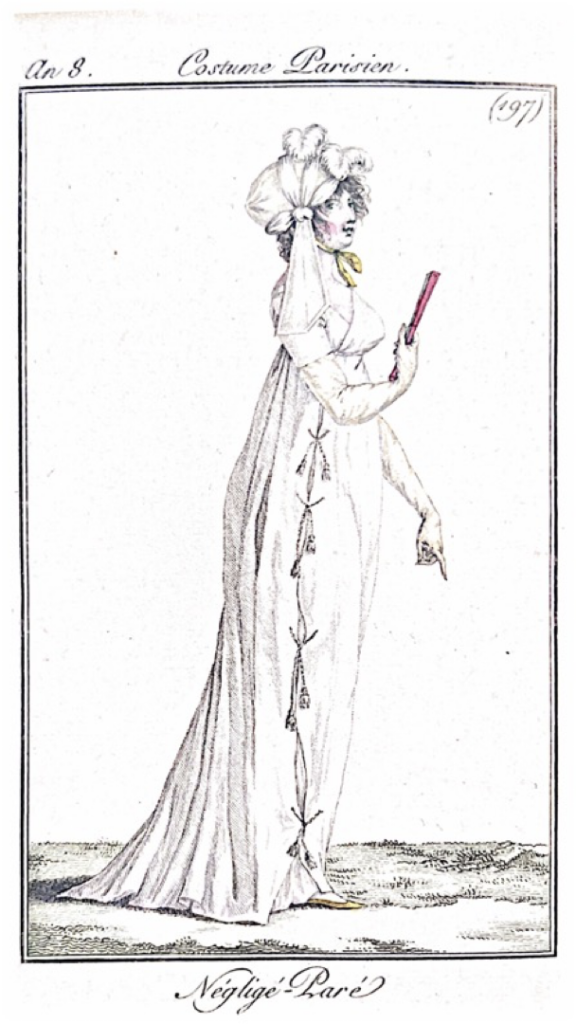
In the photo of Bettina and Aurelien they are the sole subjects. The bench Aurelia stands on adds movement between the two, but they are the focal point of the image. The background, sterile except for chairs lining the wall, somehow adds both to the feeling of this image being candid, yet also points towards the idea that the scenario is fabricated. Through the backlighting, the photographer separates the lively subjects (and thus the clothing) from the bright background, drawing our focus to the motion and, unbeknownst to the audience, the clothes. Like the hand-colored engravings from Costumes Parisiens, Journal des dames et des modes, year VII (1799-1800), these trends in publicity and print showcase an idealized view of fashion and self that allows new demographics to participate. In the Cardin ad, children are allowed to experiment with fashion, and in the engravings from Costumes Parisiens, women have space in the print world that weren’t otherwise there.
Here, we also see Walter Benjamin’s idea of the “aura” shine through. The aura, as Benjamin defines it, is “a peculiar web of space and time: the unique manifestation of a distance, however near it might be” (Benjamin 20). This photograph, perhaps a moment of both candidness and posing, depicts a specific moment in time that cannot be replicated. The emphasis on the clothing also places these photos in a very specific moment, that helps convey trends of the time. When discussing aura in regards to ads it showcases the ideal the advertisers want to present to their audience, as well as how the photographs hold up as time goes on. This specific advertisement also plays with what counts as objectivity, and what can be accomplished when one paints an advertisement in a different light. When photography first became popularized through the Daguerreotype, they were valued as a way of preserving loved ones. “In our age there is no work of art which is regarded with as much attention as a photograph of oneself, one’s closest relatives and friends, one’s sweetheart’, wrote Lichtwark as early as 1907, thereby shifting the investigation from the sphere of aesthetic distinctions to that of social functions” (Benjamin 22). In the photo of Bettina and Aurelien, the photographer works in between the realms of “aesthetic distinctions” and “social functions” to create an image that can be seen as either. This makes the advertisement effective because it defamiliarizes the audience with what they typically see as an ad.
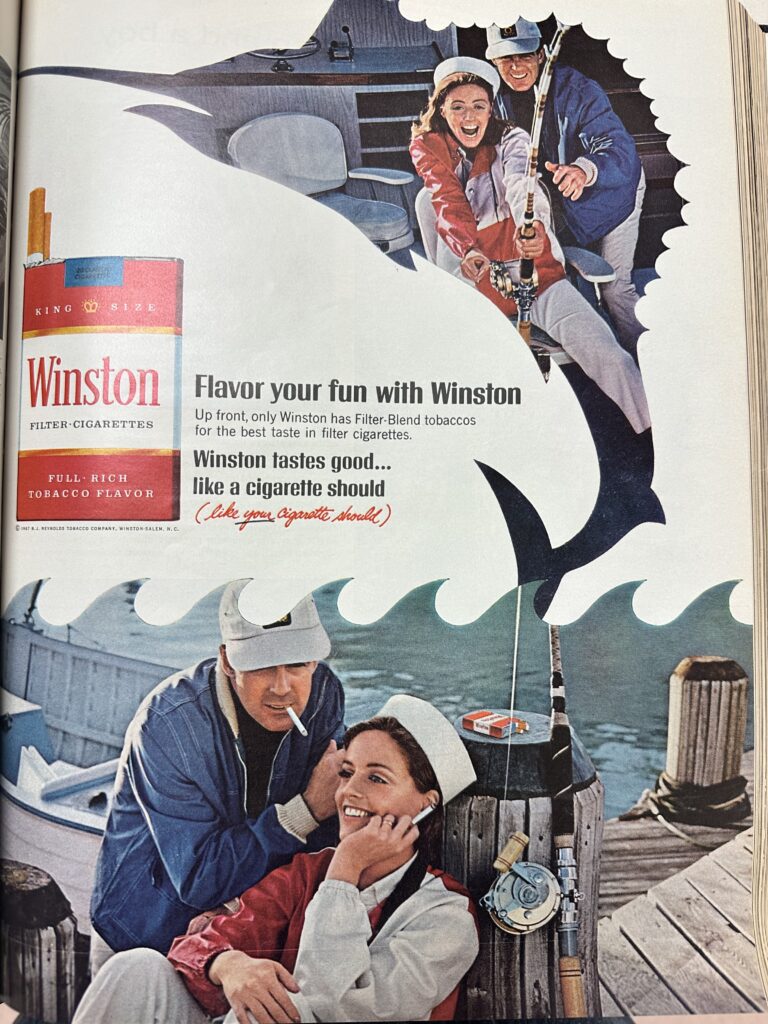
This spread contrasts the majority of the advertisements seen in other magazines during the time. The September 15, 1967 edition of Life Magazine has many examples of what I have come to see as the typical 60’s ad. In one advertisement for Winston cigarettes we see two stereotypically attractive white models posing on a pier, enjoying fishing and a Winston cigarette. These photos obviously sell a particular lifestyle, whereas the Cardin photographs sell their products in a more covert way. Through this we see how the Cardin spread blurs objectivity to create something that transcends the idea of purely aesthetic or purely something that serves as a memory for family. Instead, the ad showcases the clothing in a real, lively, way that uses ideas of reality to present a more realistic ideal lifestyle than the Winston advertisement. On a smaller scale, the Cardin photographs showcase what Anna Andrzejewski was discussing in regards to the elephants Carl II and Rosie working in South Florida. Carl Fischer used the elephants as both labor and entertainment, which he admitted to in a promotional brochure. Andrzejewski states “the fact that the pachyderms are positioned alongside other amusements within the landscape of leisure shows that even their “work” formed part of the “play” (Andrzejewski para. 20). While it is a different situation, the photographs utilized by Cardin mixes advertising and play in a way that feels unique for the time, similarly to how Andrzejewski describes the work the elephants do.
The caption on the Cardin image also operates as an aura that places it in a very specific time and place; it is the moment where magazine readers understand that this photo is selling a product. It reads, “Garbed as a proper young lady in Cardin’s flared coat with contrasting rolled hem ($60), 5-year-old Bettina Screyner is admired by Aurelien, who has added a Beatle cap to outfit shown on page 64” (Paris). The phrases “proper young lady” and “admired” reveals what demographic Cardin’s clothes are targeted towards: fashionable people of high society who follow the trend of dressing their children in high style grown up clothing. While the content of the advertisement strays from others we’ve seen in 1967, this caption perpetuates the gender roles seen at the time. In keeping with the “grown up vibe” of the clothing, the caption implies that if another 5-year-old were to wear the designs by Cardin, they too would become proper and be admired by others.
“Paris for Young Swingers” showcases a new age of advertising that presents products in a more subliminal way. At first glance the image seems like a cute moment captured by a family member and placed in a magazine, but on a second viewing we can see how these images blend advertising and reality to create a specific aura that represents the feelings around fashion in 1967.
Works Cited
Andrzejewski, Anna. “The Hidden History of Resort Elephants at Miami Beach.” Edge Effects, 28 Apr. 2023, edgeeffects.net/miami-beach-elephants/.
Benjamin, Walter. “A Short History of Photography.” Screen, vol. 13, 1972, pp. 5–26.
Journal Des Dames et Des Modes, Costumes Parisiens, Paris, 1799.
Lesso, Rosie. “Pierre Cardin: Fashion for the Space Age.” The Thread, blog.fabrics-store.com/2020/01/30/pierre-cardin-fashion-for-the-space-age/. Accessed 15 Apr. 2024.
Pierre Cardin. “Paris for Young Swingers.” Life Magazine, vol. 63, no. 12, 22 Sept. 1967, pp. 63–64.Winston Cigarettes. “Flavor Your Fun with Winston.” Life Magazine, vol. 63, no. 11, 15 Sept. 1967, p. 55.

Leave a Reply