Global Coca-Cola Community
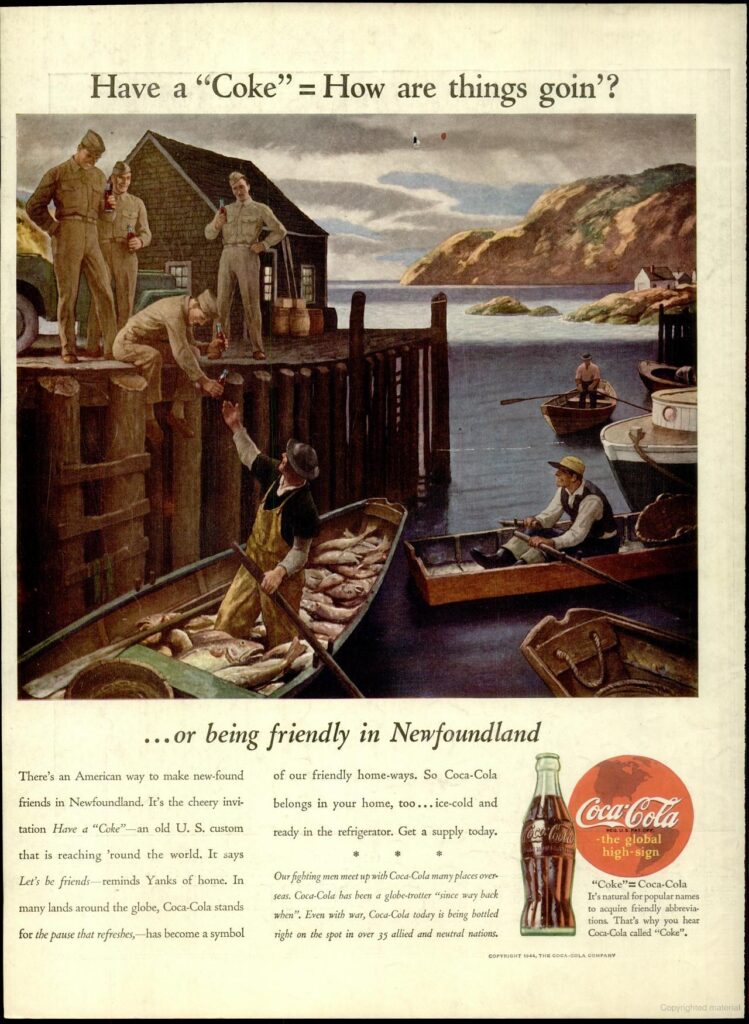
Published in the July 3rd, 1944 edition of LIFE Magazine, this Coca-Cola advertisement strikes to the pulse of wartime sentiment and geographically locates the American military presence in allied countries through the distribution of Coca-Cola. The advertisement reinforces and supports US military presence in Newfoundland Canada while portraying the refreshing beverage as an American staple of community and global connection. Nestled at the last page of the magazine, the majority of the page is covered by a large image. Illustrated in a seemingly true to life way, with neutral colors and warm hues, the image invites the viewer to step into the small town life of Newfoundland Canada. The image depicts four US soldiers holding Coca-Cola bottles, standing on a pier overlooking the scenic bay. Three fishermen in small boats float in the water, one of them extends his grasp towards a soldier offering him a sip of his Coca-Cola. In support of the image, the page contains text that describes Coca-Cola’s role as a symbol of friendship and global connection during wartime. In this advertisement for a soda, the Coca-Cola brand acts as a stand-in for the American presence in allied countries and intentionally portrays the overwhelmingly positive role that American Military presence played in other countries.
The image shows the moment of connection between the local fishermen of Newfoundland and Labrador and the US soldiers that are presumably stationed there. The surrounding text tells the story of “the American way to make friends.” This advertisement was written from the American perspective and aimed for an American audience. The text clearly tells the story of this consumer product, Coca-Cola, as a distinctly American drink that acts as a stand in for the friendly and generous American presence. Both nationalistic and consumeristic, this advertisement directly correlates the consumption of “Coke” and the phrase, “Have a Coke” with American social customs and reminders of home for soldiers overseas.
My research did not yield any specific artist credited to this image. However there were many artists that produced official wartime art that were based in Newfoundland around this time. Among these artists includes Albert Cloutier (1902-1965), Tom Wood (1913-1997), and Thomas Harold Beament (1898-1985) (Neary).
After the main text section, there is a smaller, italicized block of text that serves a blatant nationalistic purpose.
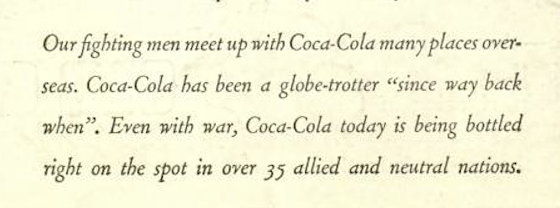
After the main text section, there is a smaller, italicized block of text that serves a blatant nationalistic purpose. The text informs the reader that “our fighting men meet up with Coca-Cola many places overseas” and that “even with war, Coca-Cola today is being bottled right on the spot in over 35 allied and neutral nations.” Through asserting Coca-Cola’s presence in allied and natural nations, the private company shows the influence of American products and global capitalism in tandem with the US military presence in other nations. Further, by sharing a Coke with those allied nations across the world as we see and read in the advertisement image, the US remains as a dominant militaristic and economic force among the allied and neutral powers in WWII.
US Global Military Presence
Historical context is imperative to the understanding of this piece of visual media. The advertisement depicts US military presence in Newfoundland and Labrador, Canada which was made possible by the Leased Bases Agreement of September 2, 1940. Three months prior to the agreement in June of 1940, France had fallen to the Nazi powers which left Great Britain as the lone allied power in Europe. The US had yet to enter the war but felt the imminent pressure to secure more military bases in order to protect the Western hemisphere. With the anxiety of France’s fall, the US struck a deal with Great Britain which exchanged US Naval destroyer ships for rent-free 99-year leases on many British naval and air bases throughout the Atlantic. This deal included rights to the properties and bases in Newfoundland and Labrador, Canada’s Easternmost Province. This involvement in the war met criticism from anti-war Americans who claimed this broke the US’ neutrality. The US presence in Newfoundland was just as (if not more) controversial to Canadians.
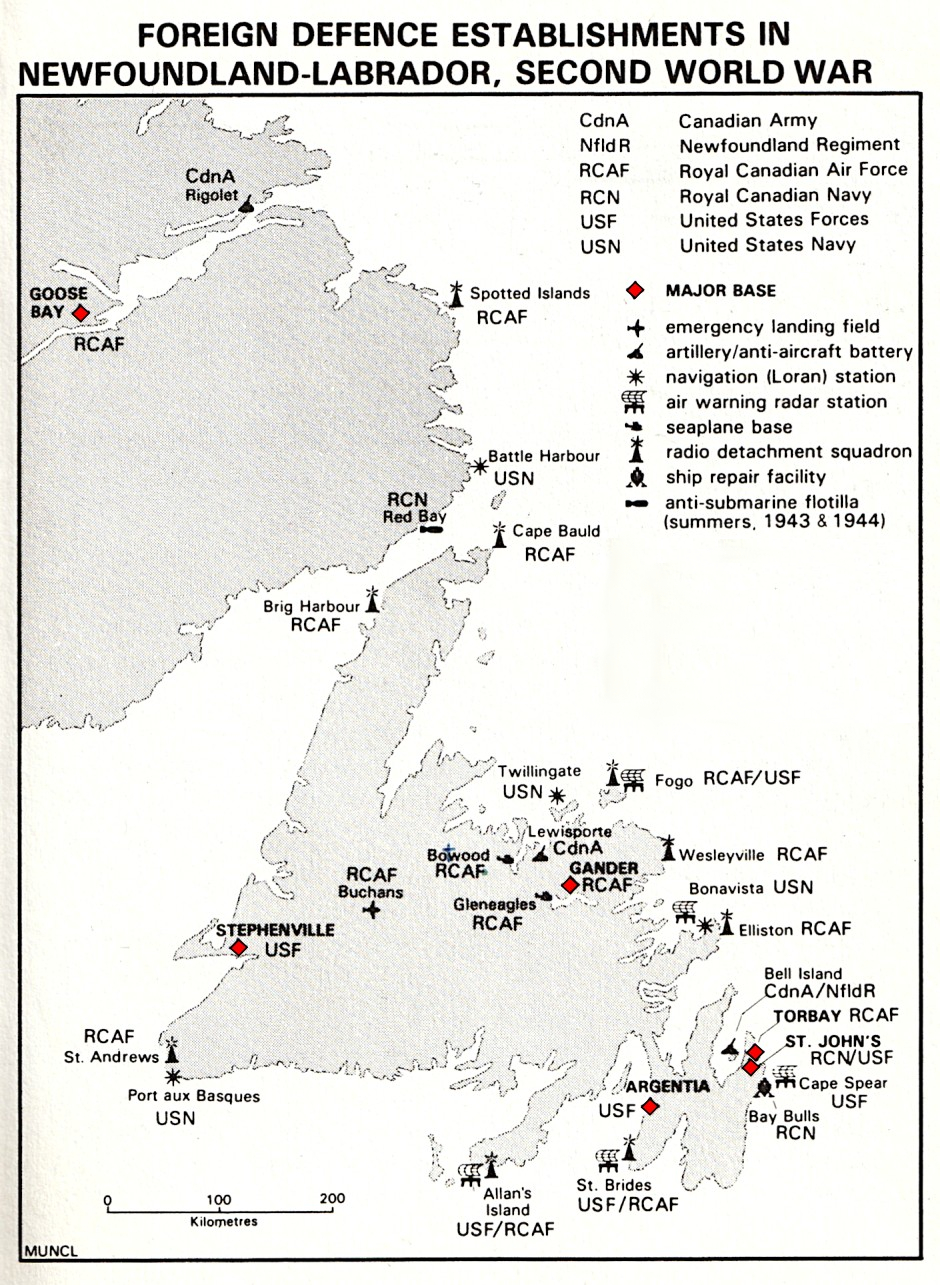
Initially, the construction of the US bases in Newfoundland brought economic opportunity to the area. The Newfoundland and Labrador Heritage website cites that “Newfoundland and Labrador became one of the most highly militarized places in North America as the United States spent more than $100 million to build military bases in St. John’s, Argentia, and Stephenville” (Higgins). With the construction of new bases, locals benefited from jobs, health services, increased food supply, infrastructure and improved technology. Although the Newfounders and Labradorians benefited from the presence of jobs, they were paid less than their US counterparts. Further, people living on the land that the US appropriated were forced to move and only offered a small monetary compensation (Higgins). The Coca-Cola advertisement emphasizes the friendly relations between the local Newfounders and Labradorians, which is only partially historically accurate.
Understanding Advertisements
Advertisements, by definition, are meant to persuade their viewer to do, buy, or think something. They are not a new phenomenon to the American public by any means. Sometimes overt and sometimes more insidious, advertisements show prevailing national narratives of their time and show contemporary readers information about the cultural moment in which the advertisement was created and distributed. Anna Andrzejewski in her article “Work, Play, and Elephants in South Florida’s Leisure Landscape” describes the way Miami Beach newspapers and developers advertised Carl II and Rosie, the Elephants, to entice people to invest and move to Florida during the Florida Land Boom in the 1920s. Carl II and Rose came to be seen as natural to the leisure landscape of Miami, while everything about their presence was unnatural. Further, the advertisements do not show the stark reality of their forced labor and their deeply problematic often drawn comparisons to black workers, who were not welcome in the new spaces of white middle-class privilege (Andrzejewski). Vanessa Schwartz discusses another American advertisement in her book, Jet Age Aesthetic. In the chapter on Disneyland, Schwartz notes the changing medium of advertisements from magazines and newspapers to the new frontier of television (Schwartz, 16). When it comes to advertising, there isn’t much restriction or fact checking that occurs, it seems to be all fair in love and war.
Coca-Cola’s advertisement in the July 3rd 1944 edition of LIFE magazine employs the power of persuasive advertising through it’s inviting visuals and convincing supporting text. Total war refers to “a war that is unrestricted in terms of the weapons used, the territory or combatants involved, or the objectives pursued, especially one in which the laws of war are disregarded” (Oxford). Coca-Cola, a private company, places itself as an agent for US Military propaganda and engages with the US Total Wartime machine through the weapon of advertisement. This single page at the end of the magazine works simultaneously to associate Coca-Cola with American culture and military strength, and to connect the US presence in Newfoundland and Labrador with positive and cordial memories.
Works Cited
Andrzejewski, Anna. “Work, Play, and Elephants in South Florida’s Leisure Landscape.” Edge Effects, 27 Apr. 2023, https://edgeeffects.net/miami-beach-elephants/.
Coca-Cola Advertisement. LIFE Magazine, 3 Jul. 1944, p. 90.
“Foreign Defense Establishments in Newfoundland Labrador, Second World War.” Adapted from Malcolm MacLeod, 1986, Peace of the Continent, Harry Cuff Publications, St. John’s, NL.
Higgins, Jenny. “The American Presence in Newfoundland and Labrador.” Newfoundland and Labrador Heritage Web Site, 2006, https://www.heritage.nf.ca/articles/politics/american-presence-newfoundland-labrador.php.
Neary, Peter. “The History of Newfoundland and Labrador During the Second World War.” Canadian War Museum, https://www.warmuseum.ca/learn/dispatches/the-history-of-newfoundland-and-labrador-during-the-second-world-war/#tabs.
Schwarts, Vanessa. “Disneyland and the Art of People-Moving.” Jet Age Aesthetic, Yale University Press, 2020, p. 57-97.
“total war.” Oxford English Dictionary, Date of access 15 Apr. 2024, https://www.oxfordreference.com/view/10.1093/oi/authority.20110803105038425.

Leave a Reply