In the November 23, 1922 issue of Life magazine, there is an advertisement for the Bermuda Trade Development Board. It’s a very bold advertisement, taking up the full page and being one of the only pages in the entire issue of Life in color, including the cover. It urges readers to call the board and set up their vacation to “Golf in Bermuda.” Below this title of sorts, the text goes on to highlight the “18-hole courses” and other outdoor sports and activities, the “equable” climate and geography, and the simple and “luxurious” travel and lodging. Above the text is a picture of men golfing in a beautiful, tropical land close to the sea. Surrounding both the picture and the text is a frame, full of ornate patterns with imagery relating to the sea. This advertisement is obviously very dated, but not just because of its reliance on text or the aesthetic of the picture. It also feels dated because of the sorts of ideas that it relies on in order to appeal to its audience, utilizing an established visual aesthetic of exoticism and ownership in order to appeal to its heteronormative, White, middle-class, male audience.
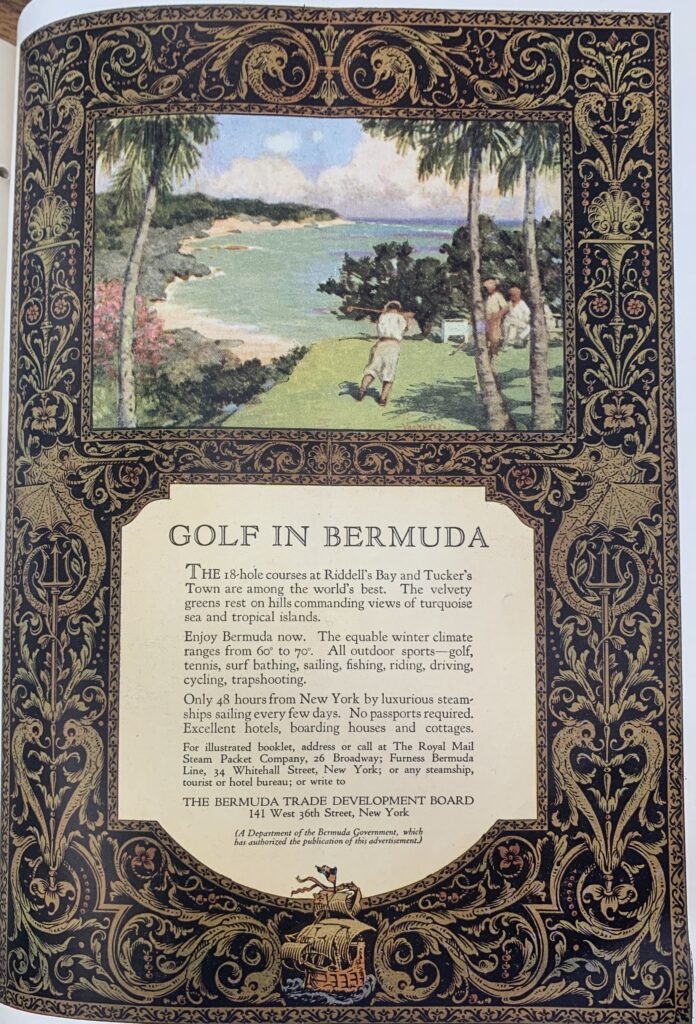
The advertisement simultaneously appeals to a sense of exoticism and familiarity, providing an image of far-off paradise made for the enjoyment of White, American middle-class men. Both the text and the picture illustrate this pairing of exotic and familiar by putting the two in close proximity to each other. In the text, any mention of Bermuda’s tropicality is paired with typical White, (male), middle-class activity: a promotion of its “18-hole courses” is followed by description of “the velvety greens” and “turquoise sea,” and a mention of the “equable winter climate” is followed by a list “outdoor sports” like tennis, sailing, and riding. In fact, even the title of this ad, “Golf in Bermuda,” presents this proximity of familiar and exotic. The picture sitting on top of the text makes this pairing as well, picturing the tropical landscape of Bermuda, but grounding the audience’s eye by placing White men in western-style clothing golfing at the picture’s forefront. Notably, there is no presence of Indigenous peoples in this picture. Therefore, the ad heavily emphasizes the exoticism and tropicality of Bermuda, but only to the extent that its primary audience still feels safe and comfortable enough to perform their normative “Americanness” in that space. That safety and comfort does not necessarily come from a place of acceptance (in the sense of “be yourself”), however, but rather a sense of entitlement to Bermuda. The most obvious appeal to exoticism comes from the frame, an “exotic,” vaguely “South Asian” patterning in, most generally, black and gold. These patterns recall a sense of adventurism that is typically reserved for men like Christopher Columbus, picturing flowers, leaves, tridents, and sea creatures of an unknown but apparently far-off place. However, at the frame’s center and literally highlighted through its much more vibrant colors, is a ship that looks like it belongs to the colonial-era, effectively grounding all of the “exotic” imagery pictured above it. Despite the fact that the “48 hours” to Bermuda are by “luxurious steamships,” the advertisers chose to center a colonial-era ship. The most egregious example of physically pairing the exotic with the familiar, then, creates the familiar through colonial imagery. Thereby, the advertisement subtly, but still explicitly, claims Bermuda as a vacation destination that White, middle-class men are entitled to.
If the colonial-era ship was not enough, however, the advertisement’s biggest appeals to potential visitors to Bermuda employ a notably (and established) colonialist visual aesthetic. Exoticism as an appeal to tourism in and of itself is a concept familiar to colonists. For example, take images of the late 19th century’s “New Jamaica”—essentially, a PR move by British and American corporations to create a new ideal of the colony of Jamaica to promote tourism and the fruit trade (Thompson 44). Art historian Krista Thompson notes that, in a postcard undoubtedly used to promote tourism in Jamaica, the producer of the postcard altered the original image to make the fruit appear fuller and hide the electrical lines (48). These changes made Jamaica seem more tropical and untouched by the western world—overall, more “exotic.” The appeal to exoticism in the Bermuda advertisement, then, recalls an appeal quite common in colonialist visual and written language. Additionally, the ad’s picture’s visual aesthetic of realistic landscape is also common in depictions of “far-off” lands as a means to declare the producer and viewer’s ownership of the pictured land. As visual theorist Nicholas Mirzoeff argues, the aesthetic of realism, meaning the “most sharp-edged, lens-based representation of exterior reality possible,” claims authority over what is pictured by “disciplining, normalizing, and ordering vision” (Mirzoeff 28, 23). Essentially, the visual aesthetic of realism employed by the Bermuda ad’s picture makes a claim that the producer (the Bermuda Trade Development Board) and potentially the viewer (after becoming a consumer and vacationer) know this place in its true reality—enough to discipline it, capture it, own it. Of course, this does not mean that all “realistic” paintings necessarily have this intention of colonialistic ownership. But in conjunction with its appeals to exoticism, I don’t think it is a pure accident that the advertisement’s biggest appeals are reminiscent of those used with colonized spaces. By doing so, the advertisement does not just paint Bermuda as a fun, tropical place for White men to visit for leisure, but a fun, tropical place that White men can control for their leisure on the basis that they effectively own it.
While perhaps seemingly innocuous, this vacation ad to Bermuda in Life magazine makes its appeal on the basis of “safe exoticism,” simultaneously “othering” Bermuda and assuring potential vacationers that they are entitled to this space—and even own it—by recalling a visual and written language of colonialism. I think what’s perhaps most important to note is that this ad doesn’t present anything that is particular to Bermudian culture or land—it is presented as a tropical, exotic paradise in the vaguest way possible. In fact, the ad spends more time detailing the typically middle-class, outdoor sports that can be played in this space, rather than the space itself. In conclusion, then, this ad has never cared about Bermuda as a land, but its potential to be known by White, middle-class, male consumers as their vacation spot. Next time you see an advertisement for a traveling or tourism agency, see if they make these sorts of appeals to exoticism or imply ownership through colonialist language. Are they showing you a place that exists, or selling one created for you?
Works Cited:
Mirzoeff, Nicholas. “The Right to Look: Or, How to Think With and Against Visuality.” The Right to Look: A Counterhistory of Visuality, DUKE University Press, Durham, NC, 2012, pp. 1–34.
Thompson, Krista. “The evidence of things not photographed: Slavery and historical memory in the British West Indies.” Representations, vol. 113, no. 1, 2011, pp. 39–71, https://doi.org/10.1525/rep.2011.113.1.39.

Leave a Reply