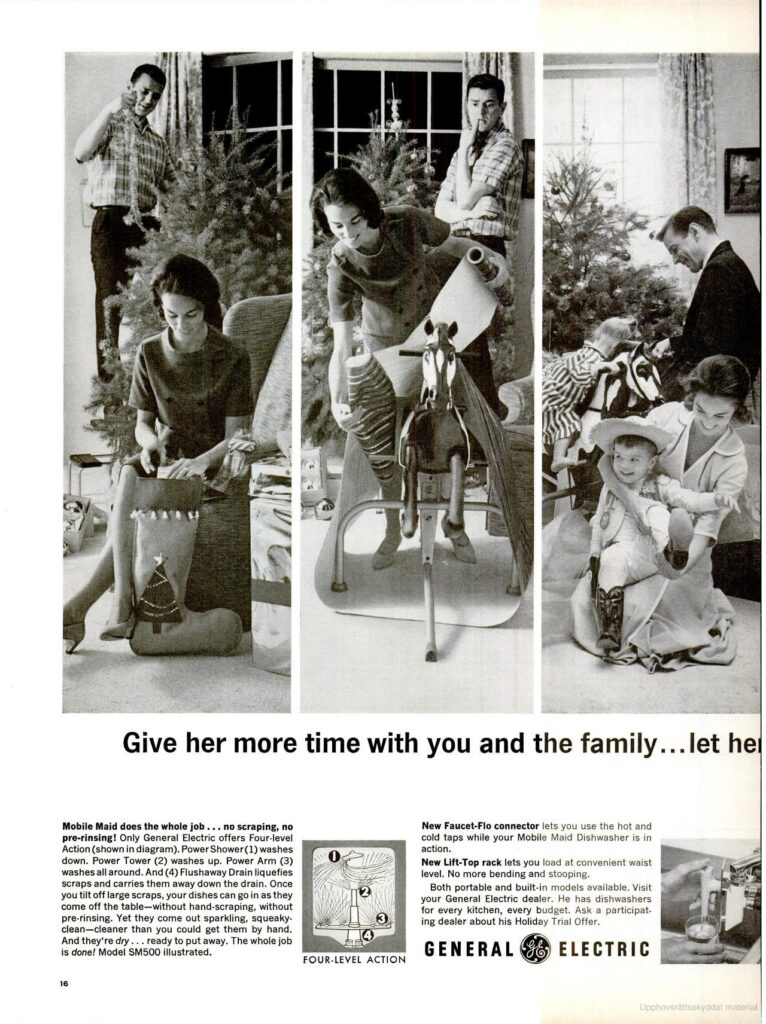
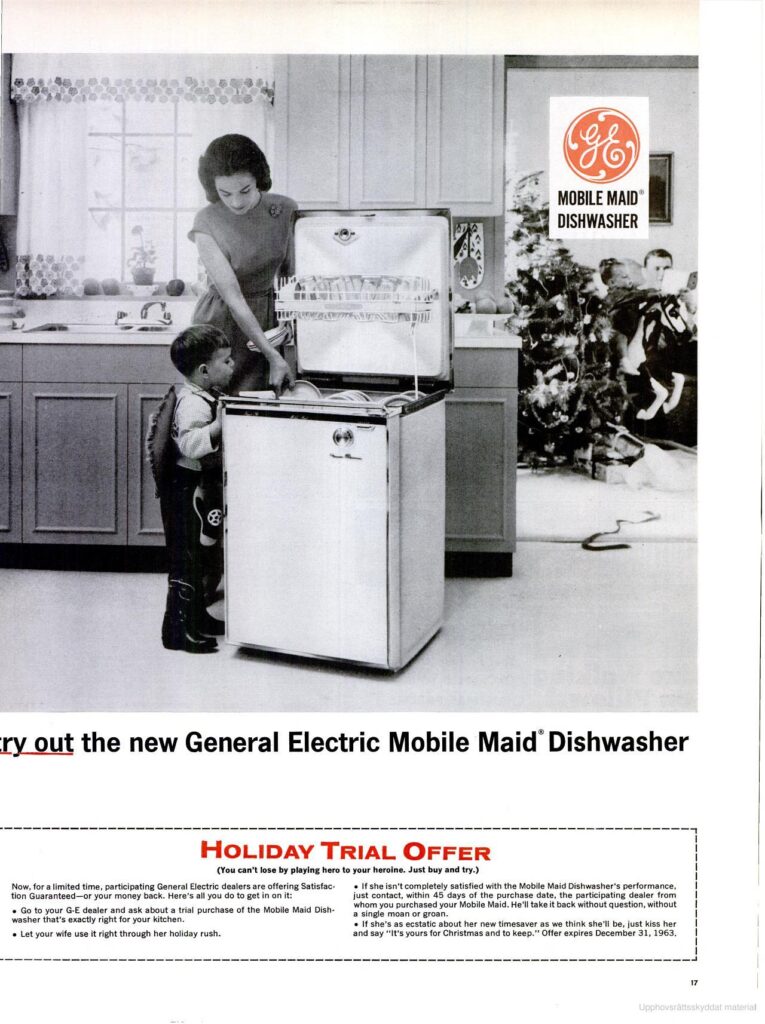
The advertisement discussed here is from the November 29th 1963 issue of LIFE magazine. This issue was the first one published after John F Kennedy’s assassination on November 22nd, a time of mourning for many in the country. It is also the issue of the magazine that kicks off the holiday season, a time of love and hope. In between media describing the legacy and effects of the tragic event that took place in Parkland Health Dallas, Texas is this advertisement for a washing machine. This piece of visual media is an advertisement made by the company General Electric for a Mobile Maid Dishwasher. The advertisement itself depicts what one in the 1960s might consider to be the “perfect” American family, composed of a Caucasian mother, father, and two children- one boy and one girl. This issue of LIFE Magazine was released at the end of November so a majority of the advertisements are geared towards the holidays. On the left page, there are three panels. The first two panels show the mother and father preparing for Christmas, decorating the tree, filling the stockings and wrapping the presents for the kids. The third panel depicts the family of four with radiant smiles and the children enjoy their new toys and costumes. On the right side of the advertisement, there is one large photo of a typical looking american kitchen that leads into the living room. The mother and the son are admiring the dishwasher in the kitchen while the Father reads a book to the daughter on the couch. Under these pictures the advertisement reads “Give her more time with you and the family…let her try out the new General Electric Mobile Maid Dishwasher”. Under these large pictures and lettering, there is a small description of how the machine works and some highlighted features as well as a trial offer statement.
In all of the three picture panels on the left page of the advertisement, the husband is positioned above his wife. In the second image he is even literally looking down on her while she works. The woman in this advertisement is beautiful, dressed and primed perfectly, even in her own home. She is wearing a very respectable dress, her hair is a perfect execution of one of the most popular early 60’s hair times and her skin and makeup is flawless. She is wrapping presents, preparing for the holiday and playing with her young son, smiling while doing so. In reality, preparing for the holidays can be stressful and not always cheerful and wholesome work. In modern times present wrapping, at least in my opinion, is done in sweatpants in front of the television with a messy bun. It is certainly not crossed legged in heels under the watchful eye of one’s husband. All elements of how the woman is presented compared to her male counterpart suggest that she is under his control or authority and the woman is blissfully happy about this situation. They are also putting up Christmas decorations suggesting that this is more than likely a Christian family. The living room and kitchen set up and decor looks as though it could be any middle class family’s home living in America during the 60’s. In this sense I think this advertisement was made strategically to be relatable to targeted stereotypical American families.
The depiction of the perfect American family as being white and Christian in such a widely consumed magazine is also problematic. Similar to Schwartz’s explanation in her chapter Disneyland and the Art of People-Moving, having one group of people decide what to display or what is shown to masses of American individuals allows ideologies of racism and racial exclusion, similar to what Walt Disney and his associates were critiqued for. Schwartz explains that “To these critics Disneyland is a very dangerous place indeed, especially because it performs its content as ideological mystification with a smile on its face to an unwitting audience”. Publishing such ideology from a brand as prominent as General Electric in one of the nations most read magazines perpetuates this dangerous ideology that it is preferred to be white and Christian to the masses, suggesting that all perfect families are Caucasian and celebrate Christmas.
The pictures in this advertisement depict the “perfect” family celebrating a “perfect” Christmas. The parents are seen happily setting up for the holidays and then enjoying their blissful Christmas morning all together. The young boy enjoys his new cowboy costume while the young daughter plays on her rocking horse, almost like they are filming a Christmas Hallmark special. This work creates a similar illusion to the elephants in Florida analyzed in Andrzejewski’s Work, Play, and Elephants in South Florida’s Leisure Landscape. This picture of the perfect family and Christmas morning is not representative of how all families look and act, yet this advertisement seemingly suggests that buying this dishwasher could transform a family into what is seen in these pictures.
While General Electric is obviously insinuating that the Mobile Maid Dishwasher is a product for women, the advertisement itself does not target their product towards women directly. They call out to the man of the household, the individual more equipped and capable to buy a costly product, suggesting women could not make this kind of a decision or a purchase for themselves. They also do not suggest that any adult would be interested in this dishwasher- only women and specifically mothers. This ad also does not suggest gifting a dishwasher to one’s wife for her enjoyment and leisure, but advertises that if one’s wife can spend less time doing the dishes, they will have more time to spend on their husbands and children. Advertising a dishwasher as something only a woman would be interested in clearly demonstrates the gender roles and social standards/norms at the time. This advertisement suggests that the only thing a woman should concern themselves with is their families and their only purpose as wives or mothers is to take care of said families. The advertisement does not suggest that a lady might enjoy herself with the time she saves not washing individual dishes but more so explains that this time would give her more opportunity to serve her husband and children- almost as if she is a robot, an object, rather than a human being with freewill.
Works Cited
General Electric advertisement. Life, Nov. 1963.
Andrzejewski, A. (2023, April 28). The Hidden History of Resort Elephants at Miami Beach. Edge Effects. https://edgeeffects.net/miami-beach-elephants/
Schwartz, Vanessa R. Jet Age Aesthetic: The Glamour of Media in Motion, Yale University Press, 2020. A&AePortal, aaeportal.com/?id=-20293.

Leave a Reply