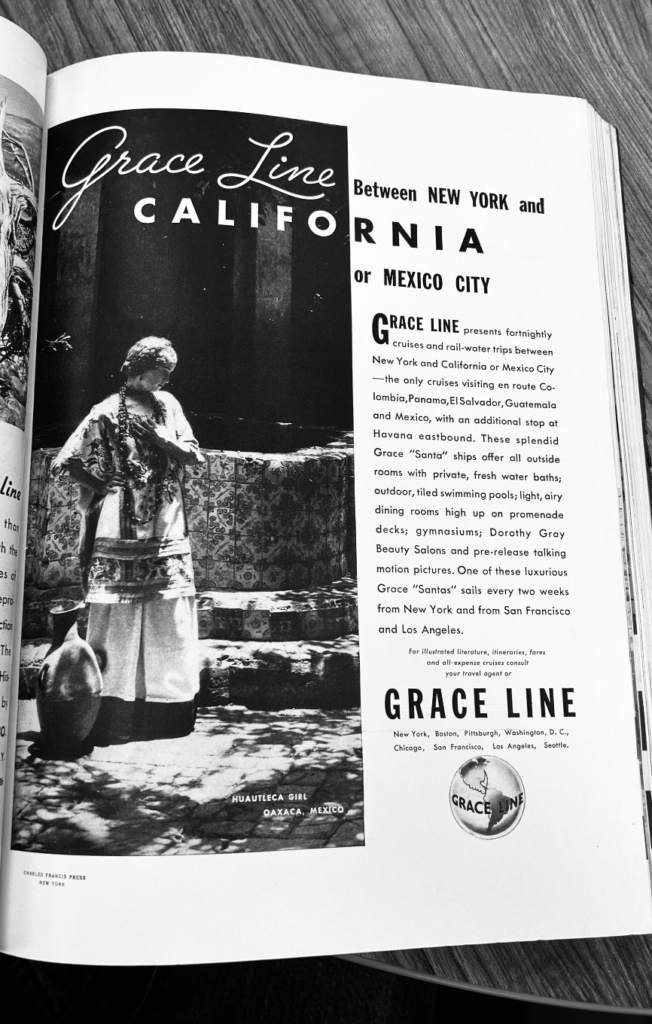
This advertisement features Grace Line, a luxury cruise line famous for visiting various South American countries. The voyage anchors in New York, Los Angeles, and Mexico City; stops include Colombia, Panama, El Salvador, Guatemala, Mexico, and Havana. The bottom left hand corner of the advertisement indicates its publisher: Charles Francis Press, located in New York. When I first looked at the advertisement, I noticed that the layout of the page was relatively simple and straightforward. The left side features a black and white photo, titled Huautleca Girl, taken in Oaxaca, Mexico. In this image, a woman occupies the majority of the frame. She has one hand on her heart, the other on her hip. Although she stands upright, her eyes are aimed at the ground: she seems to be intently transfixed on something outside of the frame. Separately, the right side of the page features a text box advertising Grace Line to magazine readers. It lists a number of amenities available to guests on board and provides details about the destinations visited. Ultimately, I think we should care about this piece of media because it provides commentary about the privileged as overseers and the marginalized as surveilled. I believe that this advertisement reflects the panoptic idea that white, upper-class individuals are granted the right to look at disadvantaged populations of color through the lens of the tourist industry.
Using context clues, I was able to determine the intended audience for this advertisement: the bourgeoisie. The wide range of amenities listed, in addition to the use of the word ‘luxurious’ clarified this information – clearly, common folk could not afford a vacation of this prestige. It’s also sophisticated, with its fancy fonts and world logo – there’s an assumption of elitism and feeling important. Then, I decided to focus on the photograph – this was more difficult to analyze than the adjoining text. First, I was struck by the subject’s body positioning, as it almost seemed unnatural. Next, I questioned if she was posed by a photographer, rather than candidly captured on the go. This made me realize that there weren’t many context clues about Oaxaca as a destination or the rich culture it contained. Although the viewer is able to analyze the subject’s garments, we fail to visualize anything relating to the scenery or community.
To be honest, the image looked sanitized to me, like it could be taken anywhere or used for anything (e.g. a clothing catalog). The fact that the text does not even reference the image, and fails to provide the viewer with any context whatsoever, makes me think that it was solely meant to serve an aesthetic purpose. They are further segregated by the stark contrast of black and white backgrounds. This reflects a detachment from the culture and narratives advertised. Subsequently, I began thinking about the panopticon. Foucoult says, “He is seen, but he does not see; he is the object of information, never a subject in communication.” (98). This reflects my thoughts about the advertisement, as the subject is visible in the way that we are allowed to look at her body, but invisible in the way that we don’t know her story. The fact that she’s not even looking at the camera strengthens the message that she has no agency in the situation to look back at us. Mirzoeff would describe this as countervisuality, the right to look, “challenging the law that sustains visuality’s authority in order to justify its own sense of ‘right’” (25).
I’d like to return to the juxtaposition between the privileged overseers and the surveilled marginalized. Although the advertisement communicates an erasure of culture by sanitizing the photograph, the implication of the cruise sends a different message. Plainly, if white, upper-class people didn’t want to think about disadvantaged populations, they would voyage somewhere else. If visiting the marginalized populations’ home countries is the privileged peoples’ vacations, the act of watching becomes an experience of pleasure and entertainment. This is referenced in the adjectives used in the text; further emphasized by the serene look on the subject’s face.
This made me think about Andrzejewski’s article, the intersection of labor and leisure in South Florida’s landscape. Specifically, Carl II’s displacement of African Americans helped scholars realize what role they are forced to serve beyond brute labor, black bodies provide the privileged with entertainment. Ultimately, what was priorly invisible became visible when it was performed by an elephant. Just like Carl II, marginalized communities were treated like animals in a zoo – something that needed to be contained (Ordinance 457 in 1936 required over 5,000 service workers to register). Furthermore, the trainer’s way of disciplining Carl II involved terms such as “master” as well as “obedient” and “docile” – evoking enslavement and the Jim Crow era (Andrzejewski). Again, the histories of marginalized people are ignored, effectively erased, on a visual level. The viewer has to read between the lines to understand that these perspectives are not only silenced but sanitized to represent beautiful, perfect, and unproblematic tourist attractions.
The advertisement implies that white, upper-class people visit South American countries to look, but not touch. They’re incentivized to go on the cruise by outdoor, tiled swimming pools, Dorothy Gray Beauty Salons and pre-release talking motion pictures – not engaging in other cultures or their stories. The right to look is powerful, because it puts pressure on those who are surveilled, even when they’re not being actively watched. Foucault puts it well, “Visible: the inmate will constantly have before his eyes the tall outline of the central tower from which he is spied on. Unverifiable: the inmate must never know whether he is being looked at at any one moment; but he must be sure that he may always be so” (98). Essentially, the fact that the privileged are focused on their own luxuries doesn’t matter – as long as they’re in the presence of marginalized populations, they act as overseers and exert power over others. Tourism effectively gives rise to this phenomenon in the form of a financial industry.
I’m wondering how modern technology will impact the panopticon’s power of surveillance. Mirzoeff discusses its future, stating, “The post-panoptic visuality of global counterinsurgency produces a visualized authority whose location not only cannot be determined from the visual technologies being used but may itself be invisible. This viewpoint can toggle between image sets, zoom in and out of an image whether by digi- tal or optical means, and compare them to databases of previous imagery” (20). I thought this quote would be an interesting point to end on because it engages with a new type of seeing, one that can not be recognized by human presence. The panopticon reaches a new level when there doesn’t need to be a tower anymore, as we have cameras and speakers and microphones that connect to bluetooth in inconspicuous ways. This risks the possibility of the surveilled populations not even realizing they’re being watched, a further disadvantage in the ways of seeing.

Leave a Reply