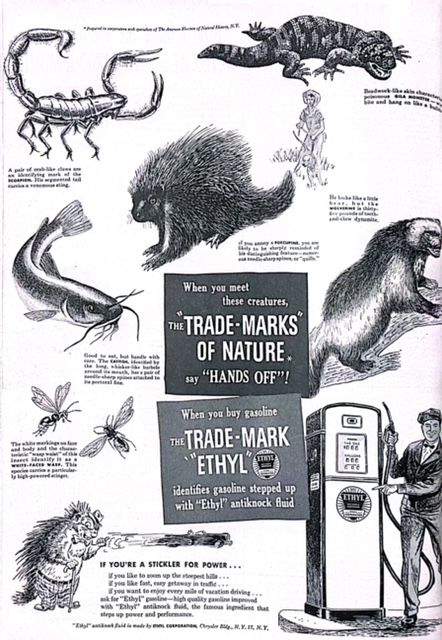
In 1921, after five years of lab work, General Motors researchers discovered the anti-knock properties of tetraethyl lead gasoline. “Ethyl” vastly improved gasoline performance, doubling the efficiency of automobiles. GM and Standard Oil formed a joint company, the Ethyl Gasoline Corporation, in order to manufacture and distribute leaded gasoline (Wells and Wells). Despite the constant controversy around the health risks, the additive was deemed safe to sell in 1926 and within a few years nearly all gasoline contained lead (Kovarik). This full page ad from the July 11, 1949 issue of Life magazine advertises the trade-mark logo of the corporation, explaining that gasoline branded with the “Ethyl” logo identifies gasoline stepped up with “Ethyl” antiknock fluid, promising improved speed, power and performance. The ad is covered with realistic illustrations of wild animals. Next to each illustration is a short block of text that explains a physical feature of the wild animal that makes the animal dangerous or powerful, such as the characteristic segmented tail of a scorpion that carries a venomous sting, or the needle-sharp spines attached to the fins of a catfish. The ad makes a clear connection: just like how these natural characteristic trade-marks are signs of these powerful and dangerous creatures warning one to stay away, the characteristic trade-mark logo of “Ethyl” is a sign of powerful gasoline encouraging one to purchase.
The ethos of the visual is written in text on top of the page: “Prepared in cooperation with specialists of The American Museum of Natural History, N.Y.” What is striking about the style of these illustrations is how closely they resemble illustrations on scientific atlases. The scientific style of these is coherent with the collaboration with a scientific museum, but why would a gasoline company collaborate with a natural history museum for their advertisement? Illustrations on scientific atlases form the basis of Daston and Galison’s discussion on objectivity. They describe these illustrations as guides for what is worth looking at, what things look like, and most importantly, how they should be looked at. These illustrations attempt to portray objects in an objective way by removing them from cultural background and placing them in front of a plain white background, guiding viewers’ interpretations of objects, making sure they are seeing in an objective way, according to a set of culturally acceptable, mutually understood standards. Similar to a scientific atlas, the Ethyl ad creates the illusion of objectivity by placing these animal figures on an empty background, giving the viewers an almost panoramic view. Through these images, the ad aims to present the claim as a simple, scientific, objective fact. Despite this desire for objectivity, the illustrations fall into the same essentializing and idealizing principle used in many scientific atlas illustrations. The perfectly shaped and symmetrical legs and claws of the scorpion, the perfectly arranged quills of the porcupine, the perfectly symmetrical wasp all point to an overly simplified and idealized view of these creatures. Perfect is chosen over imperfect, variation is integrated into regularity, an idealized subset is generalized to the whole. Seeing these creatures in real life would be a much different experience than seeing these illustrations. Through the use of these images, Ethyl becomes natural and essential and ideal. The Ethyl trade-mark becomes the essence of powerful gasoline. Just like how seeing these creatures in real life would make it much harder to recognize these essential trade-marks, the reality of Ethyl gasoline is much more nuanced.
The removal of these creatures from their context against a white background and the clean and clear organization and labeling of this page is not only about creating the illusion of objectivity, but also about power. Following the idea of museums and collections, these idealized illustrations removed from context are familiar to us not only through atlases but also through cabinets of curiosities and paper museums. Through the use of objective representations on paper, illustrations associated with cabinets of curiosities and paper museums attempt to claim ownership over nature or a different world. In examples such as the case study of Baltasar Jaime Martínez Compañon y Bujanda’s cabinet of curiosities where a series of over 1,400 watercolor illustrations by local artists became a part of his collection as important as, if not more important than the objects (Trever and Pillsbury), or the catalog from the cabinet of M. Gaillard de Gagny, which included paper drawings of everything that belonged to him from letters to seashells and aquatic specimens (Remy), these illustrations stand for something larger than the objects. They stand for a collector’s power, the power not only to collect them by reaching to other worlds, but also the power to organize and the power to understand. The power to remove from origin by placing against a white background, the power to know how to view and how to interpret these objects is the same idea that is communicated through this ad. Ethyl gasoline is so powerful that it is able to not only bring all of these different creatures to you, but also explain to you how to view them and what to do if you encounter them. You, before you even purchase the product, by seeing and recognizing the Ethyl trademark, gain power. This is only enhanced by the emphasis on Ethyl gasoline’s power throughout the ad. The ad even features an unlabeled image of a dog on a leash. This image stands alone with no descriptors, and does not fit with the style of the rest of these illustrations. The image functions as another testament to the sense of power and control communicated in a simple page. Ethyl claims control over nature, control over these animals. By placing them on this page, Ethyl has domesticated these animals, represented through the image of a safe, controlled, domesticated pet. The ad suggests that by following Ethyl’s advice, you too will gain more power and control over nature. Not only is the objectivity of the illustrations an illusion, but so is the sense of power and control. The Ethyl corporation does not have the power to collect these animals, and very clearly advises you to stay away if you encounter them.
It is no surprise that power and power over nature are used in a post-WW2 environment, especially considering Ethyl’s role in World War 2. The properties of tetraethyl lead were vital to the Allies due to advances in aviation fuel that increased power and efficiency shortly before the war (Wells and Wells). In a world dominated by anxieties around news coming from all over the world, control over nature meant a kind of certainty and security. Ethyl presented the world as something that is controlled and contained, in line with the kind of world people seeked out after the war. Ethyl was able to make this promise because they, quite literally, powered the victory (Wells and Wells).
The connection between these dangerous, even deadly animals in the ad and Ethyl might be even more direct than one would assume. Leaded gasoline was extremely dangerous from the beginning and research always focused on improving the formula over the dangers. By the early 1950s, thanks to American geochemist Clair Patterson, the toxicity of tetraethyl lead was taken more seriously, resulting in the phase-out of its use in 1976. By 1986, lead was eliminated, which EPA Administrator Carol Browner described as one of the greatest environmental achievements of all time in 1996 (Wells and Wells). It is safe to say that the control of Ethyl over nature was wildly destructive. Perhaps, ironically, Ethyl’s advertisement made this self-evident. The trade-marks of nature so indeed say “hands off”!
Works Cited
Daston, Lorraine, and Peter Galison. Objectivity. Zone Books, 2010.
Kovarik, William. “Ethyl leaded gasoline: How a Classic Occupational Disease Became an International Public Health Disaster.” International Journal of Occupational and Environmental Health, vol. 11, no. 4, 2005, pp. 384–397, https://environmentalhistory.org/about/ethyl-leaded-gasoline. Accessed 14 Apr. 2024.
Remy, Pierre. “Catalogue raisonné des tableaux, estampes, coquilles, & autres curiosités : après le décès de feu Monsieur Dezalier d’Argenville, maître des comptes, & membre des Sociétés royale de Londres & de Monpellier.” Paris, 1766.
Trever, Lisa, and Joanne Pillsbury. “Martínez Compañón and His Illustrated ‘Museum’.” Collecting Across Cultures: Material Exchanges in the Early Modern Atlantic World, University of Pennsylvania Press, 2011, pp. 236-253, https://www.jstor.org/stable/j.ctt3fhbdc.18
Wells, Bruce A., and K. L. Wells. “Ethyl Anti-Knock Gas.” American Oil & Gas Historical Society, 7 Dec. 2014, aoghs.org/products/tetraethyl-lead-gasoline/.

Leave a Reply