Negroe Dance, West Indies: Cultural Representation, Artistic
Context, and Colonial Spectatorship
INTRODUCTION
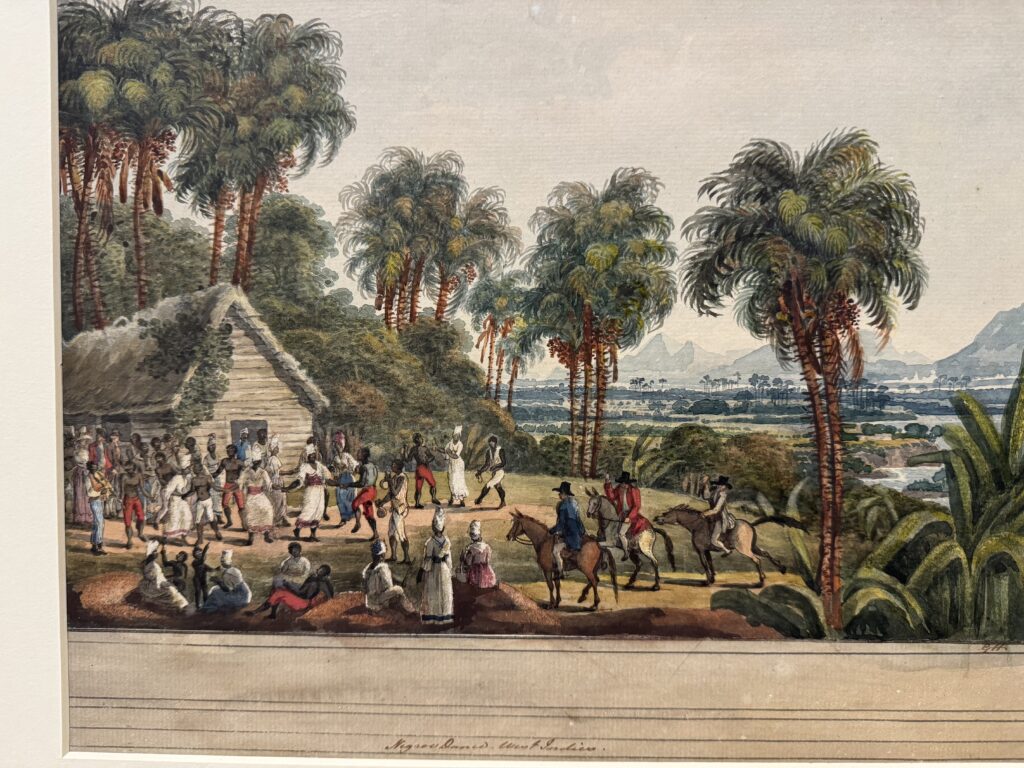
George Heriot’s watercolor “Negroe Dance, West Indies” is a visually striking and historically significant artwork that offers a glimpse into Afro-Caribbean life during the colonial period. Painted in an era when slavery was deeply entrenched in the British West Indies, the scene captures a moment of communal dancing among enslaved individuals, juxtaposed with the distant yet conspicuous presence of European spectators. This visual tension reflects the broader dynamics of colonial power, where cultural expression by the oppressed was both a form of resistance and a spectacle for the ruling class.
This research investigates the multifaceted narrative of “Negroe Dance, West Indies”, arguing that the painting reveals the resilience of Afro-Caribbean culture amidst systemic oppression. The central act of dance in the painting embodies cultural preservation and resistance, while the spectators’ presence highlights the dehumanizing gaze of colonial authority. By analyzing the artist’s perspective, the cultural and social significance of the dance, the role of the surrounding landscape, and the artwork’s legacy, this paper sheds light on how Heriot’s depiction functions both as a documentation of cultural vitality and a reflection of the exploitative systems that framed it.
ABOUT AUTHOR
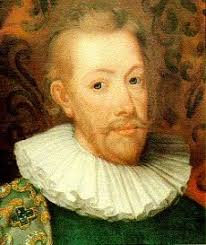
George Heriot (1766–1844), a Canadian-born artist, was known for his detailed watercolor landscapes and depictions of colonial life. As a colonial administrator and observer, Heriot’s artworks often catered to European audiences curious about life in the colonies. His role as an outsider documenting Afro-Caribbean culture places “Negroe Dance, West Indies” within the tradition of the colonial gaze, a perspective that sought to depict colonized peoples as both “exotic” and subordinate.
Imagine a vibrant scene set in the lush, tropical Caribbean. At the center of the painting, a group of Afro-Caribbean dancers moves with energy and rhythm, their colorful garments and dynamic gestures breathing life into the composition. They are surrounded by others, some participating, others observing, immersed in what appears to be a moment of shared joy and cultural expression. Towering palm trees frame the scene, their swaying fronds blending with the rolling hills and the open, expansive sky in the background.
This celebration of movement and culture is not without tension. In the distance, mounted on horseback and set apart from the dancers, are a group of European spectators. Their elevated position not only physically separates them from the vibrant gathering but also symbolizes their place in the colonial hierarchy. These figures do not participate; they watch, their gazes transforming the dance into a spectacle rather than a shared cultural moment. Their distant yet dominating presence serves as a reminder of the oppressive structures at play, where even acts of joy and resilience were surveilled and controlled.
Through this striking juxtaposition of exuberant dancers and detached spectators, the artwork is a vivid tableau, where the act of dancing becomes both a declaration of identity and a performance under the weight of colonial voyeurism.
Heriot’s depiction of Black individuals dancing in Negroe Dance, West Indies raises some thought-provoking questions. Did Heriot actually witness this scene himself, or was it pieced together from secondhand stories, or maybe even just his imagination? Figuring out his connection to what he painted really matters, since it shapes how the dancers, and the act of dancing, are portrayed. Another key question is whether the individuals shown in the painting were enslaved. On the surface, it seems likely they were, given the context of the West Indies during colonial times. But there’s a chance for alternative interpretations too. Could these figures have been free Black individuals performing cultural traditions in early European encounters, before widespread enslavement? That’s an idea worth considering. Yet, the painting’s date, set after the colonization of the region, makes it more probable that the dancers were indeed enslaved.
This uncertainty makes it important to think about how Heriot’s role as a colonial artist influenced his work. Scholars like Mia Bagneris have pointed out how colonial-era art often turns enslaved individuals into objects of curiosity, denying them their humanity and reinforcing harmful stereotypes. From that perspective, Heriot’s painting might have been more about entertaining European viewers than truly reflecting the dancers’ cultural or emotional experience. This tension, between representation and exploitation, makes Heriot’s work both fascinating and deeply problematic.
BLACK ATLANTIC
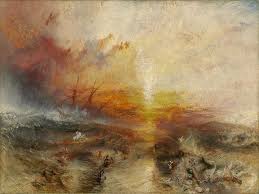
The process of transporting enslaved Africans across the Atlantic, known as the Middle Passage, was marked by unimaginable suffering. Yet, for European traders, these losses were considered an acceptable cost of doing business. Paul Gilroy’s Black Atlantic framework extends this discussion by emphasizing how the forced migrations disrupted African identities and gave rise to new diasporic cultures. The Middle Passage, while dehumanizing, also became a space where cultural resistance and hybridization began to emerge. Enslaved Africans retained and adapted elements of their cultural practices, creating the foundations of the rich Afro-Caribbean traditions we recognize today.
Once in the West Indies, enslaved Africans were sold at markets and auctions, further dehumanizing them by reducing them to commodities. As Edwards documents, they were categorized based on physical abilities and market value, with the strongest typically allocated to grueling plantation labor. Edwards highlights how the plantation system reinforced racial hierarchies, ensuring that enslaved Africans remained at the bottom of the social order.
Gilroy’s work complements these historical accounts by underscoring the broader cultural ramifications of the trade. The transatlantic slave trade, he argues, was not just an economic system but a cultural one, generating the conditions for the development of diasporic identities and a shared “Black Atlantic” consciousness.
AFRICAN DANCE
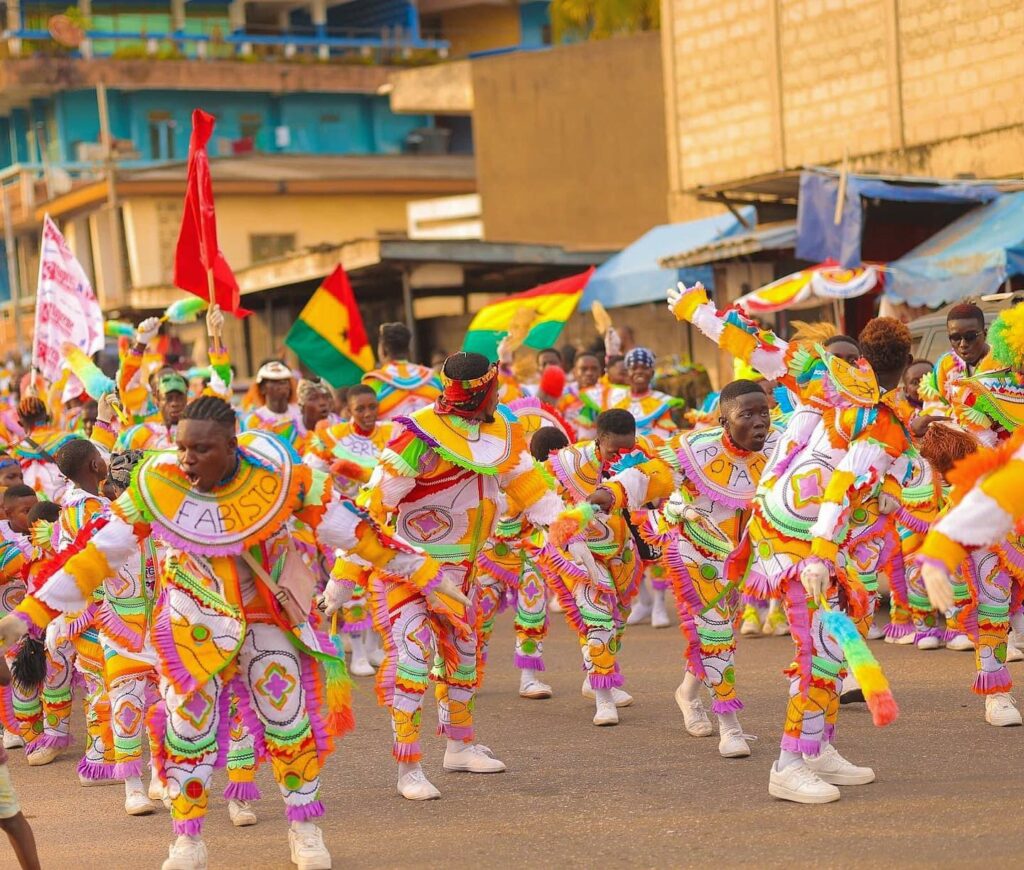
Dance in the Afro-Caribbean context wasn’t just about entertainment, it was survival. It was a way for enslaved Africans to hold onto their culture, express their spirituality, and push back against the harshness of their reality. Even though they had been ripped away from their homelands and forced into unimaginable conditions, they carried their rhythms, their movements, and their traditions with them. These weren’t just dances; they were lifelines. They helped people hold onto their humanity when everything around them was designed to take it away. Below is an image of a popular Ghanaian festival called Ankos festival; similar to the Jonkunno, the dress in beautiful colors signaling freedom. This shows traits of African activities reflecting in the west indies like in this art
When they arrived in the Caribbean, their music and dance didn’t stay the same, they changed, blending African roots with the influences of their new surroundings. The result was something new but still deeply tied to their heritage, and these dances weren’t just for fun. They became a way to resist, to celebrate their identity, and to stay connected to their ancestors. In the act of dancing, they found moments of joy and unity, even moments of freedom, small spaces where they could remind themselves that their spirits were still their own.
Heriot’s painting, “Negroe Dance, West Indies,” captures this energy beautifully. The dancers in his work move with such vitality, their bright, colorful clothing standing out against the oppressive backdrop of slavery. It’s as if every step, every movement, is an act of defiance, a way of saying, “We’re still here.” Through dance, they reclaimed a part of themselves that couldn’t be taken. It became a way to celebrate who they were, to keep their culture alive, and to resist the erasure of their identity. Heriot’s painting freezes this powerful moment in time, reminding us of the strength and resilience of Afro-Caribbean traditions.
JONKONNU
The dancing scene depicted in Heriot’s painting resonates deeply with cultural traditions such as Jonkonnu, a vibrant celebration rooted in African rituals and creatively adapted to the realities of the Caribbean. Jonkonnu was not merely a festive occasion, it was an act of defiance and cultural survival, blending African, Caribbean, and even European influences into a uniquely Afro-Caribbean tradition. Characterized by elaborate costumes, pulsating drum beats, and rhythmic dance, Jonkonnu provided enslaved individuals with a rare space to assert their identity and creativity in a world designed to strip them of both. Below is Jonkonnu dancing image.
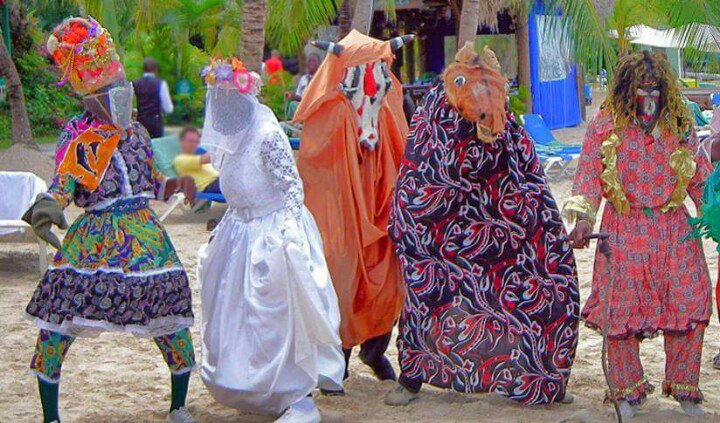
The performative nature of Jonkonnu is beautifully captured by scholar Joseph Roach, who describes these cultural expressions as acts of “surrogation,” or the process of preserving memory and identity in the face of displacement and trauma. For the enslaved, every dance step, every beat of the drum, and every movement in these communal rituals served as a powerful reminder of their heritage and a declaration of their humanity. These performances were not passive acts; they were charged with emotion, history, and resistance, serving as a living link to the ancestral traditions that colonial systems sought to erase.
In Heriot’s painting, the act of dancing can be seen as a symbolic reclamation of freedom. Though physically confined by the brutal structures of the plantation system, the dancers’ movements transcend their oppression. Their bodies, full of vitality and rhythm, defy the conditions imposed upon them, turning dance into a profound statement of resilience. The cultural importance of this act cannot be overstated. Dance became a language of survival, a way to communicate hope, resistance, and solidarity in a world that sought to silence them.
Moreover, the communal nature of the event depicted in “Negroe Dance, West Indies” underscores the role of dance in fostering community and solidarity. Gathered together, the enslaved individuals shared not only physical space but also a collective spirit of resistance and cultural affirmation. These communal dances strengthened bonds among the enslaved, allowing them to forge a sense of belonging even in the face of relentless dehumanization. The vibrant movements, the music, and the shared joy in these moments became acts of healing and empowerment.
SPECTATORSHIP ANALYSIS
The European spectators depicted in the art are a pivotal element of the painting, enriching its narrative while complicating its interpretation. Their presence subtly underscores the power dynamics of the colonial system, casting a shadow over what might otherwise be seen as a purely celebratory depiction of Afro-Caribbean cultural expression. Positioned on horseback and physically removed from the dancers, the spectators embody authority and control, transforming a moment of cultural vitality into a performance observed through the hierarchical lens of colonialism.
The spectators’ elevated positioning is emblematic of their roles as overseers, whether literal or symbolic. It reflects their detached engagement, a viewing from afar that simultaneously grants them dominance and distances them from the humanity of the dancers. This hierarchical arrangement not only underscores the systemic surveillance enslaved individuals endured but also suggests the commodification of their culture. The vibrant, communal dance, an act of identity, resistance, and joy for the performers, is reduced to a source of entertainment for the onlookers. Yet, this interpretation raises compelling questions about the spectators themselves. Were they simply curious visitors, drawn by the allure of a cultural performance, or were they plantation owners, whose presence inherently carried the weight of oppression?
It is plausible that not all the spectators were colonizers in the traditional sense. Some might have been travelers or local individuals without direct ties to the plantation economy, drawn to the dance out of fascination or admiration rather than a desire to assert dominance. Their gaze, while still external, might not carry the same oppressive implications as that of plantation overseers. This ambiguity invites viewers to consider the multiple layers of spectatorship: were these individuals innocently enjoying a cultural expression, or did their very act of watching, regardless of intent, perpetuate the broader colonial framework that commodified Black lives and traditions?
The duality of the dance as both a cultural expression and a spectacle creates a profound tension within the painting. For the dancers, the performance is an act of self-assertion, a way to preserve and celebrate their heritage in the face of systematic dehumanization. Yet, for the spectators, it may exist purely as a moment of visual or cultural consumption, stripped of its deeper meanings. This interplay between performance and observation raises critical questions about the ethics of representation in colonial art. Did Heriot want us to figure out the meaning of the spectatorship ourselves? This succumbs to the problem of art. As we discussed in class early in the semester; art can be perceived in different ways depending on the viewer. Whenever the artist doesn’t make the intention of an art clear, interpretation of the art relies on the viewers. In this case, one can argue that the Europeans were just spectators not masters because on the far right of the art, you can see two Europeans mingling with the africans. So it’s very tricky to pinpoint who they are. What if they’re not even Europeans, but an African dressed like an European, just like Angelo Soliman. The painting thus becomes a site of contested meaning, challenging modern viewers to grapple with its complex legacy and the nuanced dynamics of power, culture, and gaze that it embodies.
The landscape in the art isn’t just a passive backdrop. It’s a carefully crafted element that reveals the contradictions of the colonial Caribbean. When you look at it through the perspectives of Tim Barringer and Dian Kriz, the landscape becomes something much bigger: an ideological construct. It reflects power, identity, and control, all within the tense framework of colonialism. At first glance, the scene is romantic, even idyllic, but when you dig deeper, it’s also heavy with the realities of exploitation and suffering. By focusing on the painting’s visual clues and cultural context, it’s clear that the scene is set in the West Indies, and the landscape isn’t just part of the scenery; it’s central to understanding Heriot’s work.
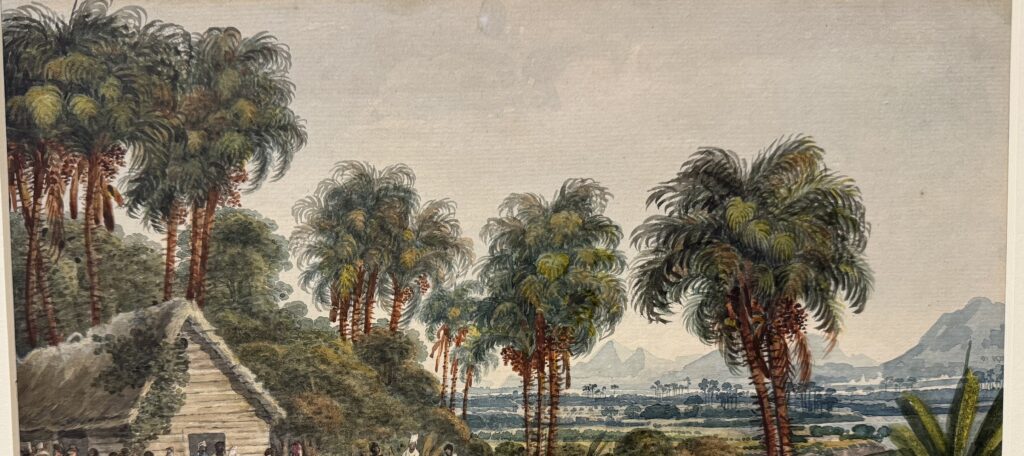
Tim Barringer provides a useful framework for unpacking this. He argues that colonial landscapes were often designed to send a message: that these faraway places were not only beautiful but also “knowable” and “manageable” under European control. In Negroe Dance, West Indies, the tropical setting with its palm trees, rolling hills, and bright horizon paints the Caribbean as a land of abundance. It’s the kind of beauty that European audiences found exotic and alluring, but it’s also deceptive. This picturesque view hides the reality of what was happening there; the forced labor and violence that made such abundance possible. The landscape, in this sense, becomes part of a larger imperial fantasy, one that glosses over the suffering that fueled its prosperity.
Dian Kriz adds another layer to this idea by highlighting the duality of colonial landscapes. These images were seductive, presenting colonies as paradises while masking their darker side. You can see this duality in Heriot’s painting. On one hand, the towering palms and lush terrain are symbols of the Caribbean’s natural richness, evoking a sense of peace and plenty. On the other hand, the enslaved people in the foreground remind us that this “paradise” was anything but not peace. These individuals cleared the land, planted the crops, and harvested the wealth that European powers took for themselves. The landscape, then, becomes a paradox, celebrating the Caribbean’s beauty while bearing silent witness to the brutality behind it.
Heriot’s painting also gives us specific clues that firmly place it in the West Indies. The palm trees and dense tropical greenery are hallmarks of the region, particularly the British-controlled islands. Palm trees, in particular, became shorthand for the exotic in European art and literature. Then there’s the thatched wooden house: it’s a detail often associated with rural Caribbean communities, especially those tied to plantations. These homes were common among enslaved populations, adding another layer of historical specificity to the painting. Even the geography of the scene, with its mountains and wide-open skies, matches the Caribbean landscape, where hilly interiors meet cultivated lowlands.
One might ask where the West Indies are in this art. The cultural activity in the painting, particularly the dance in the foreground, also helps situate the scene. The communal celebration bears a striking resemblance to Afro-Caribbean traditions like Jonkonnu. These dances, though rooted in African heritage, evolved uniquely in the Caribbean as enslaved people adapted their cultural practices to their new reality. What Heriot captures here is more than just a moment of performance. It’s a deeply Caribbean expression of resilience and identity, shaped by the history of the region.
However, the landscape in this painting isn’t just about geography or culture, it’s also a reflection of the power dynamics at play. Look at how the figures are arranged. The dancers, with their vibrant movements and colorful clothing, are at the center of the composition. They’re lively and dynamic, commanding the viewer’s attention. Meanwhile, the European overseers are set apart, pushed to the margins of the scene, observing from a distance on horseback. This spatial separation underscores the hierarchies of the plantation system. And yet, there’s something subversive about the way Heriot centers the dancers. Their energy and vitality take over the painting, making them the focus rather than the overseers. In doing so, the painting hints at the resilience and cultural significance of the enslaved community, even in the face of oppression.
Ultimately, the contradictions in the landscape of Negroe Dance, West Indies mirror the contradictions of colonialism itself. The land is beautiful, yes, but it’s also deeply tied to violence and exploitation. Tim Barringer points out how landscapes like this were often crafted to make colonies seem appealing to European audiences, while hiding the labor systems that sustained them. Dian Kriz takes it further, explaining how these images seduce viewers with their beauty, even as they obscure the harsh realities beneath. Heriot’s painting does this, too, but it also leaves room to see the strength and humanity of the people who lived in this landscape.
“Negroe Dance, West Indies” is more than just a painting, it’s a window into the complex realities of colonial life in the Caribbean. Heriot’s lively depiction of Afro-Caribbean dancers reveals the strength and joy of a culture that survived under immense pressure. For the enslaved communities, the dance wasn’t just entertainment; it was an act of resistance, a way to preserve identity and spirit in the face of brutal oppression. At the same time, the painting raises tough questions for today’s viewers. The European spectators in the scene stand apart, observing the dancers as though they’re part of a performance rather than a community’s lived experience. This dynamic reveals the colonial gaze, where moments of life and culture were often reduced to exoticized spectacles for European consumption. Heriot, as a colonial artist, plays into this narrative while also documenting its tensions. The painting’s contradictions are striking. The beauty of the setting hides the pain it represents, and the dancers’ energy resists the oppression around them. “Negroe Dance, West Indies” isn’t just a historical snapshot, it’s a reminder of colonialism’s legacies and the enduring power of cultural resilience.
REFERENCES
Barringer, Tim. Imperial Landscapes: Britain’s Global Visual Culture and the Art of Exploration. New Haven: Yale University Press, 2007.
Edwards, Bryan. The History, Civil and Commercial, of the British Colonies in the West Indies. London: Printed for J. Stockdale, 1793.
Gilroy, Paul. The Black Atlantic: Modernity and Double Consciousness. Cambridge: Harvard University Press, 1993.
Kriz, Kay Dian. Slavery, Sugar, and the Culture of Refinement: Picturing the British West Indies, 1700–1840. New Haven: Yale University Press, 2008.
Roach, Joseph. Cities of the Dead: Circum-Atlantic Performance. New York: Columbia University Press, 1996.
Wynter, Sylvia. “Jonkonnu in Jamaica: Towards the Interpretation of Folk Dance as a Cultural Process.” Jamaica Journal4, no. 2 (1970): 34–48
Leave a Reply