An Examination of a 1947 Ford Advertisement from LIFE Magazine
Almost everyone has seen a car advertisement in their life. The single family car became an increasingly popular product during the 1950s as more Americans moved from urban to suburban areas in search of domesticity. Today, most people rely on cars for daily travel and the public transit system in America is severely lacking compared to European countries. Multi-million dollar advertisements for the newest car models plague televisions like no other industry, but this consumerist trajectory had much humbler roots. This 1947 advertisement from Ford published in LIFE Magazine uses a humorous comparison between different types of birds and desirable features of their cars to attract customers while simultaneously balancing the technical and aesthetic elements of the vehicle in a style similar to Disneyland.
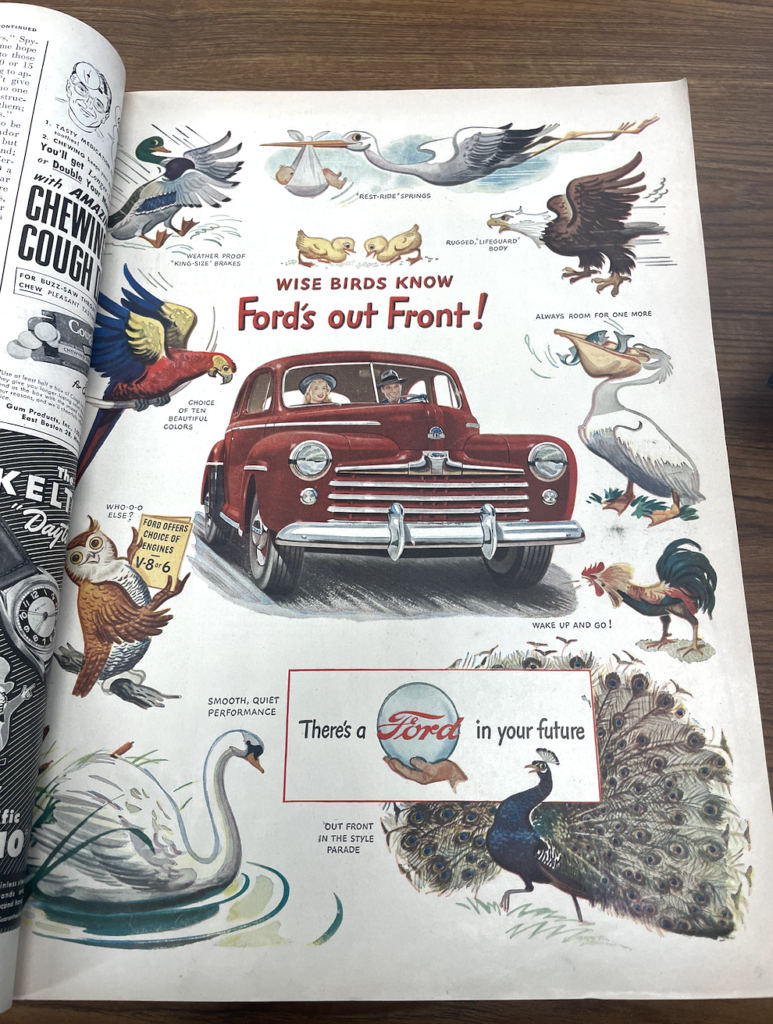
Much like the Florida Land Boom of the 1920s when entrepreneurs deployed creative tactics to entice investors or potential buyers, this advertisement uses animals to draw in viewers. During resort development at Miami Beach, “tourists encountered a surprising attraction: elephants” (Andrzejewski). The addition of the elephants in this landscape became synonymous with the exotic and leisure-oriented nature of Miami Beach. The elephants “quickly started making rounds at Fisher’s hotels, performing stunts and delighting guests” (Andrzejewski). Instead of elephants, Ford uses a different animal for advertising purposes: birds. Each bird is chosen carefully based on the specific qualities and associations the advertisement wants to make with the characteristics of its product. For example, there is a rooster with the caption “wake up and go” because roosters are known to rise with the sun and announce the start of the day. If you drive this car, it is because, much like the rooster, you are a go getter and this car will be able to accommodate your energetic, go-getter lifestyle. Simultaneously, the bald eagle captures the “rugged, ‘lifeguard’ body” of the car. “Lifeguard” was a 1956 safety package offered by Ford. The adjective “rugged” as well as the image of the bald eagle denotes a sense of masculinity. Based on the male driver in the advertisement, this car was most likely being targeted towards men, so Ford attempts to appeal to buyers by invoking the masculine ideal of being a protector through its safe, yet still rugged, car. The idea of protection could also be important towards potential buyers because of the familial implications in the advertisement.
The advertisement uses subtle visual and verbal messaging to appeal to the family nature that comes with buying a car. There is a couple driving the car and above them is a stork carrying a baby; below the stork are two little yellow baby chicks. The stork has the caption “‘rest-ride’ springs” which at first glance seems to just be focusing on another technical aspect of the car, but soft brakes could be a great feature to have with a new baby in the back. The stork is already traditionally associated with bringing babies into the world and the baby chicks also act as infantile avian representations. Additionally, the caption for the pelican reads “always room for one more” which speaks to adding a baby to this young couple’s family. Finally, the caption at the bottom of the advertisement says, “There’s a Ford in your future” implying that viewers of this advertisement will be thinking about their future and the kind of car they need to accommodate their growing family.
There is an even balance between highlighting the improved technological features of the car from earlier models as well as the stylistic qualities that make the car unique and special. A sleek swan is used to highlight the cars “smooth, quiet performance” while the flashy, colorful peacock assures buyers they will be “out front in the style parade.” Similarly, the owl, a symbol associated with wisdom, is holding a pamphlet that reads “Ford offers choice of engines V-8 or 6” while the duck is drawn with action lines so that it appears to be screeching to a halt in a small puddle to showcase the car’s “weather proof ‘king-sized’ breaks.” The bright parrot also informs customers that the car comes in a “choice of ten beautiful colors.” Again, this shows the balance between the technical and aesthetic features of the car and the advertisement. Improving the mode of travel while also maintaining a certain level of aestheticism is highly similar to how Disney focused on making people-moving as seamless as possible in his new park.
When Walt Disney first came up with the idea for Disneyland he said it would be “something that will never be finished…[its] something alive, something that could grow” (Schwartz 2). Cars are similar to Disneyland in this regard. Nowadays, hundreds of new car models come out every year in an endless process of technological improvement and innovation balanced against comfort and luxury. Disney had also learned to make “inanimate objects seem alive” (Schwartz 3) through his time as an animator, and by conflating different elements of the car with different birds, the car itself seems to become more alive. Disney was focused on “the aestheticization of ‘people-moving’ to foster the ‘happiness of people’ (Schwartz 3). The car is a form of people-moving, although it does not carry the same extent of people as the trams at Disney do, and much like Disney, this advertisement focuses on how this car will make you happier in life. Schwartz writes, “Like the jet age airport, Disneyland also made the experience of motion itself into something beautiful, pleasurable, and easy” (9). The Ford car makes motion as easy as the flight of a graceful swan or a soaring eagle.
This 1947 Ford advertisement, with its clever integration of various bird species to symbolize different qualities of the showcased car, not only reflects the evolution of consumerist culture from its modest beginnings but also draws parallels to creative marketing strategies employed periods like the Florida Land Boom and the balance between cutting edge technology and the feeling of luxury cultivated at Disneyland. By skillfully combining technical details with aesthetic appeal, the advertisement targets a burgeoning suburban demographic, particularly emphasizing the car’s suitability for families. The subtle messaging, using birds and familial imagery, speaks to the potential buyers’ desire for safety, comfort, and growth. Moreover, the advertisement’s dual focus on technological advancements and stylistic features mirrors Walt Disney’s approach to creating Disneyland — an ever-evolving and aesthetically pleasing experience. In essence, just as Disneyland aimed to make people-moving a joyful and seamless experience, the Ford advertisement positions the car as a means to enhance the happiness of its owners, seamlessly blending innovation with aesthetic allure in the ongoing narrative of automotive progress.
Anna Vemer Andrzejewski, “Work, Play, and Elephants in South Florida’s Leisure Landscape” < https://edgeeffects.net/miami-beach-elephants/>
Vanessa R. Schwartz, “Disneyland and the Art of People-Moving” in Jet Age Aesthetic: The Glamour of Media in Motion, (New Haven and London: Yale University Press, 2020), 57-97.

Leave a Reply