Leonard Freed was an American photojournalist who was born in 1929 and died in 2006. Freed was a Jewish man who grew up in New York City, and was a member of Magnum Photos. Freed’s work really fascinated me when we recently visited the Wellin Museum, especially a photograph entitled, “Blind Yemenite Jew Praying at Home, Zafad, Israel.”1 The photograph was taken in 1967, and the medium was gelatin silver print. When I first looked at the photograph, something stood out to me, but I couldn’t exactly identify what that was. So I took a picture of it so I could look at it more. As I looked more and more at it, I realized why this photograph caught my attention. This whole class is called “Ways of Seeing.” And this photograph depicted a blind man as the main subject, who at first glance seems to be “looking”, or at least trying to “look”, back at us. When I first saw the photograph, I didn’t realize that the man was blind. Had I not looked at it further, I would’ve just thought that the photograph was of an old man and his (possibly) wife. But there is something so interesting to me about having a blind man be the subject of a photograph. I think what mainly happened that made me so fascinated with this photograph is that it reminded me of a lot of themes in class (that will be discussed later in this paper), such as objectivity, concerned photography, auras, and even for some reason TV “snapshots”2. I was not only reminded of these ideas that we discussed in class, but I also started to think about the general purpose of photography. “Blind Yemenite Jew Praying at Home, Zafad, Israel” supports the idea that a main purpose of photography is to make the viewer feel uncomfortable by forcing them to look at subjects who have completely different lives than they do. Photography promotes being empathetic, and also the belief that being uncomfortable is sometimes a positive experience that helps us enhance and further our view of the world.
“Blind Yemenite Jew Praying at Home, Zafad, Israel” by Leonard Freed is a photograph that actually has a lot going on. The title of the piece serves as an aid in terms of understanding what the photograph is depicting and guiding the viewer’s thinking. Something that fascinates me about this piece is the angle that Freed decided to use for this photograph. The perspective that the viewer gets is very up close and personal, and I almost felt like I was invading the man’s privacy by getting such a close view of him and his home. Additionally, the photograph being in black and white stops the viewer from fully invading the man’s privacy, as color in photography can sometimes evoke some extra emotion or feeling. The photograph being in black and white makes it mysterious and makes some aspects of it unexplainable. I was reminded of Walter Benjamin’s discussion of the “aura” by this photograph. “Blind Yemenite Jew Praying at Home, Zafad, Israel” truly is a “peculiar web of space and time” (A Short History of Photography, Page 20)3. Benjamin discusses that auras get destroyed by an object/artwork losing uniqueness. That is a possible explanation for why I felt so weird just being able to look as much as I wanted at this photograph. I felt that I was almost destroying a bit of the piece’s aura by looking at a photograph that was clearly meant to be in a very specific “web of space and time” and thinking about it in 2023. There are so many aspects of the photograph that define its aura. Just the expressions on the old man and woman’s faces leave the viewer with so many thoughts and questions. Why does the man only have one eye open? Is the woman smiling? Where exactly are the man and woman looking? And parts of the photograph like the background provoke even more curiosity. Why isn’t the man sitting with the woman behind him? Why are rugs on the wall? And the incredible thing about this photograph is that we will probably never know the answer to these questions. Finding out the answers would destroy the aura of the piece, as the viewers of it would lose curiosity and even that (good) uncomfortable feeling I discussed earlier.
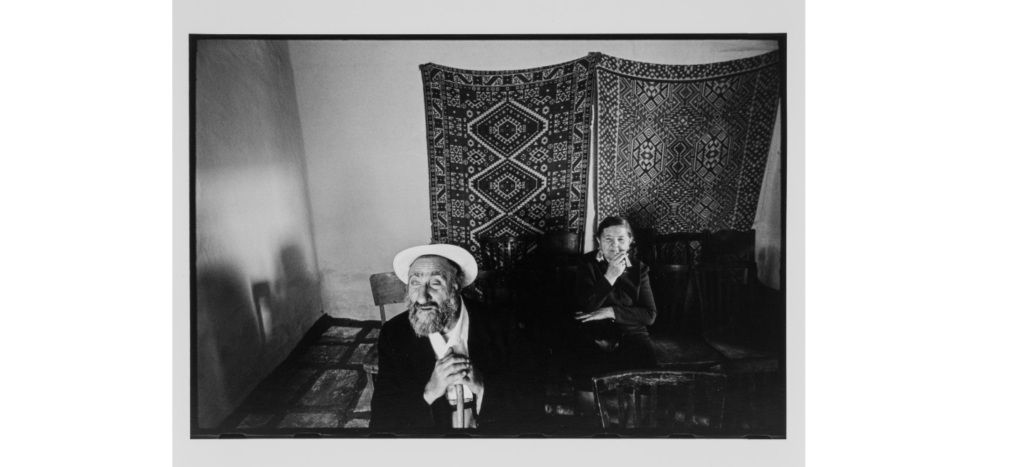
As I mentioned previously, “Blind Yemenite Jew Praying at Home, Zafad, Israel” leaves the viewer with lots of questions. The main question that I had after examining the photograph was, “why?”. Why did Freed choose this subject matter, in this location, at this specific time period? I think that the answers to these questions lie in Nadya Bair’s “The International Origins of ‘Concerned Photography.”4 Bair says that, “In place of a systematic and theoretically rigorous definition of concerned photography, Capa leaned heavily on a phrase attributed to Lewis Hine, although it is not clear where and if Hine ever uttered the words: ‘There were two things I wanted to do. I wanted to show the things that had to be corrected. I wanted to show the things that had to be appreciated” (Page 84). “Blind Yemenite Jew Praying at Home, Zafad, Israel” shows a lot that needs to be appreciated. Not too much is provided in terms of context of the photograph, but it is important to keep in mind that the Six-Day War between Israel and some Arab states happened in 1967 (June 5th-10th)5. Therefore, this photograph could have been taken slightly before or after war, or even during it (no exact date is provided with the photograph). Therefore, Freed might be trying to get the viewer to acknowledge/spread awareness about religion, especially Judaism, as he chose to photograph the blind man praying. Additionally, Freed seems to be trying to make the viewer appreciate being able to see by showing an image of a man who does not have that privilege. Lastly, I think that the viewer starts to appreciate what exactly “home” means by looking at this photograph. The title explains that the man is praying at home. Therefore, to this man, his home is a place of worship. Also, the man’s relationship to the woman behind him is not certain, but she is most likely his wife. Regardless of what exactly the relationship between the two is, the important thing that the viewer must appreciate is that the man feels safe enough to pray in front of the woman, therefore suggesting that the home is a place to feel comfortable.
I felt that looking at and studying “Blind Yemenite Jew Praying at Home, Zafad, Israel” by Leonard Freed was the perfect way to end my semester in “Ways of Seeing.” Of course, as the title of the class suggests, the class is all about seeing, specifically about examining various pieces of art throughout history and thinking about the ways and reasons why/how we see the way we do. Thinking about a subject like a blind Jewish man in a class like this really helped me to appreciate being able to see, and once again I think this may have been one of the purposes of Freed taking this photograph. As I mentioned in the introduction, this photograph even reminded me of a sort of reverse TV snapshot (as if the photograph was taken from the perspective of a TV, or some other centerpiece of the man’s living room). Not only is “Blind Yemenite Jew Praying at Home, Zafad, Israel” by Leonard Freed an important photograph to look at in terms of the context of photography during the mid/late 20th century, but it also has many aspects that are reminiscent of several themes from Art History in general. Most importantly, this particular photograph by Freed is an example of how photography encourages/allows people to be empathetic and step out of their comfort zone in order to build on their view of the world.
- Freed, Leonard. “Blind Yemenite Jew Praying at Home, Zafad, Israel.” eMuseum, 1 Jan. 1967, emuseum-2022.hamilton.edu/objects/7181/blind-yemenite-jew-praying-at-home-zafad-israel?ctx=50cb2e21f76ca9c83ea393c236250dda51142aa2&idx=32.
↩︎ - Spigel, Lynn. “Companion Technologies.” Make Room for TV Television and the Family Ideal in Postwar America, Univ. of Chicago Press, Chicago u.a., 2010.
↩︎ - Benjamin, Walter. A Short History of Photography. 1972.
↩︎ - Bair, Nadya. “The International Origins of ‘Concerned Photography.’” American Art, vol. 36, no. 2, 2022, pp. 74–101, https://doi.org/10.1086/720917.
↩︎ - “Six-Day War.” Encyclopædia Britannica, Encyclopædia Britannica, inc., 7 Dec. 2023, www.britannica.com/event/Six-Day-War.
↩︎

Leave a Reply