An exploration in a Standard Oil Company advertisement promoting explosive oil mining
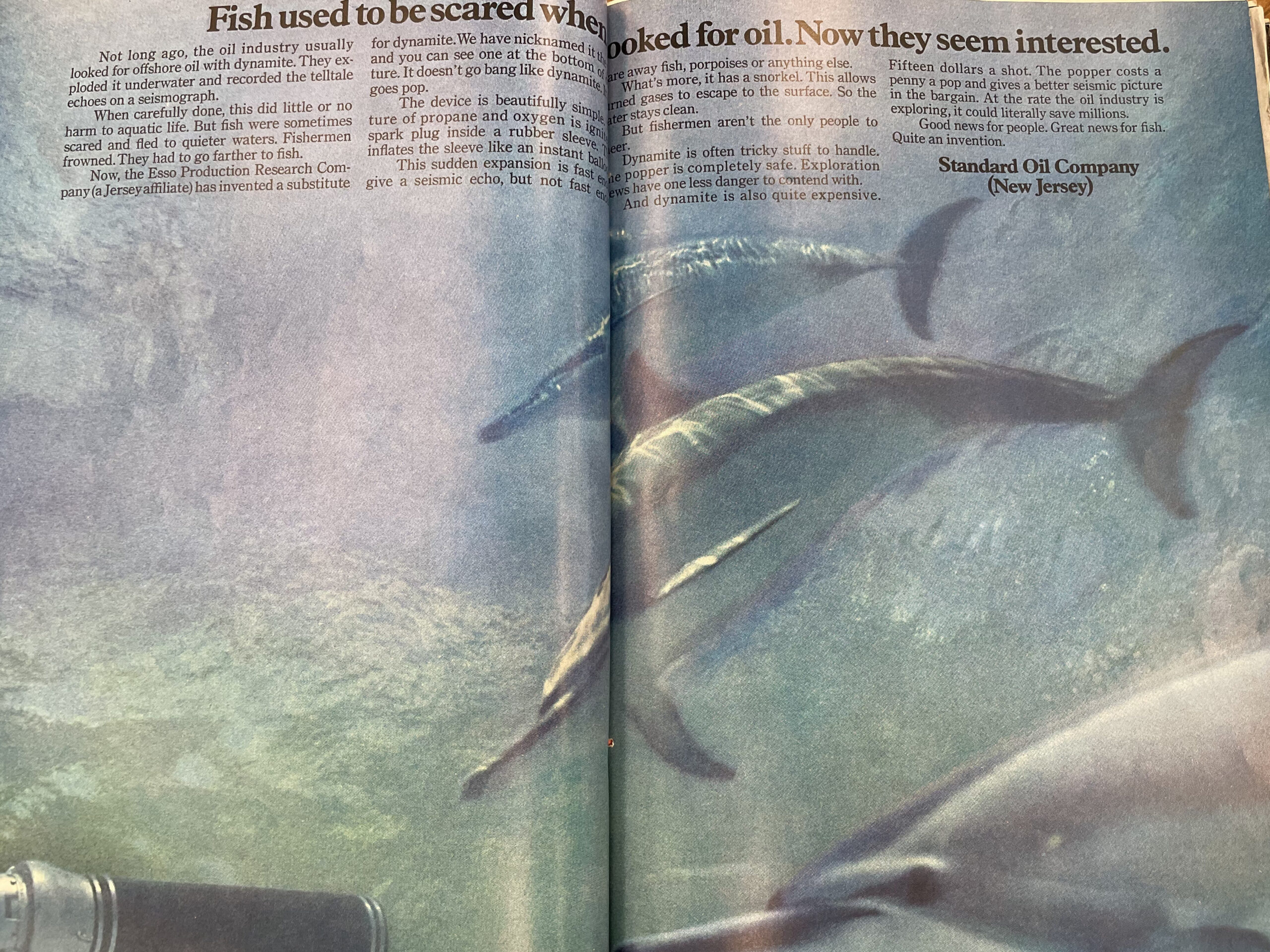
“Fish used to be scared when we looked for oil. Now they seem interested.”
Standard Oil Company (New Jersey)
“Fish used to be scared when we looked for oil. Now they seem interested.” This is the headline from a Standard Oil Company advertisement in the 1969 January edition of the Natural History magazine.1 The Standard Oil Company, based in New Jersey as read in the advertisement, created a full spread advertisement in which we can see a pod of dolphins seemingly interested in an explosive device that mines oil. The composition functions well within the pages and allows the dolphins and the device to each have their own little section in the spread. The blue and green tones of the ocean have a nice calming effect that might ease the viewer when reading about explosions and dynamite mining. The text is black and split up into four paragraphs across the two pages with the more important headline and company name being bolded. The advertisement comes from a company owned by John D. Rockefeller with a mission that prioritized the consumer’s perception of quality over anything else.2 This mission allows for advertisements to take any approach to sell the quality of the product and that can be seen in this specific advertisement through the lens of environmental deception. The Standard Oil Company advertisement utilizes deceptive tactics through common advertising aesthetic tropes and asserts, what Daston and Galison introduce as, objectivity through its purposeful placement within the leading magazine about everything nature and environmental issues.3

The Standard Oil Company advertisement is incredibly, purposeful, precise, and smart. The concept of objectivity was introduced by Daston and Galison and they built their definition of objectivity around the exploration of the sciences. Within scientific atlases and their collection of images, are results of choices about knowledge, collective sight, and the pursuit of truth-to-nature. In summation, objectivity holds a plethora of baggage from birthing media and publicity, to a shared vocabulary of knowledge, to justifying narratives, and to the weaponization of observation and ownership.4 When one considers the placement of the advertisement at a basic level it’s an environmental advertisement within a leading magazine that many people believe talks about the “environmental truth” when it comes to all things nature, i.e. the Natural History Magazine. This magazine holds a shared vocabulary of knowledge on nature and as a result it holds a significant amount of consumer perceptive power as one of the leading and most profitable nature magazines. Due to its popularity, many consumers of the magazine consider what’s in it to be the objective truth of what is important and what’s happening in the natural world. The Standard Oil Company would have had to pay for its spot in the magazine and the unbearable irony is that the magazine that shows the beauty of nature is displaying an advertisement that promotes the destruction of natural resources, i.e. oil mining in the ocean.
After the Standard Oil Company gets its spot in the magazine they cleverly come up with advertising tactics and common deceptive aesthetic tropes to promote and justify a narrative.5 The text that accompanies the image allows for a falsified holistic narrative to exist. The image is of a pod of dolphins swimming in proximity to the new technological mining invention. The text implies that the fish are “interested” with the machine. This may or may not be true but we can’t be sure. The image is so vague that whatever is paired with it can tell any story. For example, I could say: “Pod of dolphins explore mining wreckage or three dolphins fear for their lives as a new mining machine ravages the ocean floor or new invention leaves dolphins perplexed… etc.” The open endedness of the image allows for open ended narratives. The text is then dumbed down. It’s almost condescending to its reader as though the reader has no idea what this new thing is. Some examples of this include, “dynamite is often tricky stuff to handle. The popper is completely safe. Good news for people. The device is beautifully simple.” This way of writing in simple short, supposedly true, statements conveys information with a tone of comfort and simpleness as a way to promote its cause. These aesthetic tropes of vagueness and comfort can be seen all throughout the advertisement.
This advertisement is selling a product. It’s selling oil and oil can be hard to sell with any concern for environmental harm. In order to remove even any consideration of environmental harm it suggests that oil mining being harmful is something of the past. The media expands upon old aesthetic tropes and brings it into the modern world of advertising. Comparing the past to the present is a common trope that can be expressed in a plethora of ways. For this advertisement, the present utilizes new technology that only makes a “pop” instead of a “boom” and fish now seem “interested.” To create and sell the straightforward narrative the advertisement expands on aesthetic tropes to deceptively promote comfort and quality of a product through vagueness and short clean sentences.
When profit is an end goal and necessity, advertising campaigns utilize deceptive tactics that are not 100% true or false to sell a product. They function in a sort of gray area. Adversarial components, like environmental harm to oil mining companies, are removed from the equation from the very beginning through the promotion of the product itself. Visual qualities and aesthetic tropes such as vague imagery, simplistic text, easy to read, non-complex narratives, and clever locations for the advertisements are all aspects to our larger view of media. Successful advertising makes sure that when we see we only see what is best for that particular cause. When we consider what it means to see, especially in the media, we have to consider what it means to be true or not and how different aesthetic techniques change our sight of the full picture.
By: Sawyer Kron
- History, Natural. “Natural History Magazine.” Jan. 1969.
↩︎ - “Research Guides: This Month in Business History: Standard Oil Established.” Standard Oil Established – This Month in Business History – Research Guides at Library of Congress, guides.loc.gov/this-month-in-business-history/january/standard-oil-established. Accessed 7 Dec. 2023.
↩︎ - Daston, Lorraine, and Peter Galison. Objectivity. Zone Books, 2021.
↩︎ - ^ ↩︎
- Batchen, Geoffrey. Burning with Desire: The Conception of Photography. MTP Press, 2006.
↩︎

Leave a Reply