By: Hayden Zeller
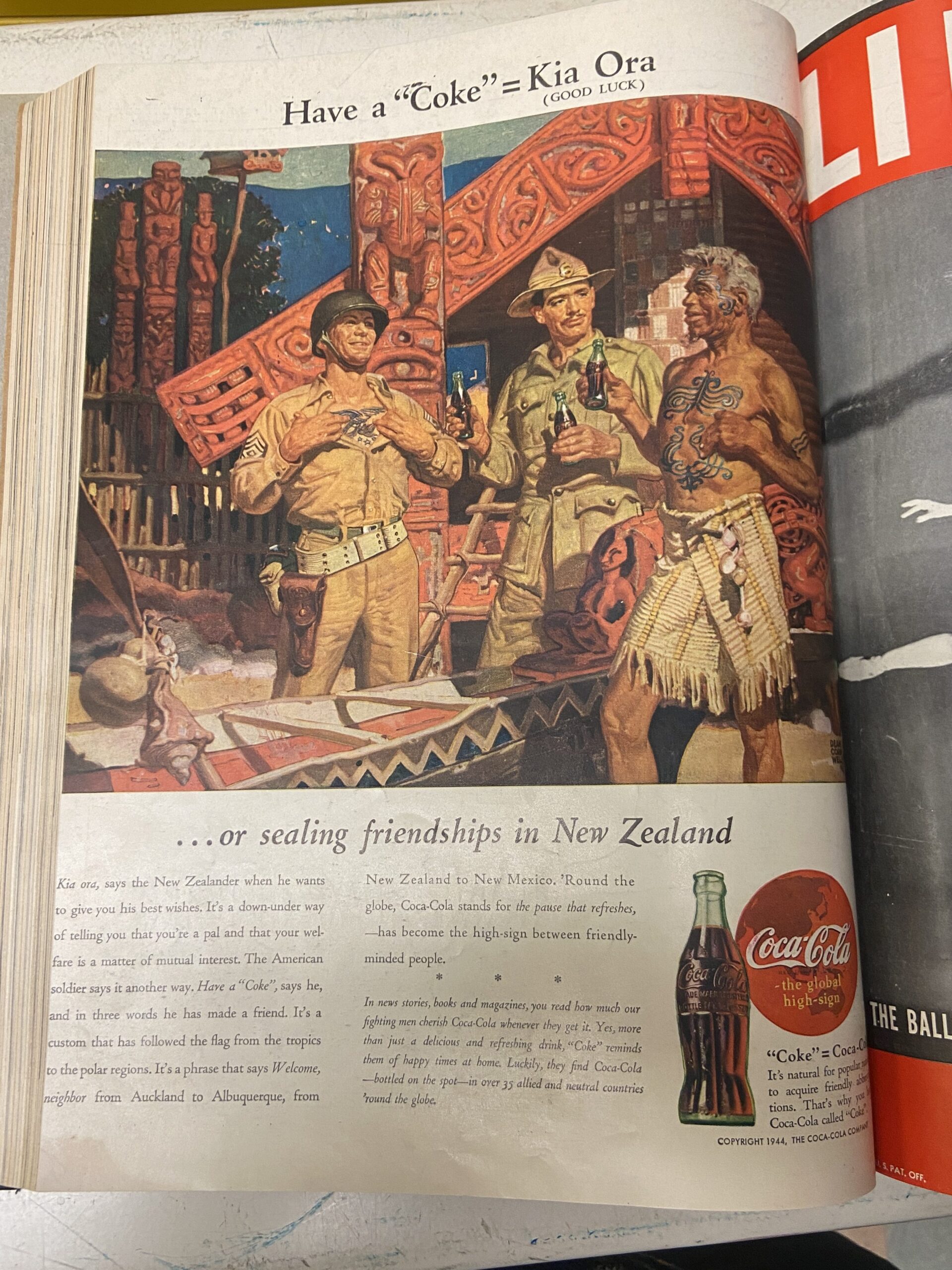
Coca-Cola Advertisement March 14th, 1944 edition of LIFE Magazine
Have a Coke!
Have a Coke! According to Coca-Cola, with those three words, one has just created a friendship understood globally. At least, that is what they claim in the March 14th, 1944 edition of LIFE Magazine. This Coca-Cola advertisement caught my attention for many reasons; however, the most prominent was the curious timing of the advertisement. Published In 1944, this advertisement came towards the end of WW2. Military presence and wartime sentiment were at an all-time high. Coca-Cola utilized that to highlight their company’s reach and association with some of the most respected men of the era. The ad depicts and supports the presence of the US military in “exotic lands” such as New Zealand, and the front and center is the iconic Coca-Cola glass.
Historical Context of US Military Involvement In New Zealand
From 1940 to 1945, the United States military partnered significantly with New Zealand. This involvement encompassed strategic, logistical, and operational aspects aimed at bolstering the Allied effort against Axis powers. One key aspect of this partnership was the establishment of military bases and facilities in New Zealand. These bases served as hubs for American forces, providing crucial support for training, rest, and refueling operations in the Pacific. While New Zealand offered logistical assistance to the US military, they also provided supplies and equipment. This support helped facilitate American regional operations and contributed to the overall Allied war effort. Naval cooperation between the United States and New Zealand was another significant component of their partnership. Both countries collaborated closely in patrolling and protecting vital shipping lanes in the South Pacific. During World War II, the United States and New Zealand worked closely together due to shared common goals and a commitment to keeping each other safe. This cooperation continued even after the war ended, strengthening the bond between the two countries both diplomatically and militarily.
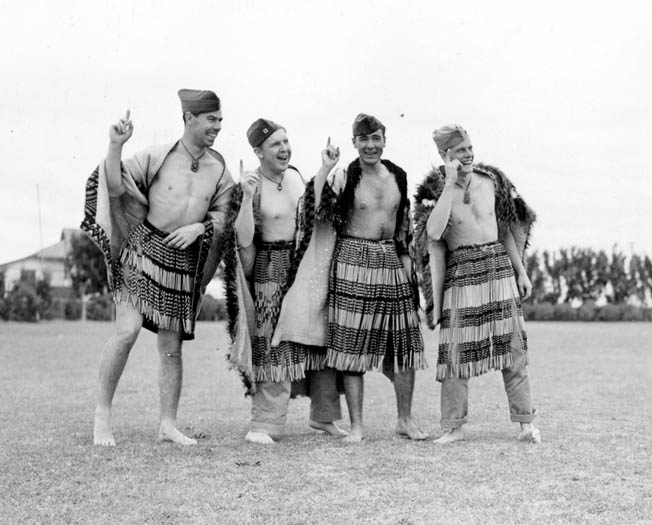
Warfare History Network, “An American Invasion in New Zealand.” Warfare History Network, August, 2014.
What’s Going on Within the Image
It is essential to understand what is happening in the image and the intricacies that are taking place. Depicted in the image is a friendly meeting between two American soldiers and a New Zealander in what can be assumed to be traditional attire. The meeting is supported by the accompanying text that describes how the New Zealander is saying “Kia ora,” meaning he wants to give you his best wishes. According to Coca-Cola, it is a “down-under way” of telling you that “your a pal and that your welfare is a matter of mutual interest.” To emphasize how Coca-Cola can unite people, the “American soldier says it another way: Have a “coke.” Whether or not the New Zealander speaks English is not of concern here, which points to how this ad is written from an American perspective and aimed at the American audience. There is a clear connection that Coca-Cola is trying to make, and that is an American drink that can be synonymous with a friendly and generous American presence in faraway lands. I think the text also makes an important point in that the phrase, “have a coke,” is a custom that has “followed the flag (American Flag) from the tropics to the polar regions. It is a phrase that says, “Welcome, neighbor from Auckland to Albuquerque, from New Zealand to New Mexico.” This is problematic in the sense that the American Flag has been in places it should not have during colonization and war. However, Coca-Cola was trying to make the argument that because the “have a coke” phrase is known all across the world it is now the “high-sign” (play on high-five) between friendly minded people.” Building off the wartime enthusiasm, the lower part of this image proudly states that “our fighting men cherish Coca-Cola whenever they get it. Yes, more than just a delicious and refreshing drink, “Coke” reminds them of happy times at home.” By emphasizing that “they find Coca-Cola – bottled on the spot – in over 35 allied and neutral countries around the globe,” Coca-Cola’s presence in allied and neutral territories speaks to the influence of American consumerism and global trade. The advertisement tries to speak to the company’s target audience of Americans by placing them in the advertisement itself. Suppose the consumer can identify with the American soldiers in the advertisement or take part in the experience of sharing a Coke. In that case, they are more likely to purchase the product.
This ad covers the entire page and leaves room for important context in the lower section. Although not a photograph, the image is life-like to a certain degree, and one could believe that the meeting of these three men took place. This image shows three gentlemen, two described as American soldiers (via the context below) and the third as a New Zealander. There appear to be three Coca-Cola bottles. However, we assume that one American soldier has to hold one for his comrade because he and the New Zealander are connecting. They are all standing in what we can assume to be the New Zelander’s home village because the architecture is far different from what we see in the United States. This scene depicts an iconic example of a “couple buddies sharing a beer”; however, in this case, they are all part of a corporate advertisement aimed at displaying Coca-Cola’s reach. Coca-Cola represents the American presence in allied nations and highlights the positive impact of the US military abroad.
How Does This Connect to What We’ve Been Learning?
This image embodies many concepts we have covered this semester in class. Walter Benjamin first proposed the idea of the aura. He explains it is “a peculiar web of space and time: the unique manifestation of a distance, however near it may be” (Benjamin, 20). Benjamin suggests that artwork’s aura stems from its unique presence within a specific historical and cultural context. He argues that removing the aura is not harmful; instead, he sees it as beneficial. When an aura diminishes and “fog” emerges, new avenues for creative storytelling and interpretation are opened. This loss of aura enables advertisers to spur thought; as seen in this image, we wonder what they are discussing. How did they arrive in New Zealand?
This leads nicely into the next aspect of this image, which comes down to narrative creation, as discussed also by Walter Benjamin. His essay “A Short History of Photography” explores how photography influences narrative, perception, and order. Photographs capture fleeting moments, representing selective perspectives and shaping collective memory. In this image, one can generate any narrative they see fit, and another person may see an entirely different narrative. That is the beauty of how perception can determine one’s thoughts about an image and create a story of what one believes to be happening. One may also wonder why this image was included in Life Magazine and how it fits into the wartime discussion, as there was still a year of the war.
Another aspect at play in this image is the concept of the “optical unconscious.” Walter Benjamin describes optical unconsciousness as portraying visuals in a way that allows the viewer to see things differently than their original perception may have allowed them to. When truly practicing the optical unconscious, a viewer will place themselves in the image or advertisement and become acutely observant of things they may miss in everyday life. For instance, in the image, the New Zealander points to his chest, where he has a prominent tattoo. We also see one of the American soldiers displaying his tattoo, which is very similar.
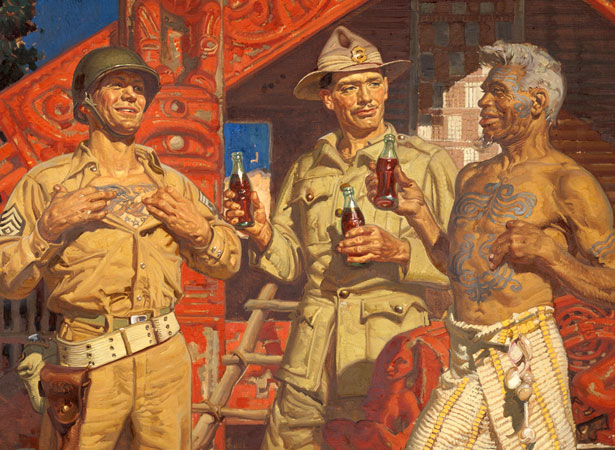
Also, notice how this image depicts New Zealand as a village where the people still wear traditional attire; however, in the 1940s, modern fashion was very present in New Zealand. It leads us to wonder why they try to put them in that clothing and a village that mirrors a traditional village. These observations and questions lead us to peel back layers of images and find details that we may not have seen initially.
Lastly, with the optical unconsciousness, the question of objectivity comes into play with this image. Daston and Galison claim that “to be objective is to aspire to knowledge that bears no trace to the knower.” (Datson & Galison) The creator of this image had in mind a specific depiction to show the viewer, which inherently makes this image susceptible to bias and potentially jeopardizes its “objectivity.” The image does not seem natural given the historical context, but instead, it shows how corporations mold images to help promote their brand and consumerism.
Works Cited
Benjamin, Walter. “A short history of photography.” Screen, vol. 13, no. 1, 1 Mar. 1972, pp.
Datson, Lorraine and Peter Galison. Objectivity. Zone Books, 2007.
New Zealand Ministry for Culture and Heritage. “United States Forces in New Zealand.” New Zealand History, Ministry for Culture and Heritage, 22 Feb. 2019, https://nzhistory.govt.nz/war/us-forces-in-nz
US Naval History and Heritage Command. “NH Series: NH 97100 – NH 97115.” History.navy.mil, https://www.history.navy.mil/our-collections/photography/numerical-list-of-images/nhhc-series/nh-series/NH-97100/NH-97115.html.

Leave a Reply